
TL;DR:
- Cyber incident root cause analysis (RCA) systematically identifies systemic weaknesses that enabled breaches beyond immediate triggers. It uses methodologies like the 5 Whys, Fishbone diagrams, and Fault Tree Analysis to uncover technical, human, and process failures, supporting durable security improvements. Effective RCA relies on high-quality evidence, conducted post-incident, with clear corrective actions to prevent recurrence and satisfy organizational, regulatory, and legal requirements.
Cyber incident root cause analysis (RCA) is defined as the systematic process of identifying the fundamental reasons why a security breach occurred, moving beyond immediate triggers to expose the deeper technical, human, and organisational weaknesses that enabled it. Where incident response stops the bleeding, RCA prevents the next wound. RCA frames every incident across a chain: symptom, immediate cause, and root cause, spanning technical failures, human error, and process gaps simultaneously. Without this discipline, security teams patch the surface and leave the underlying vulnerability intact. Tools like EnCase, FTK, and SIEM platforms feed the evidence base that makes credible RCA possible.
What is cyber incident root cause analysis and why does it matter?
RCA identifies systemic weaknesses, not just the proximate event that triggered an alert. The distinction is critical. A phishing email is a symptom. The root cause might be a combination of inadequate email filtering, absent multi-factor authentication, and insufficient staff awareness training operating simultaneously. Root causes in cyber incidents are multi-layered, spanning technical, human, process, and visibility categories at once.

The practical consequence of skipping RCA is predictable: the same attack vector gets exploited again, often within months. Security teams that treat incidents as isolated events rather than signals of systemic failure spend their budgets on reactive containment rather than durable defence. RCA shifts that equation by producing findings that feed directly into control improvements, governance updates, and revised incident response playbooks.
The importance of root cause analysis extends beyond the technical team. Boards, regulators, and insurers increasingly expect documented evidence that an organisation has investigated incidents thoroughly and acted on the findings. A credible RCA report, supported by a preserved chain of custody and court-admissible forensic evidence, satisfies that expectation in a way that a basic incident summary cannot.
What methodologies and techniques are used in cyber RCA?
Three techniques dominate cybersecurity incident investigation: the 5 Whys, the Fishbone (Ishikawa) diagram, and Fault Tree Analysis. Each method suits different investigation scenarios depending on the complexity and scope of the incident.
| Technique | Best suited for | Limitation |
|---|---|---|
| 5 Whys | Focused, linear incident chains | Misses parallel contributing factors |
| Fishbone (Ishikawa) | Broad, multi-factor incidents | Can become unwieldy without facilitation |
| Fault Tree Analysis | Complex system failure enumeration | Resource-intensive; requires technical depth |
| Pareto chart | Prioritising multiple contributing causes | Requires sufficient historical data |
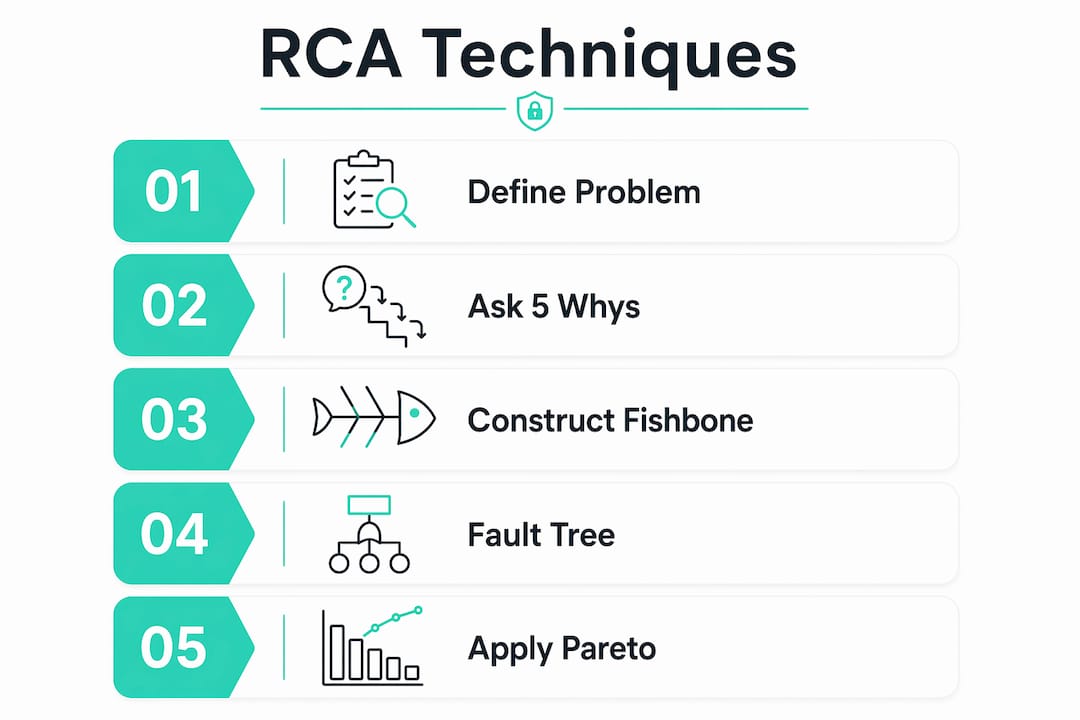
The 5 Whys method works well for incidents with a clear linear chain: a misconfigured firewall rule allowed lateral movement, which succeeded because network segmentation was absent, which existed because no policy mandated it, and so on. Fishbone diagrams are better suited to incidents like a ransomware deployment where causes span people, technology, process, and external factors at the same time. Fault Tree Analysis is the most rigorous of the three, mapping every possible failure pathway in a Boolean logic structure, and is typically reserved for critical infrastructure investigations.
Pareto charts add a prioritisation layer. When an investigation surfaces five contributing causes, a Pareto analysis identifies which two or three account for the majority of risk exposure. This prevents teams from spreading remediation effort thinly across every finding.
Pro Tip: Combine at least two techniques on any significant incident. Use the 5 Whys to establish depth on the primary failure chain, then apply a Fishbone diagram to check for parallel contributing factors you may have missed. Single-method investigations routinely leave gaps.
How does evidence collection underpin credible root cause analysis?
Evidence quality determines RCA quality. The data sources that matter most in a cybersecurity incident investigation are endpoint detection and response (EDR) telemetry, SIEM logs, network traffic captures, Active Directory audit logs, and communications records such as email headers and collaboration platform logs. Modern RCA depends on integrating data across SIEM, EDR, cloud logs, and collaboration tools to correlate events accurately.
The single most common failure in evidence-based RCA is poor environment knowledge at the outset of an investigation. Early investigative errors caused by knowledge gaps undermine RCA credibility and are extremely difficult to correct after the fact. A team that does not know which systems are business-critical, how data flows across the network, or which accounts hold elevated privileges will misread artefacts and draw incorrect conclusions.
Best practices for evidence preservation and timeline reconstruction follow a clear sequence:
- Capture volatile data first. Live memory, active network connections, and running processes disappear on reboot. Tools like EnCase and FTK support live memory acquisition that preserves this evidence before it is lost.
- Anchor the investigation on execution and activity traces. Process execution logs, authentication events, and file system modifications provide the most defensible foundation for timeline reconstruction.
- Preserve evidence with documented chain of custody from the moment of collection. This is non-negotiable if the RCA output may be used in legal proceedings or regulatory submissions.
- Build the timeline before drawing conclusions. Jumping between artefacts without a chronological anchor produces investigations that confirm assumptions rather than test them.
- Validate findings across at least two independent data sources. A single log entry is an indicator. Corroboration across EDR telemetry and network captures is evidence.
Pro Tip: Treat the forensic timeline as the spine of the entire investigation. Every finding should attach to a specific timestamp and data source. If it cannot, it is an assumption, not a conclusion.
How does RCA differ from digital forensics and incident response?
These three disciplines are related but distinct, and confusing them produces investigations that serve none of their purposes well. RCA explains why an incident occurred after initial stabilisation, while digital forensics establishes what happened and incident response focuses on containing and eradicating the threat.
The incident response lifecycle, as defined by NIST SP 800-61, moves through preparation, detection, containment, eradication, recovery, and post-incident review. RCA sits firmly in the post-incident review phase, after the immediate threat has been neutralised. Attempting RCA during active containment is counterproductive. The investigation environment is unstable, evidence may still be changing, and the team's attention belongs on eradication.
The distinction in outputs is equally important:
- Digital forensics produces a factual record: what systems were accessed, which files were exfiltrated, how the attacker moved laterally.
- Incident response produces operational outcomes: the threat is contained, systems are restored, and business continuity is re-established.
- RCA produces explanatory findings: why the environment permitted the incident, which controls failed or were absent, and what systemic changes will prevent recurrence.
RCA should focus on conditions that enabled the incident, not assign blame to individuals. This distinction matters practically. When analysts fear that RCA findings will be used punitively, they withhold information, soften conclusions, and produce reports that protect people rather than improve systems. A blame-free RCA culture produces more accurate findings and more durable remediation.
RCA findings feed directly back into incident response playbooks. If the investigation reveals that the detection phase took 72 hours because no alert was configured for a specific log source, that gap becomes a documented update to the playbook. This is how RCA connects to incident response governance and continuous improvement.
How can organisations implement RCA findings effectively?
RCA findings that produce generic statements such as "improve security awareness training" are operationally worthless. Effective implementation requires specific, verifiable corrective actions with assigned owners, deadlines, and measurable success criteria. ISO-aligned lessons learned guidance emphasises tracking corrective actions through to completion for auditability, not simply documenting them.
The steps for root cause analysis implementation follow a structured pattern:
- Translate each root cause finding into a discrete corrective action. "Email filtering failed to block the malicious attachment" becomes "Deploy DMARC enforcement and update sandbox analysis rules by a specific date, owned by the email security team."
- Assign accountability at the individual level, not the team level. Shared ownership produces shared inaction.
- Set a verification checkpoint. Corrective actions are not complete when they are deployed; they are complete when they have been tested and confirmed effective.
- Update the risk register to reflect the newly identified control gap and its remediation status. NIST CSF 2.0 integrates RCA directly into ongoing risk management cycles, treating incident findings as inputs to the broader risk framework rather than standalone reports.
- Feed RCA outputs into the next tabletop exercise or red team scenario. Testing whether the remediation actually closes the gap is the only reliable verification method.
Automation and AI tools are accelerating the correlation phase of RCA significantly. One implementation demonstrated producing a complete root cause report in under 10 seconds by joining signals across multiple data sources. That speed is genuinely useful for reducing mean time to understand, but it does not replace the analyst's judgement in interpreting findings and designing remediation. AI surfaces correlations; humans determine causation.
What are the common challenges in cyber incident RCA?
The most persistent challenge is the tendency to stop the investigation at the first plausible explanation. A compromised credential looks like the root cause until the investigation reveals that the credential was harvested six weeks earlier via a vulnerability that had a patch available for three months. Stopping early produces a finding that is technically accurate but strategically useless.
Other common pitfalls include:
- Fragmented tooling: When EDR, SIEM, cloud logs, and network captures sit in separate platforms with no correlation layer, analysts spend the majority of their time normalising data rather than analysing it. Endpoint security visibility across AI-driven environments compounds this challenge as attack surfaces expand.
- Incomplete evidence collection: Evidence not collected in the first hours of an incident is often gone permanently. Volatile memory, temporary files, and overwritten logs cannot be recovered after the fact.
- Poor environment knowledge: Teams investigating unfamiliar infrastructure make assumptions that contaminate findings. This is particularly acute when external responders are brought in without adequate environment briefing.
- Treating RCA as a compliance exercise: Reports written to satisfy an audit rather than to drive improvement are identifiable by their vague language and absence of specific corrective actions.
The role of DFIR during an active attack illustrates why environment familiarity and rapid evidence capture are prerequisites for any RCA that will withstand scrutiny. Human validation remains the final check on any automated or AI-assisted analysis.
Key takeaways
Effective cyber incident root cause analysis requires structured methodology, credible evidence preservation, and specific corrective actions tracked through to verified completion.
| Point | Details |
|---|---|
| RCA goes beyond symptoms | Identify systemic control and design failures, not just the immediate trigger or attack vector. |
| Combine RCA techniques | Use 5 Whys for depth and Fishbone diagrams for breadth to avoid single-method blind spots. |
| Evidence quality is foundational | Capture volatile data first, anchor timelines on execution traces, and maintain chain of custody throughout. |
| RCA is post-incident work | Conduct RCA after containment and eradication, not during active response, for accurate findings. |
| Findings must drive specific action | Each root cause must produce a named owner, a deadline, and a verifiable corrective action. |
The case for treating RCA as a discipline, not a deliverable
From where we sit at Makkarisecurity, the most consistent failure we observe is not technical. Organisations invest in capable tooling, competent analysts, and thorough evidence collection, then produce an RCA report that sits in a shared drive and influences nothing. The report becomes the end point rather than the starting point.
The teams that genuinely improve their security posture after an incident treat RCA as an ongoing discipline. They schedule verification checkpoints. They test whether corrective actions actually closed the gap. They brief the board on findings in operational terms, not technical ones. They update their cloud forensics approach when RCA reveals visibility gaps in cloud environments.
The cultural dimension is underestimated. An organisation where analysts fear that RCA findings will be used to assign blame will never produce accurate RCA. The investigation will be shaped by what is safe to say rather than what is true. Building a blame-free investigation culture is not a soft consideration. It is a prerequisite for findings that are worth acting on.
Technology complements this discipline but does not replace it. AI-assisted correlation accelerates the evidence phase considerably. It does not tell you which corrective action to prioritise, how to communicate findings to a regulator, or whether a proposed control change will create a new gap elsewhere. That judgement belongs to experienced analysts who understand both the technical environment and the organisational context.
— Makkari
How Makkarisecurity supports your RCA investigations
When an incident occurs, the quality of your root cause analysis depends directly on the quality of your forensic evidence and the expertise interpreting it.
Makkarisecurity delivers court-admissible Digital Forensics and Incident Response (DFIR) across the UK, Gibraltar, and Europe, with a proprietary forensic engine built to capture live memory and cross-verify findings at speed. Our breach counsel and panel support service provides the legal and technical framework to make RCA findings defensible in regulatory and litigation contexts. From evidence preservation through to verified corrective action tracking, our team works alongside yours to produce RCA outputs that drive genuine improvement. Contact Makkarisecurity to discuss a tailored incident investigation or to establish an IR retainer before the next incident occurs.
FAQ
What is the difference between root cause and immediate cause?
The immediate cause is the direct trigger of an incident, such as a clicked phishing link. The root cause is the systemic condition that allowed it to succeed, such as absent email filtering or no multi-factor authentication policy.
How long does a cyber incident root cause analysis take?
Timeline varies with incident complexity and evidence availability. A contained, well-documented incident may yield RCA findings within days. Complex breaches involving fragmented telemetry and multiple attack stages can require several weeks of structured investigation.
Which RCA technique is best for cybersecurity incidents?
No single technique is universally best. The 5 Whys suits linear failure chains, Fishbone diagrams suit multi-factor incidents, and Fault Tree Analysis suits complex system failures. Combining two techniques produces more complete findings than relying on one alone.
Can AI replace human analysts in root cause analysis?
AI accelerates evidence correlation and can produce initial root cause reports rapidly, but human analysts are required to validate findings, interpret organisational context, and design remediation. Automation surfaces correlations; analysts determine causation and consequence.
When should RCA begin after a cyber incident?
RCA should begin after containment and eradication are confirmed, following the NIST SP 800-61 post-incident review phase. Starting RCA during active response risks contaminating evidence and drawing premature conclusions from an unstable environment.