
TL;DR:
- Digital forensic methods focus on capturing volatile memory, disk images, network traffic, and mobile data to ensure admissible evidence. Timely acquisition, proper tool use, and meticulous documentation are vital for integrity and court compliance. Blended approaches across surfaces yield the most comprehensive understanding of cybersecurity incidents.
Digital forensic investigation methods are specialised techniques used to identify, collect, and analyse digital evidence from distinct data surfaces to support cybersecurity incident response and legal proceedings. The forensic investigation lifecycle spans seven phases: Identification, Preservation, Collection, Examination, Analysis, Documentation, and Presentation, with Collection being the most technically sensitive. Professionals working across incident response and breach analysis rely on tools such as EnCase, FTK Imager, and Volatility 3 to execute these phases with precision. Selecting the wrong method for a given evidence surface is not a minor error. It can render findings inadmissible, destroy volatile data, or leave an attacker's footprint undetected.
1. Memory acquisition and volatile data capture
Memory acquisition is the process of capturing the contents of a system's RAM before shutdown or reboot destroys them. The order of volatility principle, codified in NIST SP 800-86, mandates that volatile memory must be captured first in any live investigation. RAM holds encryption keys, active network connections, injected malicious code, and plaintext credentials that exist nowhere else on the system. Missing this window is irreversible.
Practitioners use tools including FTK Imager, WinPmem, and LiME (Linux Memory Extractor) to acquire live memory images without altering the running system. Once captured, Volatility 3 and MemProcFS provide structured analysis workflows: process enumeration via "windows.pstree, network connection scanning via windows.netscan`, and extraction of suspicious code segments from memory regions. These plugins allow analysts to reconstruct attacker activity that disk artefacts alone would never reveal.
Beyond RAM, three additional volatile artefacts carry forensic value:
- pagefile.sys: Windows virtual memory overflow, often containing fragments of processes no longer in RAM
- swapfile.sys: Modern Windows swap space for suspended UWP applications
- hiberfil.sys: Hibernation file containing a compressed RAM snapshot, recoverable even after shutdown
Pro Tip: Capture hiberfil.sys immediately after a suspicious shutdown. It preserves a near-complete RAM image and can be analysed with Volatility 3 as a substitute for live memory acquisition.
The primary challenge in memory acquisition is timing. Every second a compromised system remains running, volatile artefacts change. Every second spent deliberating is a second of evidence lost. Experienced practitioners treat RAM capture during breaches as a non-negotiable first action, not an optional step.
2. Disk imaging and forensic acquisition of persistent data
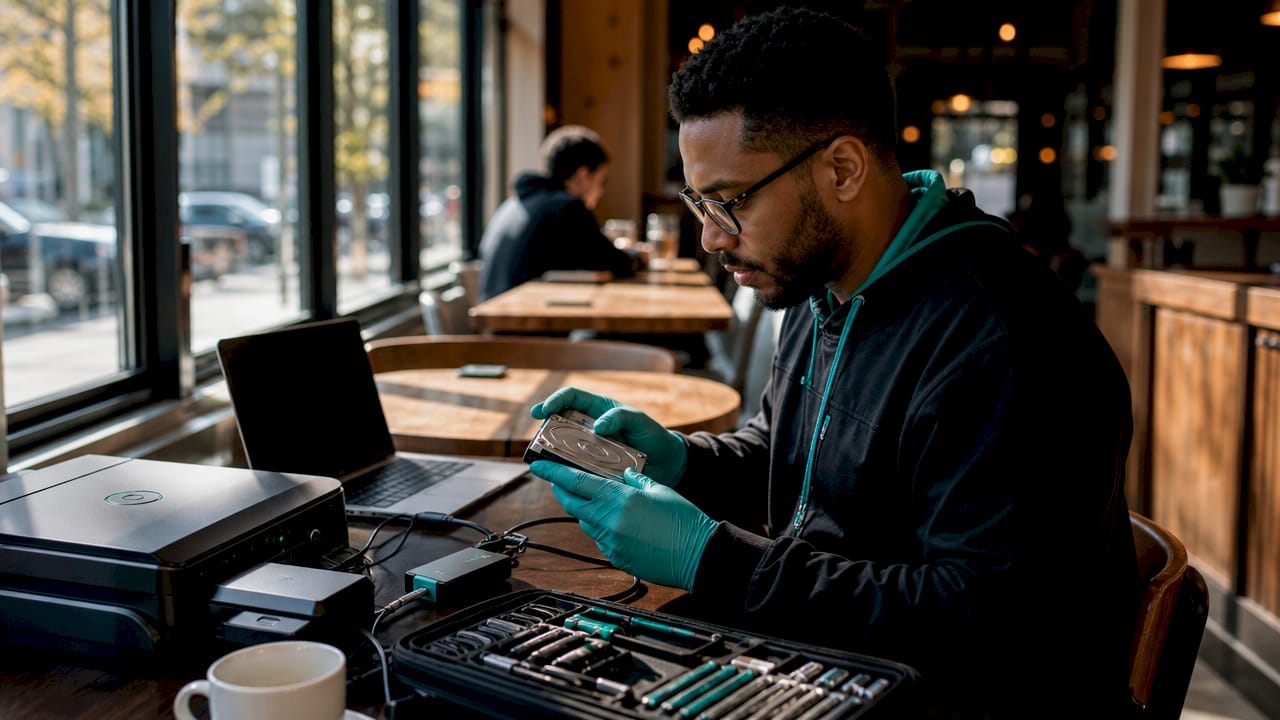
Disk imaging is the creation of a bit-for-bit copy of a storage device, capturing every sector including deleted files, unallocated space, and file system metadata. This method targets persistent data: evidence that survives power cycles and remains on the device after normal use. The ISO/IEC 27037 standard defines the roles and processes governing this acquisition, requiring auditability, repeatability, and justifiability at every step.
Two primary acquisition approaches exist:
- Full-disk (bit-by-bit) imaging: Captures every sector of the device regardless of whether it contains active data. Produces a complete forensic copy suitable for court proceedings.
- Logical and file system collection: Captures only active files and directory structures. Faster and smaller, but misses deleted data and unallocated space.
The choice of forensic image format matters significantly:
| Format | Description | Best use case |
|---|---|---|
| Raw (DD) | Uncompressed sector-by-sector copy | Maximum compatibility across tools |
| E01 (EnCase) | Compressed with embedded metadata and hash | Court submissions and long-term storage |
Write blockers are non-negotiable during disk acquisition. Defensible imaging requires hardware or software write blockers to prevent any data being written to the source device during copying. Post-acquisition, MD5 or SHA-256 hashes verify that the image is an exact copy of the original. Any deviation in hash values invalidates the evidence.
Pro Tip: Always record the hash of the source device before imaging begins, not just after. This creates an unambiguous baseline that proves the device was not altered prior to acquisition.
Encrypted drives present a significant challenge in digital forensics. Full-disk encryption via BitLocker or FileVault renders a cold image unreadable without the decryption key. In these cases, live acquisition from a running, authenticated system is the only viable path to readable data. Document the encryption state immediately upon discovery, as this affects every downstream decision in the investigation.
3. Network forensics and volatile traffic capture
Network forensics is the capture and analysis of network traffic, session logs, and protocol data to reconstruct attacker communications and lateral movement. Unlike disk or memory evidence, network data is inherently transient. Packet captures not taken in real time are lost permanently, making timing the defining challenge of this method.
Core network forensic techniques include:
- Packet sniffing: Tools such as Wireshark and tcpdump capture raw packet data at the interface level, preserving IP addresses, payloads, and protocol headers
- Firewall and IDS log analysis: Palo Alto Networks, Fortinet, and Snort logs provide session-level records of connection attempts, blocked traffic, and rule triggers
- NetFlow and session log review: Aggregated flow data from routers and switches reveals communication patterns without requiring full packet capture
- DNS query analysis: Identifies command-and-control (C2) beaconing, data exfiltration via DNS tunnelling, and malicious domain resolution
During active ransomware investigations, network forensics is particularly valuable. Attackers typically exfiltrate data before deploying encryption, and packet captures or proxy logs from the hours preceding the ransomware execution often contain the exfiltration traffic. Session logs and IP payload analysis support timeline reconstruction and attribution. Network security trends in 2026 confirm that encrypted C2 channels are increasingly common, making deep packet inspection and TLS inspection capabilities part of the standard network forensic toolkit.
4. Mobile device forensic methods
Mobile forensics covers the extraction and analysis of data from smartphones and tablets, where encryption, biometric locks, and remote wipe capabilities create unique acquisition challenges. MSAB's 2026 guide defines four primary extraction types, each with distinct capabilities and limitations:
- Logical extraction: Retrieves data the operating system exposes via standard interfaces. Fast and non-invasive, but limited to accessible files and excludes deleted data.
- File system extraction: Accesses the full file system structure, including application data and some deleted records. Requires device unlock or exploit-based access.
- Physical extraction (chip-off or JTAG): Produces a bit-for-bit image of the device storage. The most complete method, but modern encryption on iOS and Android devices frequently renders the image unreadable without the decryption key.
- RAM and volatile memory capture: Extracts active memory from the device, capturing encryption keys, open application sessions, and runtime credentials before they are lost.
The integration of volatile memory capture into mobile investigations is a relatively recent development and one that significantly changes what is recoverable. Capturing RAM before physical extraction can yield the keys needed to decrypt the physical image, making the sequence of methods as important as the methods themselves.
Device isolation is the first physical action in any mobile investigation. Faraday bags block all radio signals, preventing remote wipe commands from reaching the device. Tools such as XRY and XAMN support multi-level extraction and scripted analysis of data from obscure third-party applications, including encrypted messaging platforms.
Pro Tip: Place the device in a Faraday bag before any other action, including powering it off. Powering off a device without first isolating it can trigger remote wipe on some configurations, and it destroys volatile memory.
5. Comparison of forensic methods by evidence surface
Selecting the right forensic method requires mapping the investigation's evidence surfaces to the appropriate acquisition technique. No single method covers all surfaces, and blended approaches that pair volatile memory capture with disk imaging and network analysis consistently produce more complete findings than single-method investigations.
| Evidence surface | Primary method | Key tools | Primary limitation |
|---|---|---|---|
| RAM (volatile memory) | Live memory acquisition | FTK Imager, WinPmem, LiME | Lost on shutdown or reboot |
| Persistent disk storage | Forensic disk imaging | EnCase, FTK Imager, dd | Encrypted drives require live acquisition |
| Network traffic | Packet capture and log analysis | Wireshark, tcpdump, Snort | Transient; must be captured in real time |
| Mobile devices | Logical, file system, or physical extraction | XRY, XAMN | Encryption may block physical extraction |
| Cloud environments | API-based log and artefact collection | Vendor-native tools, SIEM | Jurisdiction and retention limits apply |
The decision of which method to prioritise depends on the investigation phase and the nature of the incident. During an active attack, volatile memory and network capture take precedence because both evidence types are being destroyed in real time. Post-incident, disk imaging and logical mobile extraction become the primary methods. For guidance on scoping these decisions under time pressure, incident scope determination frameworks provide a structured starting point.
Cloud environments introduce a separate category of challenges in digital forensics. Traditional imaging methods do not apply to virtualised infrastructure, and evidence collection depends entirely on vendor-provided APIs and log retention policies. This is a growing gap in many organisations' forensic readiness.
Key takeaways
Effective digital forensic investigation requires pairing each evidence surface with the correct acquisition method, executed in the right sequence, before volatile data is lost.
| Point | Details |
|---|---|
| Volatile data first | Capture RAM before disk imaging; lost memory cannot be recovered after shutdown. |
| Write blockers are mandatory | Any disk acquisition without a write blocker is inadmissible and forensically unsound. |
| Mobile isolation precedes extraction | Faraday bag isolation must occur before powering off or connecting any mobile device. |
| Method selection drives admissibility | ISO/IEC 27037 compliance through hashing, documentation, and controlled acquisition determines court defensibility. |
| Blended approaches outperform single methods | Combining memory, disk, network, and mobile acquisition produces the most complete breach picture. |
Makkari's view on method selection in live investigations
The most common mistake we see in post-incident reviews is not a tool failure. It is a sequencing failure. Teams arrive at a compromised system and immediately begin disk imaging because it feels methodical and familiar. Meanwhile, the RAM is running, the attacker's injected code is sitting in memory, and the encryption keys for the very disk they are imaging are evaporating. By the time the image is complete, the most valuable evidence is gone.
The ISO/IEC 27037 principles of auditability and justifiability are not bureaucratic requirements. They are the difference between findings that hold up in court and findings that get challenged on chain-of-custody grounds. Every acquisition decision needs to be documented in real time, not reconstructed afterwards.
We have also seen teams invest heavily in tools without investing equally in acquisition planning. A practitioner with a clear evidence acquisition matrix, mapping each data surface to its method and its loss risk, will consistently outperform a team with expensive software and no structured approach. The matrix does not need to be complex. It needs to exist before the incident, not during it.
The role of DFIR during an active attack demands decisions made in seconds, not minutes. The only way to make those decisions correctly under pressure is to have already made them in a tabletop exercise.
— Makkari
How Makkarisecurity supports your digital forensic investigations
Makkarisecurity delivers court-admissible DFIR services built on a proprietary forensic engine developed over five years, covering memory acquisition, disk imaging, network forensics, and mobile extraction across UK, Gibraltar, and European incidents. Every engagement includes live memory capture, cross-verified results, and full chain-of-custody documentation suitable for legal proceedings and regulatory submissions. Makkarisecurity's breach counsel support connects forensic findings directly to legal and panel requirements, removing the gap between technical evidence and courtroom presentation. If you are managing a live incident or preparing your organisation's forensic readiness, speak with the Makkarisecurity team directly.
FAQ
What are the main types of digital forensic investigation methods?
The primary types are memory acquisition, disk imaging, network forensics, and mobile device extraction. Each targets a distinct evidence surface and requires different tools and timing to preserve admissible evidence.
Why is volatile memory captured before disk imaging?
RAM contains encryption keys, active sessions, and injected code that are destroyed on shutdown. NIST SP 800-86 and the order of volatility principle both mandate volatile memory capture as the first acquisition action in live investigations.
What makes a forensic disk image court-admissible?
Admissibility requires the use of a write blocker during acquisition, MD5 or SHA-256 hash verification of both source and image, and documented chain-of-custody records aligned with ISO/IEC 27037 requirements.
How do Faraday bags support mobile forensic investigations?
Faraday bags block all radio signals, preventing remote wipe commands from reaching the device. Isolation must occur before any other action, including powering off, to preserve both volatile memory and stored data.
What are the biggest challenges in digital forensics today?
Encryption on both disk and mobile devices, the transient nature of network and memory evidence, and cloud environments with limited forensic access represent the three most significant technical challenges practitioners face in 2026.