
When a breach hits, every minute without a pre-arranged incident response service agreement costs you money, control, and evidence. Organisations that scramble to find a provider mid-incident routinely face delays of 24 to 72 hours before any meaningful response begins. This incident response retainer agreement guide covers everything legal teams and security leaders need: the three retainer models, how to draft incident response agreement clauses that hold up under legal scrutiny, activation protocols, and the performance metrics that tell you whether your contract is actually working.
Table of Contents
Key takeaways
| Point | Details |
|---|---|
| Choose the right retainer model | Match your retainer type to your risk appetite and budget before signing any cybersecurity retainer contract. |
| Protect legal privilege from the start | IR firms must report to outside legal counsel, not IT, to preserve attorney-client privilege throughout an investigation. |
| Pre-configure access before an incident | Network maps, log locations, and contact lists in the agreement enable immediate mobilisation rather than delays. |
| Use retainer hours proactively | Prepaid hours can fund tabletop exercises and readiness assessments, not just reactive breach response. |
| Review and renegotiate regularly | SLAs and scope should be revisited annually or after any significant organisational or threat change. |
Retainer models: costs, flexibility, and fit
Understanding the three primary retainer structures is the foundation of any solid incident response planning guide. Three retainer models exist as of mid-2026: no-cost, prepaid, and funds-based. Each carries distinct trade-offs.
| Model | Upfront cost | Per-incident cost | Best suited for |
|---|---|---|---|
| No-cost | None | High (on-demand rates) | Smaller organisations with limited budgets |
| Prepaid | Moderate (block of hours) | Lower (hours already purchased) | Mid-size organisations with predictable risk |
| Funds-based | Flexible allocation | Variable | Large enterprises balancing readiness and response |
The no-cost model sounds attractive but carries a hidden penalty. When an incident occurs, you pay premium emergency rates with no guarantee of priority access. The prepaid model purchases a block of hours in advance, which can be applied to both reactive response and proactive activities like tabletop exercises. The funds-based model gives the most flexibility, letting organisations allocate budget dynamically between readiness and active response phases.
One factor most organisations miss: the no-cost model often means you are not the provider’s priority when a major incident hits multiple clients simultaneously. Prepaid and funds-based retainers typically include priority response commitments, which belong in your service level agreement as a contractual obligation.
Pro Tip: If your organisation operates in a regulated sector such as financial services or healthcare, a prepaid or funds-based model is almost always the better choice. The SLA guarantees and proactive readiness work included in those structures align far more closely with regulatory expectations around incident management.
Drafting your retainer agreement: essential clauses
A well-structured incident management contract template does more than define what the provider will do. It defines what happens when things go wrong, who speaks to whom, and how evidence is handled. These are the clauses that matter most.

Scope of services must be explicit. Distinguish between reactive work (breach investigation, containment, eradication, recovery) and proactive work (readiness assessments, penetration testing, tabletop exercises). Proactive retainer engagement helps organisations detect and respond faster, particularly in cloud and hybrid environments, but only if the contract actually permits and funds that work.
Service level agreements should specify response times in hours, not business days. Define what constitutes a “critical incident” versus a “standard incident” and attach different SLA tiers to each. A 4-hour response commitment for a ransomware event is meaningless if the contract does not define what “response” means.
Forensic evidence handling is where many agreements fall short. Clarity on forensic scope and reporting deliverables directly affects audit outcomes and litigation readiness. Specify chain-of-custody procedures, evidence storage requirements, and who owns the forensic artefacts after the engagement closes.
Confidentiality and legal protections require careful drafting. The agreement must address data protection obligations under UK GDPR and, where applicable, Gibraltar’s Data Protection Act 2004. Include provisions for handling personal data discovered during an investigation.
Key retainer agreement best practices to build into your drafting process:
-
Require the provider to name a dedicated incident commander and alternate contact before signing
-
Include a “right to audit” clause allowing you to verify provider readiness annually
-
Specify that all reports and findings are delivered to outside legal counsel, not directly to IT leadership
-
Define escalation paths for regulatory notification obligations (ICO reporting within 72 hours under UK GDPR)
-
Include a termination clause with a minimum notice period and a data return or destruction obligation
Pro Tip: Engage your external legal counsel during the drafting phase, not after. Many organisations treat the IR retainer as a procurement exercise rather than a legal instrument. The clauses around privilege, evidence handling, and regulatory notification carry real legal consequences if they are vague.
Activating your retainer during an incident
Having a cybersecurity retainer contract in place is only half the work. The other half is making sure your team can activate it correctly under pressure. Retainer clients avoid delays precisely because pre-configured access, environment documentation, and named contacts are already in place. Here is the activation sequence that works.
-
Declare the incident internally. Notify your CISO, legal counsel, and the designated IR contact simultaneously. Do not wait for confirmation that a breach has occurred. Suspected incidents qualify.
-
Contact the IR provider using the pre-agreed channel. Email is not sufficient for critical incidents. The retainer should specify a 24/7 phone number or secure messaging channel.
-
Brief the provider using your environment documentation. Network maps, asset inventories, log source locations, and active directory structure should already be in the retainer onboarding pack. Provide immediate access.
-
Restrict internal communications. All incident-related communications should route through legal counsel from this point forward to preserve privilege.
-
Grant pre-configured access. VPN credentials, SIEM read access, and endpoint tool access should have been provisioned during onboarding. Verify they are still active.
-
Establish a war room cadence. Agree on update frequency (every two hours is standard for critical incidents) and the format of those updates.
-
Document everything. Every action taken, every finding, and every decision should be logged with timestamps. This record becomes critical in any subsequent regulatory or legal proceeding.
Integration with existing security stacks is a common activation failure point. If your IR provider has never connected to your SIEM or EDR platform before the incident, expect delays. Require a technical integration test during the onboarding phase and repeat it annually.
Pro Tip: Run a tabletop exercise specifically focused on retainer activation within 30 days of signing. The goal is not to test your security posture. It is to test whether your team can actually execute the first three steps of the activation sequence without consulting the contract.
Legal considerations and common pitfalls
Legal teams consistently underestimate how quickly privilege can be lost during an incident response engagement. Maintaining attorney-client privilege requires IR firms to report directly to legal counsel, with a clear separation between forensic investigation contracts and routine cybersecurity agreements.
The practical implication: you may need two separate agreements with your IR provider. One governs the privileged forensic investigation directed by outside counsel. The other governs business continuity work such as restoring systems and maintaining operations. Dual-track investigations with separate teams and separate reporting lines are the most defensible structure when litigation is a realistic possibility.
“Scope clarity and separate teams are critical to legally protect IR reports from disclosure in litigation.” — Debevoise & Plimpton, 2026
Additional legal pitfalls to address in your retainer:
-
Scope creep: Providers sometimes expand work beyond the agreed scope without a formal change order. Define a written change-order process.
-
Parallel investigations: If a regulator or law enforcement agency launches a parallel investigation, your retainer must address how the provider cooperates and what information can be shared.
-
Privacy obligations: Investigations frequently uncover personal data belonging to employees or customers. Define how that data is handled, stored, and reported.
-
Renegotiation triggers: Include specific triggers that require a contract review, such as a significant change in your cloud infrastructure, a merger, or a material change in the threat environment.
Incident response services differ fundamentally from consulting engagements, and contracts that blur this line create problems during activation. Keep the scope language clean and specific.
Measuring retainer effectiveness
A retainer agreement that sits in a drawer is not an asset. These are the metrics that tell you whether your investment is delivering value.
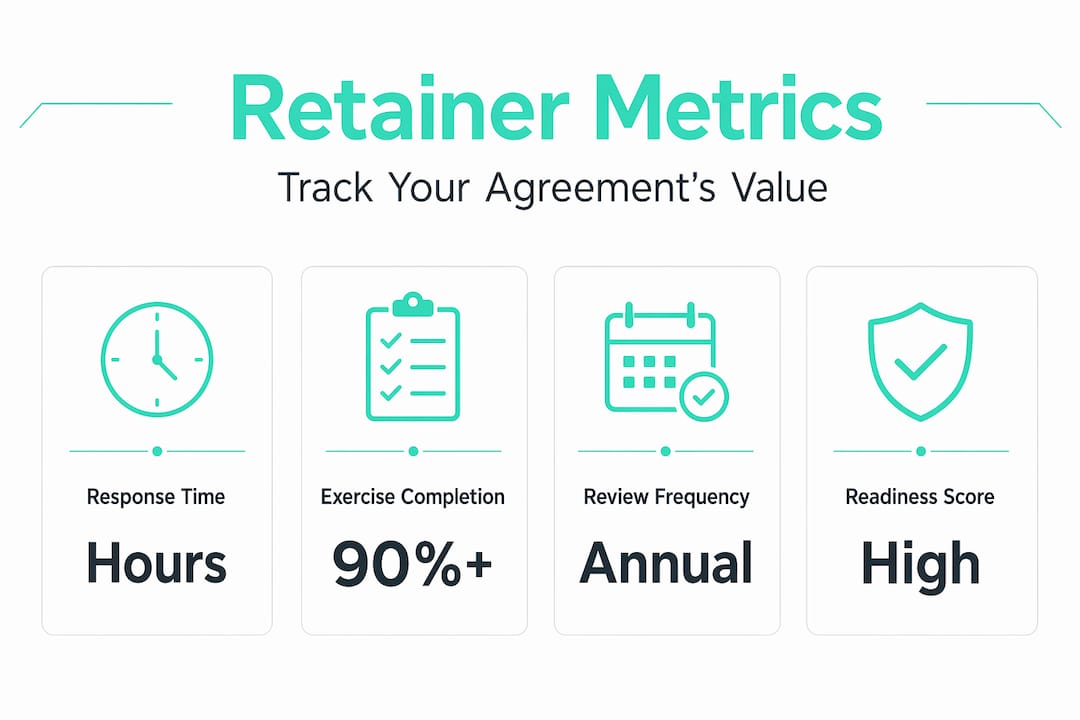
| Metric | What to measure | Improvement action |
|---|---|---|
| Initial response time | Time from incident declaration to first provider contact | Review SLA tiers and activation protocol |
| Containment time | Time from engagement to threat containment | Assess pre-configured access and environment documentation |
| Reporting quality | Completeness and legal admissibility of forensic reports | Specify reporting standards in the contract |
| Proactive hours utilised | Percentage of prepaid hours used for readiness activities | Schedule tabletop exercises and readiness reviews quarterly |
| Post-incident review completion | Whether formal reviews are conducted after each incident | Build post-incident review obligations into the agreement |
Retainer value extends beyond emergency response to include readiness assessments, tabletop exercises, and penetration testing. Organisations that use proactive hours consistently report faster containment times when real incidents occur. Track utilisation quarterly and adjust your model if prepaid hours are consistently going unused.
Pro Tip: After any significant incident, conduct a formal post-incident review with your IR provider within two weeks. Ask specifically whether the retainer agreement helped or hindered the response. The answers will tell you exactly what to renegotiate at the next renewal.
My perspective on retainer agreements
I have reviewed enough incident response engagements to say this plainly: most organisations treat their retainer as an insurance policy and then wonder why the response feels slow and disjointed when a breach actually occurs.
The organisations that get the most value from their retainers treat the agreement as the beginning of a relationship, not the end of a procurement process. The true operational advantage of a retainer is the accumulated intelligence and established access that builds over time. A provider who has already mapped your environment, tested your activation process, and sat through two tabletop exercises with your team does not start from zero when the call comes at 2am. That is the difference between a four-hour containment and a four-day containment.
The legal privilege question is the one I see handled badly most often. Legal teams assume that because the IR firm is engaged, privilege is automatically protected. It is not. The contract structure, the reporting chain, and the scope language all matter. Get this wrong and your forensic report becomes discoverable in litigation.
My advice: treat your retainer renewal as seriously as the initial signing. The threat environment in 2026 looks nothing like it did two years ago, and a contract drafted for on-premises infrastructure will not serve you well in a hybrid cloud incident. Review annually, test regularly, and build a genuine working relationship with your provider before you need them.
— Team Makkari
How Makkarisecurity supports your retainer strategy
Makkarisecurity operates at the intersection of digital forensics, incident response, and legal support. If you are building or renegotiating a retainer agreement, the team brings the technical depth and legal integration that most providers cannot match. Their IR retainer and DFIR services include pre-incident readiness assessments, priority response commitments, and a proprietary forensic engine that delivers court-admissible results faster than standard tooling. For organisations where legal privilege and regulatory compliance are non-negotiable, Makkarisecurity’s breach counsel support integrates outside legal oversight directly into the forensic investigation process. The Eviction Pledge, which guarantees no re-breach for a minimum of 60 days or no charge, reflects a standard of accountability that belongs in every retainer agreement. Contact Makkarisecurity for a consultation tailored to your organisation’s risk profile and regulatory obligations.
FAQ
What are the three main incident response retainer models?
The three models are no-cost, prepaid, and funds-based. No-cost carries no upfront fee but higher per-incident rates; prepaid purchases hours in advance; funds-based allows flexible allocation between readiness and response activities.
How do I protect attorney-client privilege in an IR retainer?
Structure the retainer so the IR firm reports directly to outside legal counsel rather than to IT leadership. Use separate agreements for privileged forensic work and business continuity activities to maintain clear scope separation.
What should a cybersecurity retainer contract always include?
At minimum, include defined scope of services, SLA response times, forensic evidence handling procedures, communication protocols, regulatory notification obligations, and a post-incident review requirement.
How often should we review our incident response retainer agreement?
Review annually at minimum, and immediately after any significant incident, major infrastructure change, or material shift in your organisation’s risk profile or regulatory obligations.
Can prepaid retainer hours be used for proactive security work?
Yes. Prepaid hours can typically fund tabletop exercises, readiness assessments, and penetration testing, not just reactive incident response. Confirm this is explicitly permitted in your agreement before signing.