
TL;DR:
- Network forensics involves capturing, preserving, and analyzing network traffic to investigate security incidents and produce legally admissible evidence. It depends on proactive full packet capture, which preserves complete session data, unlike flow data or logs, that only offer partial insights. Compliance with standards like ISO/IEC 27037 ensures evidence integrity, critical for legal proceedings and effective incident response.
Network forensics is defined as the capture, preservation, and analysis of network traffic to investigate security incidents, detect suspicious activity, and produce legally admissible evidence. Unlike endpoint forensics, which examines data at rest on disks and devices, network forensics targets data in motion. Once a packet leaves the wire without being captured, it is gone permanently. Tools such as Wireshark, Zeek, and Suricata sit at the centre of this discipline, enabling analysts to record, decode, and interrogate traffic at scale. For incident response teams and legal proceedings alike, packet capture is the forensic gold standard. Understanding network forensics explained in full means grasping not just the tools, but the techniques, standards, and investigative workflows that make evidence defensible in court.
What are the core techniques used in network forensics?
Core network forensic techniques include deep packet inspection, session reconstruction, file carving, and protocol analysis. Each method extracts a different category of forensic insight from captured traffic, and skilled analysts combine them to reconstruct attacker behaviour with precision.

Deep packet inspection (DPI) examines the full payload of each packet, not merely the header metadata. This allows analysts to read the actual content of unencrypted communications, identify malware command-and-control traffic, and detect data exfiltration in progress. DPI is computationally intensive, which is why it is typically applied to targeted traffic segments rather than entire capture files.
Session reconstruction reassembles the sequence of packets belonging to a single TCP or UDP session into a coherent communication record. This technique is what allows an analyst to replay an attacker's HTTP session, view a transferred file, or read a chat exchange verbatim. Without session reconstruction, raw packet captures are fragmented and difficult to interpret at speed.
The remaining techniques each address a specific forensic need:
- File carving extracts files and artefacts transferred across the network directly from packet payloads, without relying on filesystem metadata. This is particularly valuable when attackers use legitimate protocols such as HTTP or FTP to exfiltrate data. For a deeper look at how this works at the binary level, the role of file carving in forensic investigations is worth reviewing.
- Protocol analysis identifies misuse, tunnelling, or anomalous behaviour within standard protocols. DNS tunnelling, for example, is detectable through protocol analysis even when the traffic superficially resembles legitimate DNS queries.
- SIEM and log correlation places packet-level findings in broader context by cross-referencing with firewall logs, authentication records, and endpoint telemetry. Correlation is what transforms isolated packet observations into a coherent attack narrative.
Pro Tip: When analysing a large capture file, apply display filters in Wireshark to isolate specific protocols or IP ranges before attempting session reconstruction. Working on a filtered subset reduces processing time and sharpens analytical focus.
Full packet capture vs flow data vs logs: which matters most?
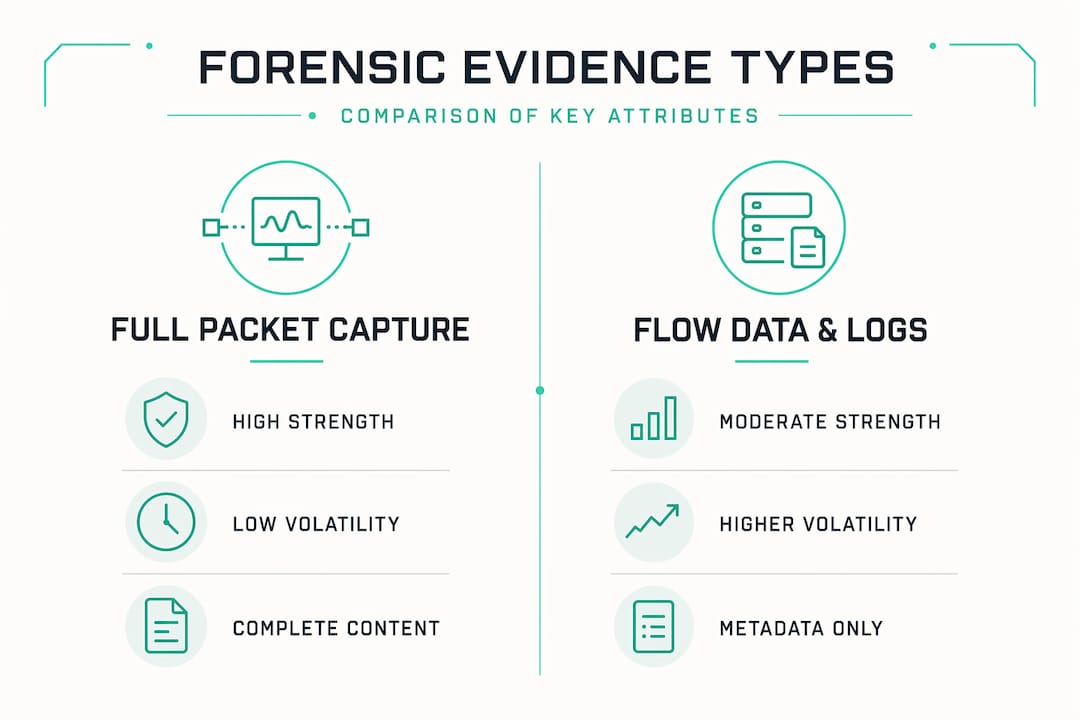
Packet capture is the forensic gold standard because it preserves complete session records, payload content, and transferable artefacts. Flow telemetry and logs are complementary, but neither can substitute for packet-level evidence when forensic completeness is required.
Flow telemetry formats such as NetFlow and IPFIX provide structured metadata about network conversations: source and destination IP addresses, port numbers, byte counts, and timestamps. NetFlow v5 is IPv4-focused with a fixed field set, while NetFlow v9 and IPFIX introduce extensible templates and broader protocol support. Flow data is lightweight, easy to retain long-term, and excellent for anomaly detection and initial scoping. It cannot, however, reconstruct what was said in a session or recover a transferred file.
Log data from firewalls, proxies, and intrusion detection systems adds policy-level context. Logs record what was allowed or blocked, which user authenticated, and which rule triggered. They are indispensable for timeline construction but share the same limitation as flow data: they describe events without preserving the underlying communication.
The table below compares the three evidence types across the dimensions that matter most in a forensic investigation.
| Evidence type | Evidentiary strength | Volatility | Primary use case |
|---|---|---|---|
| Full packet capture | Highest. Preserves payloads and session content | Very high. Lost if not captured proactively | Session reconstruction, file recovery, legal proceedings |
| Flow telemetry (NetFlow/IPFIX) | Moderate. Metadata only, no payload | Medium. Aggregated and exportable | Anomaly detection, initial scoping, traffic baselining |
| Log data | Low to moderate. Policy-level records | Low. Written to persistent storage | Timeline construction, access auditing, rule analysis |
A flow-only or log-only investigation cannot fully reconstruct communications, which means forensic conclusions drawn from those sources alone are vulnerable to challenge. For legal proceedings, this distinction is decisive.
Pro Tip: Retain flow data for 90 days as a minimum baseline. This gives you the scope to identify anomalies retrospectively and justify escalation to full packet capture for specific time windows and hosts.
What standards govern network forensic evidence handling?
ISO/IEC 27037 defines the international guidelines for identification, collection, acquisition, and preservation of digital evidence. Compliance with this standard is the baseline expectation for any network forensic evidence intended for legal proceedings or regulatory scrutiny.
The standard mandates a documented chain of custody from the moment of acquisition. Every transfer, access, or processing step must be recorded with timestamps, personnel identifiers, and purpose. A gap in the chain of custody is sufficient grounds for opposing counsel to challenge the admissibility of the entire evidence set.
The practical steps for compliant evidence handling follow a defined sequence:
- Identify and prioritise evidence sources by volatility. Network traffic is the most volatile artefact in any incident. Capture it first, before touching endpoints or storage.
- Acquire using write-protected or read-only methods wherever possible. For live traffic, use dedicated capture appliances or network taps rather than software running on production hosts.
- Hash every capture file immediately using SHA-256. Record the hash value in the chain-of-custody log before any analysis begins.
- Apply qualified electronic timestamps to acquisition records. ISO/IEC 27037 requires timestamps that are cryptographically verifiable, not simply system-generated.
- Assign roles explicitly. The standard defines the Digital Evidence First Responder (DEFR) as the person responsible for initial acquisition, and the Digital Evidence Specialist (DES) as the analyst who processes and interprets the evidence.
- Document all assumptions and tool configurations used during acquisition. Courts and regulators increasingly scrutinise the methodology, not just the output.
"Chain of custody and evidence integrity are paramount, requiring verifiable cryptographic hashing and tamper-evident documentation from acquisition onward. This ensures forensic network evidence can withstand legal scrutiny and opposing-party challenges." — Digital Evidence Preservation: Standards Compared
The EU E-Evidence Regulation, which entered into force in 2023, adds a cross-border compliance dimension for organisations operating across European jurisdictions. Network forensic evidence collected in one member state must meet the preservation standards of the requesting jurisdiction, making ISO/IEC 27037 adherence not just best practice but a legal necessity in many cases.
How is network forensics applied in incident response and breach analysis?
Real incident response prioritises flow data correlations for efficiency, then escalates to full packet capture analysis for comprehensive proof and legal reporting. This two-phase approach balances speed with forensic rigour.
In the initial triage phase, analysts correlate NetFlow records, firewall logs, and SIEM alerts to identify the affected hosts, approximate the attack timeline, and determine which protocols were involved. This scoping work is fast and can be performed on retained data without requiring new capture infrastructure. It answers the question: where should we look?
The escalation phase applies packet capture to the identified scope. Analysts use tools such as Wireshark for interactive session analysis, Zeek for protocol-level scripting and log generation, and Suricata for signature-based detection within capture files. The outputs of this phase include reconstructed attack paths, identified lateral movement, and recovered exfiltrated files. For practical examples of what these outputs look like, network forensics investigation outputs provides concrete case illustrations.
The key investigative deliverables from a network forensic engagement typically include:
- A reconstructed attack timeline with packet-level evidence for each stage of the intrusion
- Identification of the initial access vector, including any exploited protocol or credential misuse
- Evidence of lateral movement between internal hosts, supported by session reconstruction
- Confirmation or exclusion of data exfiltration, with file carving results where applicable
- Integration with endpoint forensic findings to produce a unified incident narrative
Integrating network forensic findings with endpoint and cloud forensics data is what separates a partial investigation from a complete one. Network evidence shows what crossed the wire; endpoint evidence shows what executed on the host. Together, they close the evidentiary gaps that attackers rely on.
What challenges should practitioners anticipate in network forensics?
Volatility is the defining challenge in network forensics. Network traffic exists only briefly unless captured proactively, which means retrospective investigation is only possible if capture infrastructure was already in place before the incident occurred.
Practitioners regularly encounter the following operational and technical challenges:
- Retention gaps. Without a pre-existing capture or flow retention policy, the most critical evidence window is often unrecoverable. Organisations that deploy capture infrastructure only after a breach has been detected face permanent evidence gaps.
- Flow exporter variability. NetFlow/IPFIX field completeness varies by exporter template implementation. Analysts must verify which Information Elements are present in a given flow export before drawing protocol or behavioural conclusions from it. Assuming field completeness without verification is a common source of analytical error.
- Encrypted traffic. TLS 1.3 and widespread HTTPS adoption mean that payload content is frequently inaccessible without decryption keys or a man-in-the-middle inspection capability. Protocol analysis and behavioural heuristics become the primary tools when decryption is not possible.
- Storage and processing costs. Full packet capture at high-throughput network segments generates data volumes that are expensive to store and slow to process. Selective capture strategies, such as capturing only traffic to and from critical asset segments, are a practical compromise.
- Documenting limitations. Every forensic report must explicitly state what evidence was not available and why. Failing to document the absence of a retention policy, or the presence of encrypted traffic, leaves the investigation open to challenge.
Pro Tip: Deploy network taps or SPAN ports on critical segments before an incident occurs. Reactive capture deployment after a breach is detected almost always misses the initial compromise window.
Key takeaways
Network forensics requires proactive packet capture infrastructure, ISO/IEC 27037-compliant evidence handling, and integration with endpoint and SIEM data to produce forensically complete and legally defensible incident investigations.
| Point | Details |
|---|---|
| Packet capture is irreplaceable | Flow and log data cannot reconstruct session content or recover transferred files; full packet capture is required for forensic completeness. |
| Volatility demands proactive deployment | Network traffic disappears unless captured in advance; retrospective investigation is only possible with pre-existing retention infrastructure. |
| ISO/IEC 27037 sets the evidence standard | SHA-256 hashing, chain-of-custody documentation, and qualified timestamps are mandatory for evidence to withstand legal scrutiny. |
| Technique selection depends on evidence type | Deep packet inspection and session reconstruction require packet data; flow data supports scoping and anomaly detection at lower cost. |
| Integration produces complete investigations | Combining network, endpoint, and SIEM evidence closes the gaps that partial investigations leave open for challenge. |
The uncomfortable truth about flow-only investigations
From Makkari's experience responding to breaches across the UK and Europe, the single most common investigative failure is not a lack of tools. It is a lack of packet capture data. Organisations invest heavily in SIEM platforms and flow telemetry, then discover during an incident that they cannot answer the most basic forensic question: what exactly was transferred?
Flow data is genuinely useful. It scopes incidents quickly and supports anomaly detection at scale. But treating it as a substitute for packet capture is a decision that consistently costs organisations their ability to produce court-admissible evidence, quantify data loss precisely, or exclude false positives with confidence.
The second pattern we observe is underinvestment in standards compliance. ISO/IEC 27037 is not bureaucratic overhead. It is the framework that determines whether your evidence survives cross-examination. Organisations that treat chain-of-custody documentation as optional discover its importance at the worst possible moment, when opposing counsel challenges the integrity of the entire forensic record.
The technology is improving rapidly. Advances in hardware-accelerated packet capture, AI-assisted protocol analysis, and integrated DFIR platforms are reducing the cost and complexity of full-fidelity network forensics. The barrier to doing this properly is lower than it has ever been. The organisations that invest in continuous training and tooling updates are the ones that can answer definitively what happened, when it happened, and what was taken. That capability is not a luxury. It is the foundation of a credible incident response programme.
— Makkari
How Makkari Security supports network forensic investigations
Makkari Security delivers full packet capture analysis, ISO/IEC 27037-compliant evidence preservation, and court-admissible forensic reporting for organisations facing active breaches or post-incident scrutiny. Our proprietary forensic engine performs live network capture and cross-verified analysis, producing findings that hold up under legal challenge. We support breach counsel and panel engagements with expert witness testimony and forensic reports prepared to the standard that regulators and courts require. For organisations in the UK, Gibraltar, and broader Europe seeking a DFIR partner with a flawless re-breach record, our incident response capabilities cover the full spectrum from initial triage through to final forensic reporting. Contact Makkari Security to discuss your network forensic requirements.
FAQ
What is network forensics?
Network forensics is the capture, preservation, and analysis of network traffic to investigate security incidents and produce legally admissible evidence. It focuses on data in motion rather than data at rest, making proactive packet capture infrastructure a prerequisite for effective investigation.
Why is full packet capture considered the forensic gold standard?
Full packet capture preserves complete session records, payload content, and transferable artefacts that flow data and logs cannot replicate. Without packet-level evidence, analysts cannot reconstruct communications or recover exfiltrated files with forensic certainty.
What tools are used in network forensic investigations?
Wireshark, Zeek, and Suricata are the primary tools used for packet capture, protocol analysis, and signature-based detection in network forensic investigations. These are typically combined with SIEM platforms for log correlation and broader incident context.
How does ISO/IEC 27037 apply to network forensics?
ISO/IEC 27037 mandates documented chain of custody, SHA-256 cryptographic hashing, and qualified electronic timestamps for all digital evidence, including network captures. Compliance with this standard is required for network forensic evidence to be admissible in legal proceedings.
What is the biggest practical challenge in network forensics?
Volatility is the primary challenge. Network traffic disappears unless captured proactively, meaning that organisations without pre-existing capture infrastructure face permanent evidence gaps when investigating a breach retrospectively.