
TL;DR:
- Memory forensics involves analyzing volatile RAM to recover evidence that vanishes upon system reboot, making it critical during breach investigations. It uncovers runtime-only threats like injected shellcode, active network connections, and plaintext credentials, complementing traditional disk forensics by capturing system states at the moment of compromise. Effective incident response requires immediate memory acquisition, proper chain-of-custody, and adaptation to cloud environments to prevent evidence loss and support legal and breach containment efforts.
Memory forensics is the examination of volatile RAM to recover evidence that disappears the moment a compromised system is rebooted, making it the most time-critical discipline in modern breach investigations. Where disk forensics reconstructs what happened over time, volatile memory analysis captures what is happening right now: decrypted payloads, injected shellcode, active command-and-control connections, and plaintext credentials that never touch the file system. Tools such as the Volatility Framework, Rekall, and Mandiant Redline have made this discipline operationally accessible, yet many incident response teams still treat memory acquisition as an afterthought. The global digital forensics market is growing at 12.2% CAGR through 2031, driven precisely by the demand for this kind of sophisticated, runtime evidence.
What unique evidence does memory forensics reveal in breach response?
The role of memory forensics in a breach is defined by the artefacts it recovers that no other method can. Disk forensics is blind to anything that exists only at runtime. Memory forensics is not.
The following categories of volatile evidence are recoverable from RAM during an active or recently active compromise:
- Plaintext credentials from LSASS memory. The Windows Local Security Authority Subsystem Service holds authentication tokens and credential material in memory. Attackers use tools like Mimikatz to extract these at runtime, and forensic analysts use the same memory access to recover what was stolen.
- Injected shellcode and process hollowing. Malicious code injected into legitimate processes such as "svchost.exe
orexplorer.exe` leaves no file on disk. Memory forensics recovers this injected code directly from the process address space, along with decrypted payloads that were encrypted at rest. - Active network connections and C2 beacons. RAM holds the current network socket table, revealing live connections to attacker infrastructure. This is frequently the fastest route to identifying command-and-control server addresses during an active intrusion.
- Rootkits residing only in RAM. Certain rootkits hook kernel structures and exist entirely in volatile memory. Memory forensics detects these runtime threats, including fileless malware and kernel-level rootkits, that are invisible to any disk-based scan.
- Encryption keys and decrypted data. Ransomware holds its encryption keys in memory during the encryption process. Capturing RAM at the right moment can recover those keys, potentially enabling decryption without paying a ransom.
Compared with disk forensics, which excels at recovering deleted files, browser history, and registry artefacts, volatile memory analysis provides a live snapshot of system state at the moment of compromise. The two disciplines answer different questions. Disk forensics asks what persisted; memory forensics asks what was executing.
How does memory forensics complement traditional disk-based forensics?
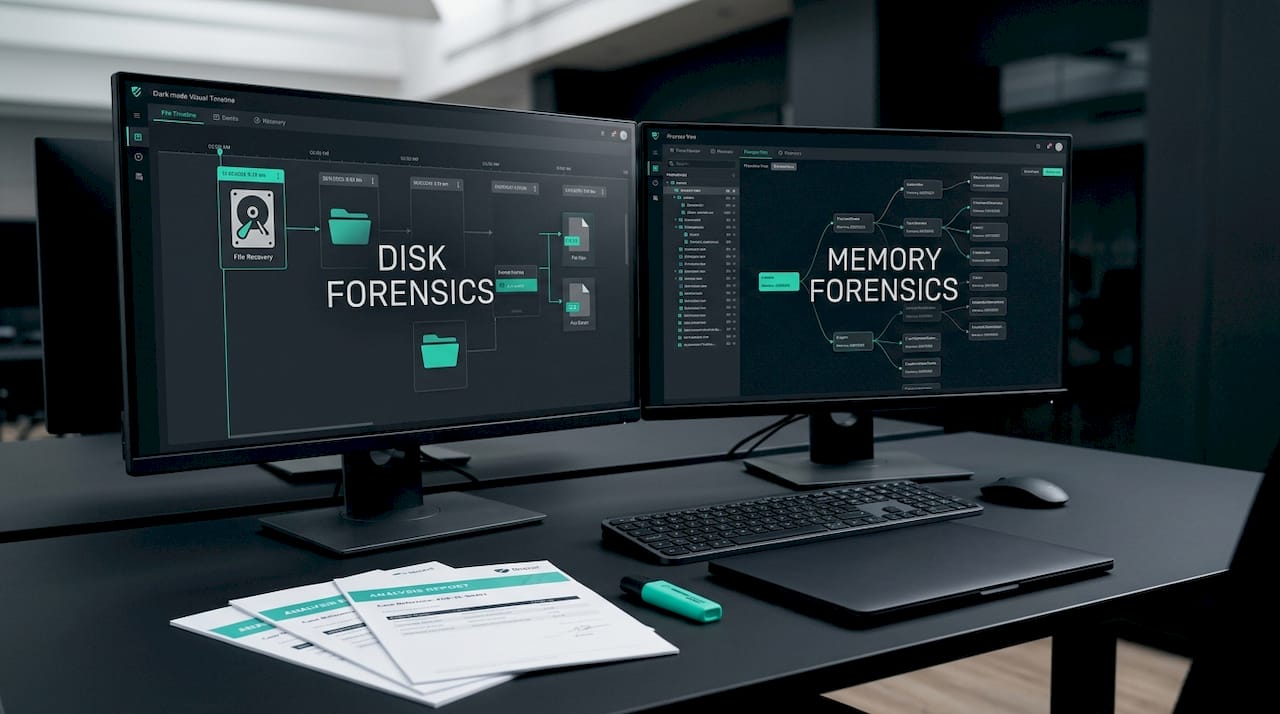
Memory forensics is a complementary technique to disk analysis, not a replacement. Each method has a distinct operational scope, and the most thorough breach investigations use both in a coordinated workflow.
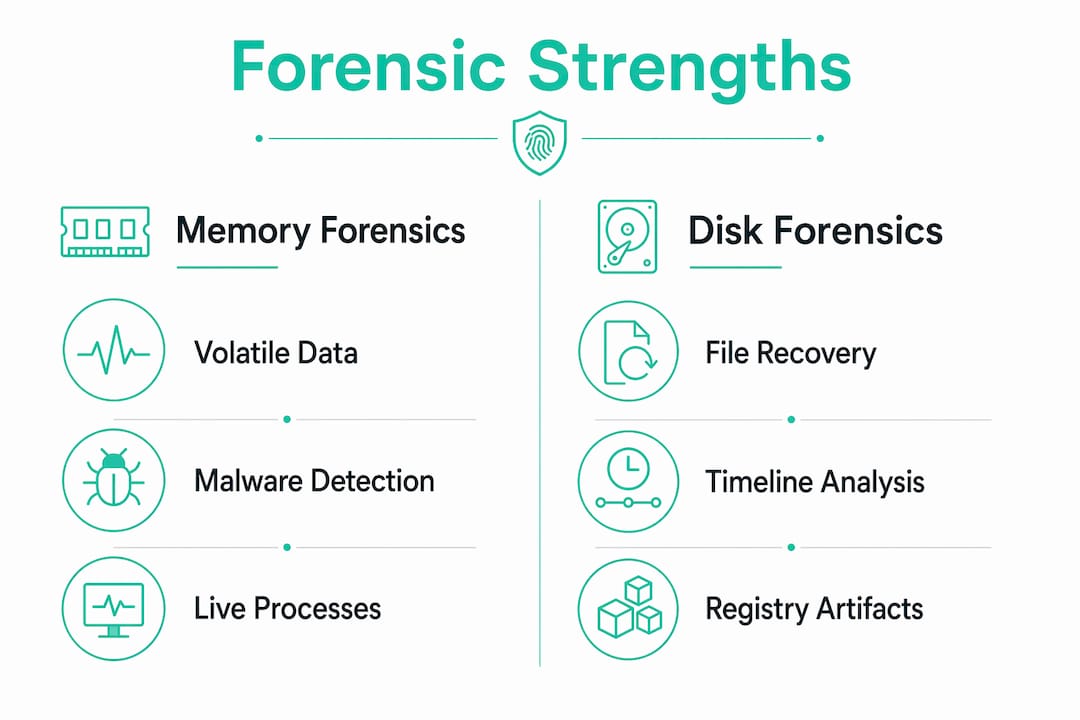
| Forensic method | Strengths | Limitations |
|---|---|---|
| Disk forensics | Timeline reconstruction, deleted file recovery, persistent artefacts, registry analysis | Cannot recover runtime-only threats; fileless malware leaves no trace |
| Memory forensics | Live process state, injected code, active connections, decrypted payloads, credential material | Evidence is lost on reboot; requires timely acquisition; larger data volumes |
DFIR teams that integrate both approaches gain the broadest possible visibility. Disk forensics establishes the attacker's persistence mechanisms and initial access vector. Memory forensics confirms what the attacker was doing at the moment of detection, which processes were compromised, and which credentials were exposed. Integrating memory with disk and network forensics provides the most complete picture for breach scoping and legal reporting.
Chain-of-custody is a governance consideration that applies to both disciplines but is particularly acute for volatile data. Memory images must be acquired using write-protected, forensically sound processes and documented with cryptographic hashes immediately upon capture. Without this, the evidence may not meet the threshold for court-admissible memory forensics in legal proceedings. The role of file carving forensics in recovering deleted disk artefacts follows similar chain-of-custody principles, reinforcing why integrated DFIR workflows must treat both evidence types with equal rigour.
Pro Tip: Acquire a full memory image before any other remediation action. Even if you are confident the threat is contained, the memory image is your only record of runtime state. Hash it immediately using SHA-256 and store it on write-protected media before analysis begins.
What operational challenges must be considered in memory forensics?
Memory acquisition is unforgiving. The window between breach detection and evidence loss is measured in minutes, not hours, and several operational factors determine whether that window is used effectively.
Timing is the primary constraint. Rebooting a compromised system before memory acquisition destroys all volatile evidence permanently. Injected shellcode, decryption keys, and active network connections cannot be recovered post-mortem from disk. This is not a recoverable mistake. Incident response runbooks must specify memory acquisition as the first technical action upon confirmed compromise, before any attempt to isolate or remediate the affected host.
The operational challenges extend beyond timing:
- Legal and chain-of-custody compliance. Memory acquisition must follow documented procedures that satisfy both internal governance and external legal requirements. In the UK, this includes compliance with the Computer Misuse Act 1990 and, where personal data is involved, the UK GDPR. Forensic images must be hashed, timestamped, and stored with an unbroken chain of custody to support the role of memory forensics in legal cases and potential prosecution.
- Cloud and container environments. Traditional memory acquisition tools designed for physical endpoints do not translate directly to cloud virtual machines or ephemeral containers. Cloud and container forensics require platform-native approaches: AWS MargaritaShotgun for EC2 instance memory capture, and Kubernetes CRIU (Checkpoint/Restore In Userspace) for container memory preservation without terminating the workload.
- Ephemeral infrastructure. Serverless functions and short-lived containers may terminate before an analyst can respond manually. Automation within SIEM and SOAR workflows is the only reliable mechanism for preserving ephemeral runtime evidence in these environments. Automated triggers that initiate memory capture upon alert firing reduce the response gap from minutes to seconds.
- Volume and analysis complexity. A single server memory image can exceed 256 GB. Parsing that volume for relevant artefacts requires purpose-built tooling and trained analysts who understand memory structures across operating system versions.
Attackers remain undetected for 200 or more days on average, with evasion techniques designed to leave traces only in RAM. Every day without memory acquisition is a day that evidence degrades or disappears entirely.
For organisations operating hybrid or multi-cloud infrastructure, understanding what cloud forensics involves for security teams is a prerequisite for building acquisition workflows that actually work at scale.
What are best practices for memory forensics in incident response?
Effective integration of volatile memory analysis into incident response requires deliberate process design, not ad hoc decisions made under pressure. The following practices reflect what works in live breach scenarios.
- Prioritise memory acquisition at the moment of detection. The first confirmed indicator of compromise should trigger an immediate memory capture workflow. This applies to endpoints, servers, and cloud instances. Delay is the primary cause of evidence loss in breach investigations.
- Use purpose-built acquisition tools. Volatility Framework remains the industry standard for memory analysis across Windows, Linux, and macOS. WinPmem and LiME (Linux Memory Extractor) are the preferred acquisition tools for live systems. Mandiant Redline provides a GUI-based option for analysts who need rapid triage without command-line proficiency.
- Correlate memory findings with network and disk data. Memory forensics identifies what was executing and which connections were active. Network forensics investigation outputs confirm whether those connections resulted in data exfiltration. Disk forensics establishes how the attacker achieved persistence. All three data sources together define the true breach scope.
- Maintain rigorous chain-of-custody documentation. Every memory image must be accompanied by acquisition metadata: the tool used, the analyst who performed the capture, the timestamp, and the SHA-256 hash of the image. This documentation is the foundation for examples of court-admissible memory forensics in subsequent legal proceedings.
- Adapt acquisition strategies for modern infrastructure. Static runbooks designed for physical endpoints will fail in containerised or serverless environments. Incident response teams must maintain separate acquisition procedures for AWS, Azure, GCP, and Kubernetes environments, tested and validated before a breach occurs.
Pro Tip: Run quarterly memory forensics exercises using tools like Volatility against known malware samples in a sandboxed environment. Analysts who have parsed memory images before a real breach are significantly faster and more accurate when it matters.
Key takeaways
Memory forensics is irreplaceable in breach investigations because volatile RAM holds evidence that disk analysis cannot recover, including injected code, active attacker connections, and plaintext credentials.
| Point | Details |
|---|---|
| Volatile evidence is time-critical | Memory must be captured before any reboot or remediation action, or the evidence is permanently lost. |
| Fileless threats require memory analysis | Injected shellcode, rootkits, and C2 beacons exist only in RAM and are invisible to disk-based tools. |
| Integration with disk and network forensics | Combining all three forensic disciplines provides the most complete breach scope and supports legal proceedings. |
| Cloud environments demand new methods | AWS MargaritaShotgun and Kubernetes CRIU are required for memory acquisition in cloud-native infrastructure. |
| Chain-of-custody is non-negotiable | Cryptographic hashing and documented acquisition procedures are prerequisites for court-admissible forensic evidence. |
Makkari's view on where memory forensics is heading
The most dangerous assumption an incident response team can make is that their existing disk-based tooling is sufficient. Fileless malware, living-off-the-land techniques, and memory-resident implants have made volatile memory analysis not a specialist add-on but a core capability. We have seen breaches where the only evidence of attacker activity was a single injected thread in a legitimate process. Without memory forensics, that breach would have been attributed to a system anomaly and closed without remediation.
What concerns us most is the gap between awareness and operational readiness. Many teams understand that memory forensics matters. Far fewer have tested their acquisition workflows against a live cloud environment, validated their chain-of-custody procedures, or trained analysts on Volatility's plugin ecosystem beyond the basics. The threat actors exploiting these gaps are not waiting for teams to catch up.
Automation is not optional in cloud-native environments. Manual memory acquisition workflows will always be too slow for ephemeral containers and serverless functions. The teams that will contain breaches fastest in the next three years are those building automated acquisition triggers into their SOAR platforms today, not those planning to address it after the next incident.
The investment required is real: tooling, training, and process redesign. The cost of not making it is a prolonged breach with no forensic record of what the attacker accessed, exfiltrated, or destroyed.
— Makkari
How Makkari Security supports your breach investigations
Makkarisecurity delivers end-to-end DFIR capability with live memory capture built into every breach response engagement. Our proprietary forensic engine, developed over five years, acquires and analyses volatile memory with cross-verified results that meet the standard for court-admissible forensic evidence in UK and European legal proceedings. Every engagement includes full chain-of-custody documentation, expert witness support, and breach counsel coordination. For organisations that need ongoing assurance, our incident response retainer includes pre-configured acquisition workflows for cloud, on-premises, and hybrid environments. And with the Eviction Pledge, once a threat actor is removed, they do not return for a minimum of 60 days. That is a guarantee backed by a flawless re-breach record.
FAQ
What is the role of memory forensics in a breach investigation?
Memory forensics recovers volatile evidence from RAM that disappears on reboot, including injected shellcode, plaintext credentials, active network connections, and decrypted payloads. It is the only method capable of detecting fileless malware and runtime-only threats that leave no trace on disk.
When must memory acquisition take place during incident response?
Memory must be acquired before any reboot, shutdown, or remediation action on a compromised system. Rebooting destroys all volatile evidence permanently, leaving investigators reliant on incomplete disk data.
How is memory forensics evidence made court-admissible?
Court-admissible memory forensics requires a documented chain-of-custody, cryptographic hashing of the memory image at acquisition, and use of forensically sound tools. In the UK, compliance with the Computer Misuse Act 1990 and UK GDPR is also required where personal data is involved.
How does memory forensics work in cloud and container environments?
Cloud memory acquisition uses platform-native tools such as AWS MargaritaShotgun for EC2 instances and Kubernetes CRIU for container checkpointing. Automation within SIEM and SOAR workflows is required to capture ephemeral evidence before containers or serverless functions terminate.
Which tools are used for memory forensics in incident response?
The Volatility Framework is the industry standard for memory analysis across Windows, Linux, and macOS. WinPmem and LiME handle live acquisition on endpoints, while Mandiant Redline provides rapid triage capability for analysts who need results without command-line tooling.