
TL;DR:
- A cyber incident response retainer guarantees organizations access to cyber experts during a breach through prearranged contracts. The two main models—prepaid and no-cost standby—differ in cost structure, pre-incident services, and provider familiarity, affecting response readiness. Testing activation drills and legal reviews of contract terms are essential to ensure the retainer's effectiveness when an incident occurs.
A cyber incident response retainer is a prearranged contractual agreement that guarantees your organisation access to qualified cybersecurity experts the moment a breach, ransomware attack, or data compromise occurs. Known formally within the Digital Forensics and Incident Response (DFIR) industry as an IR retainer, this agreement defines the scope of services, response timelines, and financial terms before any incident takes place. The distinction matters: organisations without a retainer spend critical hours sourcing help during a crisis, while those with one activate a pre-vetted team within a defined service level window. Providers such as Group-IB and Arctic Wolf have made proactive readiness services a standard component of their retainer offerings.
What are the main types of cyber incident response retainers?
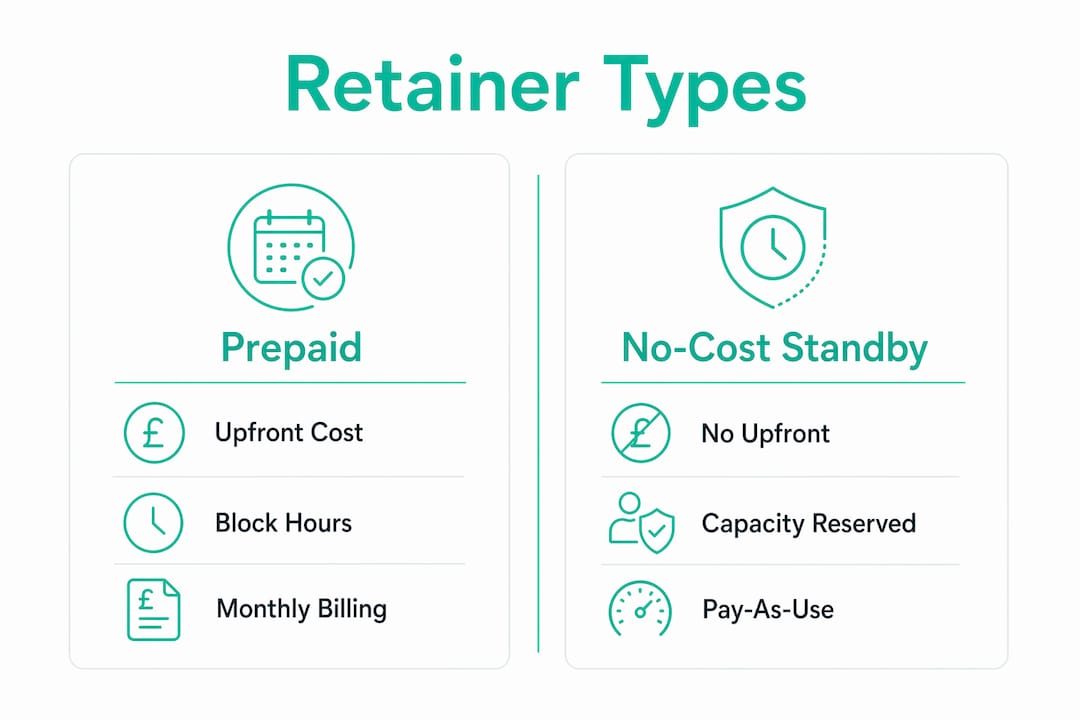
Incident response retainers are sold in two principal models, and the difference between them has direct financial and operational consequences.

Prepaid retainers involve purchasing a block of hours in advance, typically billed monthly or quarterly. Those hours fund pre-incident preparation activities such as network reviews, tabletop exercises, and readiness planning, as well as active incident response when required. Unused hours may roll over or expire depending on the contract. This model suits organisations that want predictable budgeting and ongoing engagement with their provider.
No-cost standby retainers (sometimes called pay-as-you-use agreements) carry no upfront fee. The provider reserves capacity for your organisation and defines service level commitments in the contract. You pay only when the retainer is activated. This model appears attractive on paper, but the absence of pre-incident engagement means your team and the provider's analysts have no working relationship before a crisis begins.
| Feature | Prepaid retainer | No-cost standby retainer |
|---|---|---|
| Upfront cost | Yes, block of hours purchased | None until activation |
| Pre-incident services | Included (exercises, reviews) | Typically excluded |
| Provider familiarity | High, built over time | Low, first contact at crisis |
| Budget predictability | High | Variable, surge rates apply |
| Best suited for | Organisations with active security programmes | Organisations seeking minimal spend |
Both models define SLA terms and activation conditions that govern how quickly a qualified analyst must engage once an incident is declared. The SLA is not a formality. It is the operational backbone of the entire agreement.
Pro Tip: If you opt for a no-cost standby retainer, negotiate at least one annual tabletop exercise into the contract at a fixed rate. Without it, you will meet your incident response team for the first time during an active breach.
Which contract terms define a reliable incident response retainer?
The most common cause of retainer failure is contractual ambiguity, not a lack of technical skill on the provider's part. Before signing, your legal and security teams must scrutinise the following elements with precision.
SLA clock definition is the single most consequential clause in the contract. The SLA clock should start on first contact with a qualified analyst, not on receipt of your initial call or email. An ambiguous definition allows a provider to technically meet a four-hour SLA by acknowledging your message, then assigning an analyst hours later. Specify "first qualified analyst contact" explicitly.
Billing increments and surge rates determine your actual cost during a major incident. Most providers bill in 15 or 30-minute increments during normal engagement, but escalate to surge rates during declared incidents. Confirm the multiplier and the conditions that trigger it before you sign.
The following contract elements require direct legal review:
- OFAC screening requirements: Ransomware engagements require OFAC compliance screening before any payment facilitation. Screening duration varies from under two hours to 48 hours depending on the provider. In a ransomware scenario with a payment deadline, a 48-hour screening window can be operationally catastrophic.
- Confidentiality clauses: Some agreements restrict your ability to disclose the incident to third parties, including regulators. Contract clauses restricting disclosure can directly conflict with GDPR breach notification obligations, which require notification to supervisory authorities within 72 hours. Legal vetting is non-negotiable.
- Data handling and chain-of-custody provisions: Confirm that forensic evidence collected during the engagement is handled to a standard that supports legal proceedings if required.
- Incident declaration procedures: The contract must define who has authority to declare an incident and activate the retainer. Ambiguity here causes internal delays that consume the SLA window before the provider is even contacted.
Pro Tip: Request a sample incident declaration form from your prospective provider before signing. If they cannot produce one, treat that as a signal about their operational maturity.
What are the key benefits of a cyber incident response retainer?
The financial case for maintaining a retainer is direct. The average cost of a data breach reached $4.88 million in 2025, and organisations with an active retainer reduced their breach costs by $1.49 million on average. That figure reflects faster containment, reduced dwell time, and lower regulatory exposure. It is not a marginal saving.
Beyond cost reduction, the operational benefits of cybersecurity retainer services are substantial:
- Speed of response: A pre-agreed retainer eliminates the procurement process during a crisis. Your team activates a known provider under defined terms rather than issuing emergency requests for proposal to unfamiliar firms.
- Specialist forensic capability on demand: Retainers provide access to DFIR expertise, including live memory capture, malware analysis, and court-admissible evidence handling, that most internal security teams cannot replicate.
- Proactive preparedness: Leading IR providers integrate pre-incident maturity assessments and tabletop exercises into their retainer models, improving your organisation's baseline readiness before any incident occurs.
- Regulatory and legal support: Retainers with breach counsel components provide direct access to legal expertise during an incident, supporting GDPR notification timelines, HIPAA obligations, and evidence preservation for litigation.
- Cost predictability: Negotiated retainer pricing removes the premium associated with emergency engagement. Surge rates still apply, but the baseline cost is agreed in advance.
AI-native platforms such as IR-OS now automate incident plan generation and response role assignment, improving coordination and legal defensibility during active incidents. Organisations that combine a well-structured retainer with modern incident management tooling are materially better positioned than those relying on either alone.
How should organisations test and activate their retainer effectively?
Discovering retainer limitations during a live incident is a documented failure mode. Empirical testing of SLA response times through activation drills gives your organisation genuine insight into retainer performance, beyond what the contract wording promises. The following steps build operational readiness:
- Conduct an activation drill within 30 days of signing. Call the provider's emergency line, declare a simulated incident, and measure the time to first qualified analyst contact. Document the result and compare it against the contracted SLA.
- Run a tabletop exercise annually. Tabletop exercises test your internal incident response team roles alongside the provider's analysts, identifying coordination gaps before a real event exposes them.
- Store provider contact details offline. During a ransomware attack, your email and internal systems may be unavailable. Printed contact cards and offline documentation of activation procedures are not optional.
- Understand multi-analyst billing before a major incident. Prepaid retainer hours deplete quickly when multiple analysts work simultaneously on a large-scale breach. Confirm with your provider how concurrent analyst workstreams are billed and set internal escalation thresholds accordingly.
- Review the retainer scope annually. Your organisation's infrastructure, risk profile, and regulatory obligations change. An incident response plan that was fit for purpose 18 months ago may not reflect your current environment.
Pro Tip: Ask your provider to share anonymised case studies from incidents they have handled under retainer. Real-world examples reveal how they perform under pressure far more accurately than sales materials.
Key takeaways
A cyber incident response retainer reduces breach costs and response time only when the contract terms are precise, tested, and legally vetted before any incident occurs.
| Point | Details |
|---|---|
| Two retainer models exist | Prepaid and no-cost standby retainers differ in cost structure, pre-incident services, and provider familiarity. |
| SLA clock definition is critical | Specify "first qualified analyst contact" to prevent providers meeting SLA on a technicality. |
| Retainers reduce breach costs | Organisations with retainers saved an average of $1.49 million per breach compared to those without. |
| Contractual ambiguity causes failure | Legal review of OFAC, GDPR, and confidentiality clauses is required before signing any retainer agreement. |
| Testing validates performance | Annual tabletop exercises and activation drills confirm that SLA commitments reflect actual operational timelines. |
Why most organisations get their retainer wrong before the breach even happens
From working directly on DFIR engagements across the UK and Europe, the pattern is consistent. Organisations invest in a retainer, file the contract, and consider themselves prepared. They are not. The retainer is a starting point, not a solution.
The contracts that fail in practice almost always contain one of two problems. Either the SLA clock is defined loosely enough that the provider can satisfy it without deploying an analyst, or the confidentiality clause has never been reviewed against the organisation's GDPR notification obligations. Both are avoidable. Neither is rare.
What actually works is treating the retainer as a relationship, not a document. Providers who know your environment, your key personnel, and your critical systems respond faster and more accurately when an incident occurs. That familiarity is built through tabletop exercises, annual reviews, and direct engagement, not through a signed agreement sitting in a shared drive.
The financial argument for a well-managed retainer is clear. The operational argument is stronger. When a threat actor is active in your network at 2am on a Sunday, the value of a pre-vetted team with offline contact details and a tested activation process is not theoretical. It is the difference between hours and days of exposure.
One more point that rarely appears in retainer guides: verify your provider's re-breach record. A provider who evicts a threat actor and sees them return within weeks has not solved your problem. They have deferred it.
— Makkari
How Makkarisecurity supports your incident response readiness
Makkarisecurity specialises in DFIR, providing IR retainer services built around a proprietary forensic engine developed over five years. Every engagement produces live memory capture and cross-verified results that meet chain-of-custody standards for court-admissible evidence.
Makkarisecurity's Eviction Pledge guarantees that once a threat actor is evicted, they will not return for a minimum of 60 days, or the engagement is provided at no charge. For organisations requiring legal support alongside technical response, the breach counsel and panel support service provides direct access to DFIR expertise aligned to regulatory compliance requirements across the UK, Gibraltar, and Europe. If you want to understand what a well-structured retainer agreement looks like in practice, the retainer agreement guide for 2026 is a direct starting point.
FAQ
What is a cyber incident response retainer?
A cyber incident response retainer is a pre-agreed contract between an organisation and a DFIR provider that guarantees expert cybersecurity support during a breach or attack. It defines response timelines, service scope, and financial terms before any incident occurs.
How much does an incident response retainer cost?
Retainer costs vary by model and provider. Prepaid retainers involve purchasing blocks of hours at negotiated rates, while no-cost standby retainers carry no upfront fee but apply surge rates when activated. The average data breach costs $4.88 million, making retainer investment a cost-effective risk mitigation measure.
What should an incident response retainer contract include?
A retainer contract must define the SLA clock start point, billing increments, surge rate conditions, OFAC screening timelines, confidentiality terms, GDPR compliance obligations, and incident declaration procedures. Legal review of all clauses is required before signing.
How do I test whether my retainer will perform when needed?
Conduct an activation drill within 30 days of signing to measure actual time to first qualified analyst contact, then run annual tabletop exercises to test coordination between your internal team and the provider's analysts.
What is the difference between a prepaid and a no-cost retainer?
A prepaid retainer purchases hours in advance and includes pre-incident services such as tabletop exercises and network reviews. A no-cost standby retainer reserves provider capacity at no upfront cost but excludes pre-incident engagement and applies variable rates upon activation.