
TL;DR:
- Cyber incident financial impact encompasses direct costs, operational disruption, reputational harm, and systemic effects, posing a significant threat to organizational profitability and valuation. UK organizations face an average of £195,000 per significant incident, with systemic impacts potentially costing billions and causing long-lasting share price declines. Effective financial planning requires sector-specific scenario modeling and strong cross-functional cyber risk governance led by CFOs.
Cyber incident financial impact is the total economic cost an organisation incurs following a cyberattack, covering direct remediation expenses, regulatory fines, operational disruption, reputational damage, and sustained shareholder value decline. In the UK, the average cost per significant attack reaches nearly £195,000, with the national toll estimated at £14.7 billion annually. The industry term for this discipline is cyber risk quantification, and understanding it is no longer the sole responsibility of IT teams. For CFOs, boards, and financial decision-makers, these figures represent a direct threat to profitability, capital planning, and investor confidence.
What are the main components of cyber incident financial impact?
Cyber incident costs fall into four distinct categories, and most organisations only budget for the first one. Recognising all four is the starting point for any credible financial risk assessment.
Direct costs are the most visible and the easiest to quantify:
- Incident response and digital forensics fees
- IT remediation and system restoration
- Legal counsel and regulatory notification costs
- Ransom payments, where applicable
- Regulatory fines under frameworks such as the UK GDPR or NIS Regulations
Operational disruption costs accumulate quickly during downtime and are frequently underestimated:
- Lost revenue from service outages
- Customer compensation and SLA penalties
- Productivity losses across affected teams
- Emergency procurement of replacement systems or third-party support
Reputational damage is harder to put a number on but no less real. Customer churn following a publicised breach can persist for years. Organisations in financial services, healthcare, and retail face the steepest trust deficits because their clients share sensitive personal data with them.
Market valuation and systemic impacts complete the picture. Downstream economic effects from major incidents, including supply chain disruption and partner compensation, can exceed the internal recovery costs. This is the category most board-level cost frameworks omit entirely.
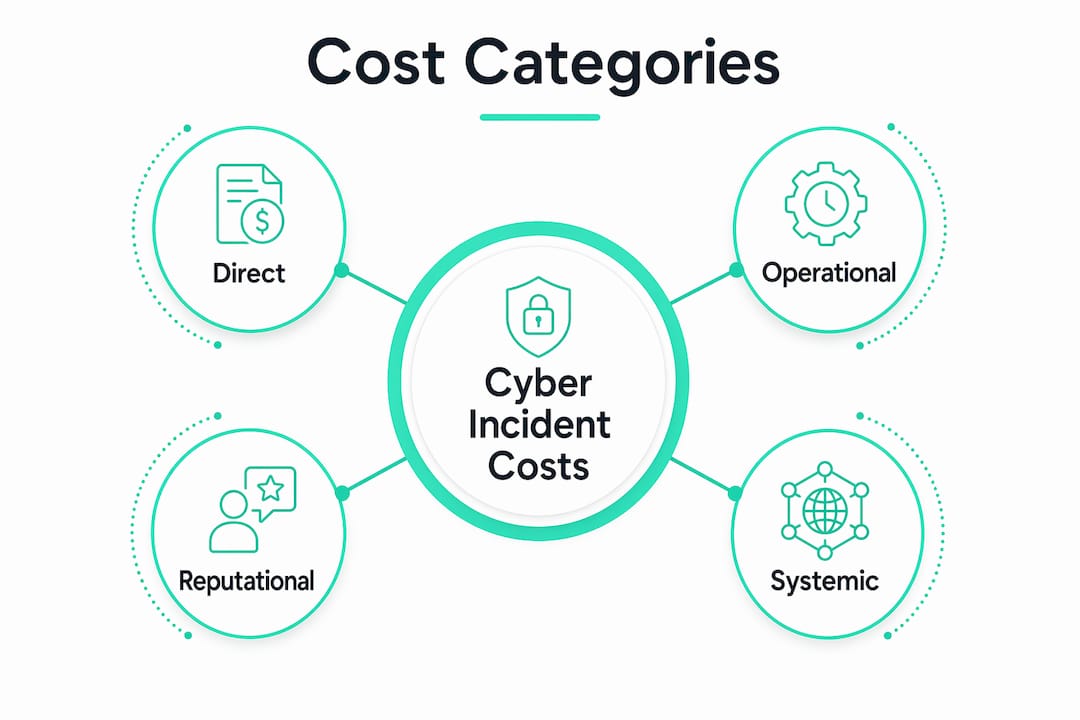
Pro Tip: When building your cyber risk register, map costs against all four categories before presenting to the board. A figure that only captures IT remediation will systematically understate your true exposure and weaken the case for adequate security investment.
How significant is the financial impact of cyber incidents?
The scale of losses documented in recent research should reframe how you think about cybersecurity as a line item.

| Metric | Figure | Source context |
|---|---|---|
| Average UK cost per significant incident | £195,000 | UK government independent research, November 2025 |
| Estimated annual UK national cost | £14.7 billion | Aggregate of incident-level costs across the economy |
| Global annual cyber risk cost estimate | Above $200 billion | Springer Nature literature review, August 2025 |
| Share price underperformance post-incident | Approximately 5% | ISS STOXX / ISS-Corporate study, Russell 3000 firms |
| Hypothetical UK rail network disruption (one week) | £1.8 billion | UK government systemic scenario modelling |
The £195,000 average is a useful benchmark, but it conceals the distribution. A mid-market manufacturer hit by ransomware may face costs several multiples higher once you account for production downtime, supply chain penalties, and the legal costs of notifying affected customers. The average flattens these extremes.
Global cyber risk costs exceed $200 billion annually, yet this figure is widely acknowledged as an underestimate. Intangible losses, including reputational harm, service disruption, and erosion of customer trust, resist precise measurement and are frequently excluded from published estimates.
The systemic dimension is equally striking. A hypothetical attack on the UK rail network could cost £1.8 billion in a single week, combining direct Network Rail costs with broader economic output losses. This is not a worst-case fantasy. It is a plausible scenario that financial planners in critical infrastructure sectors must model explicitly.
Share price effects deserve particular attention from investor relations teams. Significant cyber incidents cause sustained underperformance averaging nearly 5%, peaking at minus 4.9% after 250 trading days. Finance and healthcare sectors experience the sharpest declines. This is not a short-term market overreaction that corrects itself. It is a multi-quarter drag that compounds the direct cost of the incident itself.
What makes measuring cyber incident costs so difficult?
Quantifying the financial consequences of cyber incidents is genuinely complex, and the difficulty is not merely technical. It is structural.
Direct costs, such as forensic investigation fees and regulatory fines, are measurable within weeks of an incident. Indirect costs are not. Customer churn driven by reputational damage may not fully materialise for six to twelve months. Supply chain partners may raise contract terms or exit relationships entirely, and those effects appear in revenue figures long after the incident is closed.
Sector variability adds further complexity. A ransomware attack on a logistics firm produces different cost profiles than the same attack on a law firm or a hospital. Recovery timelines for extreme cyber risks range from two to three weeks or more, with loss estimates varying widely by sector and attack type. A single benchmark figure applied across industries produces misleading risk assessments.
Intangible factors compound the measurement problem. Total economic impact is hard to quantify due to reputational harm and service disruption, which resist standard accounting treatment. Trust erosion, in particular, is asymmetric: it takes years to build and can be destroyed in days.
Scenario modelling addresses these limitations more effectively than average-case benchmarks alone. By constructing plausible extreme-event scenarios, including supply chain cascades and prolonged operational outages, financial teams can stress-test their assumptions and identify gaps in coverage or reserves. This is the approach recommended by actuarial frameworks and increasingly adopted by sophisticated risk functions.
Pro Tip: Do not rely solely on published average breach costs for your risk register. Pair them with sector-specific scenario models that account for your organisation's recovery timeline, customer concentration, and regulatory exposure. The gap between the average and your realistic worst case is where your financial planning needs to focus.
How should business leaders use this data for financial planning?
Understanding the financial consequences of cyber incidents is only useful if it changes how you plan and allocate resources. Here is a structured approach for financial decision-makers.
-
Establish your baseline using published benchmarks. The global average breach cost of $4.4 million provides a calibration point for risk registers and business cases. Use it as a floor, not a ceiling.
-
Build sector-specific scenario models. Work with your risk function to model at least two scenarios: a contained incident affecting internal systems only, and a systemic incident with supply chain and reputational consequences. The difference in cost between these two scenarios defines your financial exposure range.
-
Incorporate cyber risk into capital planning and earnings guidance. Investors price cybersecurity risk, causing not only immediate valuation drops at disclosure but also sustained underperformance. CFOs who treat cyber risk as a technical footnote rather than a capital planning variable are leaving material risk unaddressed in their financial communications.
-
Allocate budget across all four cost categories. Direct remediation spending is necessary but insufficient. Budget lines for reputational recovery, customer retention programmes, legal support, and systemic risk mitigation reflect a complete understanding of the cost structure. An incident response readiness assessment provides a structured framework for identifying gaps before an incident occurs.
-
Engage cross-functional teams in cyber risk governance. Finance, legal, operations, and communications all carry responsibilities during and after a cyber incident. A governance structure that routes all cyber risk decisions through IT alone will produce blind spots in financial planning. The CFO's office should own the financial impact model, with IT providing technical inputs.
-
Communicate transparently with boards and investors. Cybersecurity vulnerabilities act as a drag on stock performance and are increasingly recognised by financial markets as a significant risk factor. Boards that receive clear, quantified cyber risk briefings are better positioned to approve appropriate investment and to respond credibly to investor questions post-incident.
Key takeaways
Cyber incident financial impact extends far beyond IT remediation costs and must be treated as a multi-quarter profitability and valuation risk by every financial decision-maker.
| Point | Details |
|---|---|
| Four cost categories matter | Direct, operational, reputational, and systemic costs must all be budgeted, not just IT remediation. |
| Scale is larger than most budgets reflect | UK organisations face an average of £195,000 per significant incident, with national costs reaching £14.7 billion annually. |
| Share price effects are sustained | Post-incident underperformance averages nearly 5% and persists for over a year, making cyber risk a capital planning issue. |
| Averages understate your exposure | Pair global benchmarks with sector-specific scenario models to capture realistic worst-case financial losses. |
| CFOs must lead on cyber risk | Finance teams should own the financial impact model and communicate cyber risk transparently to boards and investors. |
Makkari's view on cyber risk and financial leadership
The most persistent gap I see in organisations is not a lack of cybersecurity tools. It is a lack of financial ownership over cyber risk. The conversation still defaults to the IT director when a breach occurs, and the CFO is brought in after the fact to approve emergency spending. That sequence is backwards.
Cyber incidents are multi-quarter profitability events. The share price data makes this unambiguous: a sustained 5% underperformance lasting over a year is not an IT problem. It is an investor relations problem, a capital allocation problem, and a strategic communications problem. CFOs who wait for the breach to engage with these questions will always be responding rather than managing.
The other misunderstanding I encounter regularly is the belief that cyber risk is primarily about the probability of an attack. It is not. It is about the financial consequence of an attack relative to your organisation's resilience. Two organisations with identical threat exposure can face wildly different financial outcomes depending on their preparation, their response capability, and the quality of their forensic and legal support. That gap is where financial planning makes the difference.
Scenario modelling is the tool that closes this gap. Organisations that have stress-tested a systemic incident scenario, including supply chain cascades and prolonged downtime, are the ones that respond with clarity and speed when an actual incident occurs. Those that have not are the ones that discover their financial exposure in real time, under pressure, with the clock running.
— Makkari
How Makkarisecurity helps you limit the financial damage
Makkarisecurity specialises in Digital Forensics and Incident Response, and the work we do directly reduces the financial consequences of cyber incidents for organisations across the UK, Gibraltar, and Europe.
Our incident response and forensics services are built around speed and accuracy, using a proprietary forensic engine developed over five years to deliver live memory capture and cross-verified results. Faster containment means shorter downtime, lower operational losses, and stronger evidence for regulatory and legal proceedings. We also provide breach counsel and panel support to help organisations manage the legal and financial navigation that follows a significant incident. For organisations that want to reduce their exposure before an attack occurs, our IR retainer service provides pre-agreed response terms, priority access, and defined cost structures. The Eviction Pledge guarantees that once a threat actor is evicted, they will not return for a minimum of 60 days, or you will not be charged.
FAQ
What is cyber incident financial impact?
Cyber incident financial impact is the total economic cost an organisation incurs following a cyberattack, including direct remediation costs, regulatory fines, operational downtime, reputational damage, and sustained share price decline. In the UK, the average cost per significant incident is nearly £195,000.
What are the biggest cost drivers after a cyber attack?
The largest cost drivers are operational downtime, regulatory fines, legal fees, and reputational damage leading to customer churn. Systemic incidents that disrupt supply chains or critical infrastructure can produce costs far exceeding the direct internal response expenses.
How long do the financial effects of a cyber incident last?
Research on Russell 3000 firms shows that share price underperformance following a significant cyber incident peaks at minus 4.9% after 250 trading days, meaning the financial drag extends well beyond a year after the event.
How should CFOs approach cyber incident financial risk assessment?
CFOs should combine published benchmarks, such as the global average breach cost of $4.4 million, with sector-specific scenario models that capture extreme but plausible events. Cyber risk should be integrated into capital planning, earnings guidance, and board-level financial communications.
Does cyber insurance cover all these financial impacts?
Cyber insurance covers a defined subset of direct costs, typically including forensic investigation, legal notification, and some business interruption losses. Reputational damage, long-term customer churn, and sustained share price underperformance generally fall outside standard policy coverage, which is why pre-incident resilience investment and rapid response capability remain financially critical.