
TL;DR:
- Cyber incident scope determination involves identifying all affected systems, data, and timeframes to guide effective response and containment. Accurate scoping prevents resource wastage and regulatory non-compliance by ensuring investigations expand as new evidence emerges and legal considerations are integrated. Centralised evidence collection, iterative analysis, and early legal involvement enable organizations to produce defensible, comprehensive scope documentation throughout incident response.
Cyber incident scope determination is the process of identifying every system, user, dataset, and timeframe affected by a security breach, forming the foundation on which all containment and remediation decisions rest. Without a precise scope, response teams either over-invest resources chasing phantom compromises or, more dangerously, under-invest and leave active threats in place. NIST SP 800-61 Rev. 3 establishes evidence collection from logs and telemetry as the primary mechanism for confirming indicators of compromise (IOCs) and establishing incident severity. The industry term for this discipline is incident scoping, and it sits at the intersection of technical forensics, legal obligation, and organisational risk management.
What is cyber incident scope determination and why does it matter?
Incident scoping is defined as the structured assessment of which assets, data, and identities a threat actor has accessed, modified, or exfiltrated during a breach. Incorrect scoping leads directly to incomplete remediation, wasted resources, and potential regulatory and reputational harm. Those two outcomes represent the full cost of getting scope wrong: you either miss the attacker or you burn budget chasing a ghost.
The scope of cyber incidents determines notification obligations, containment priorities, and recovery sequencing. A ransomware event confined to a single business unit carries different legal and operational weight than one that has traversed domain controllers and reached backup infrastructure. Defining incident scope accurately is therefore not a technical nicety. It is a governance requirement.
NIST CSF 2.0 frames scope within organisational risk management rather than as an isolated technical symptom. This means scope decisions must align with the organisation's risk tolerance, not just the technical evidence available at any given moment. Embedding incident response in enterprise risk management ensures that scope boundaries reflect business impact, not just network topology.
What technical evidence is used to determine the scope of a cyber incident?
Technical evidence is the raw material of cyber incident assessment. Collection methods include system logs, network traffic captures, endpoint telemetry, threat intelligence feeds, and user-submitted reports. Each source contributes a different layer of visibility, and no single source is sufficient on its own.
The primary evidence categories used in incident response scope analysis are:
- System logs: Authentication events, process execution records, and file access logs establish a timeline of attacker activity and identify compromised accounts.
- Network traffic: Packet captures and flow data reveal lateral movement paths, command-and-control (C2) communications, and data exfiltration volumes.
- Endpoint telemetry: EDR platforms such as CrowdStrike Falcon or Microsoft Defender for Endpoint surface process injection, persistence mechanisms, and privilege escalation events.
- Threat intelligence: IOC feeds from sources such as MISP or commercial providers correlate observed artefacts with known threat actor tooling.
- User reports: Anomalous behaviour reported by staff often surfaces compromises that automated tooling misses, particularly in social engineering scenarios.
Evidence sprawl is a significant challenge requiring centralised forensic platforms to maintain scope accuracy. When logs sit in isolated silos across cloud providers, on-premises infrastructure, and SaaS applications, building a coherent picture of compromise becomes exponentially harder. Centralising telemetry into a SIEM such as Splunk or Microsoft Sentinel before an incident occurs is the single most effective preparation an IR team can make.
Pro Tip: When collecting evidence for scope determination, prioritise volatile data first. Live memory captures contain artefacts, including in-memory malware and active network connections, that disappear the moment a system is rebooted. Techniques such as cloud forensics and file carving extend this principle to distributed and deleted data sources.

Key metrics for defining the operational perimeter include the number of unique compromised records, data classification levels, duration of unauthorised access, and the extent of lateral movement to command-and-control endpoints. These metrics translate technical findings into the language that legal teams, insurers, and regulators require.
How does the scope determination process evolve during incident response?
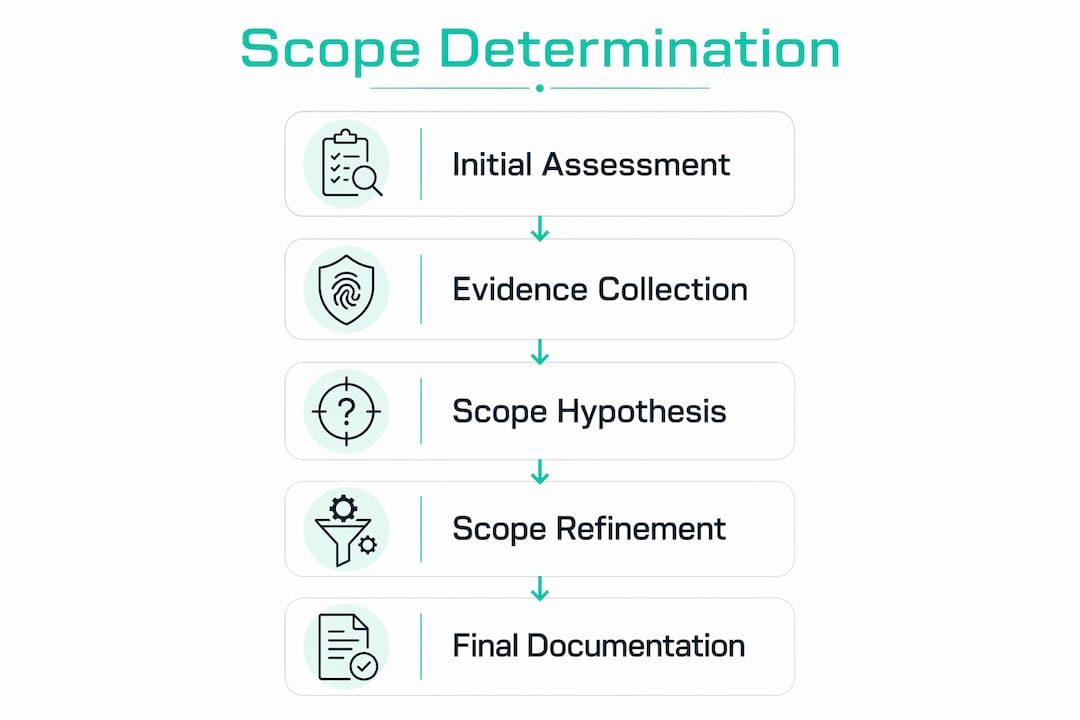
Incident scoping is not a one-time assessment. It is an iterative control that expands as lateral movement and additional evidence surface during investigation. Practitioners treat initial scope as a containment hypothesis, not a final conclusion. This distinction matters operationally: acting on an unverified scope as though it were definitive is one of the most common causes of failed eradication.
The evolution of scope typically follows this sequence:
- Initial detection: Alerts from SIEM, EDR, or user reports generate a first hypothesis. Containment actions such as network segmentation or account suspension are applied to the suspected blast radius.
- Evidence collection: Forensic acquisition of logs, memory, and disk images begins. The scope hypothesis is tested against collected artefacts.
- Lateral movement analysis: Investigators trace attacker pivots across the network using network forensics outputs, expanding scope to include every system the attacker touched.
- Scope revision: New findings trigger formal scope updates. Containment boundaries are adjusted, and legal teams are notified of material changes.
- Eradication and validation: Remediation actions are applied across the confirmed scope. Post-eradication validation confirms no residual access paths remain.
West Pharmaceutical Services' 2026 incident filing illustrates this process in practice. West Pharma's 8-K filing shows initial detection followed by ongoing scope refinement during remediation, with the confirmed scope expanding materially beyond the first alerts as the investigation progressed. This is the norm, not the exception.
"Initial scope is a working hypothesis. Every IR team should treat their first scope boundary as a starting point for investigation, not a conclusion."
Documentation of scope evolution is as important as the investigation itself. Every scope change must be recorded with the evidence that prompted it, the decision-maker who authorised it, and the timestamp. This contemporaneous record becomes the primary defence in regulatory reviews and insurer disputes.
What organisational and legal factors influence scope determination?
Legal teams directly influence real-time scoping decisions. Cyber counsel co-leads incident definition to ensure that scope boundaries align with notification timelines and regulatory frameworks such as the UK GDPR, NIS2, and sector-specific obligations under FCA or ICO guidance. A scope that is technically accurate but legally unexamined can still trigger notification failures.
The organisational factors that shape scope decisions include:
- Risk tolerance: Scope boundaries must reflect what the organisation can defend as proportionate to the confirmed threat, not just what is technically observable.
- Regulatory obligations: UK GDPR Article 33 requires notification to the ICO within 72 hours of becoming aware of a personal data breach. Scope directly determines whether that threshold is met.
- Insurer requirements: Cyber insurers require defensible scope documentation to process claims. Contemporaneous records of what evidence founded scope decisions reduce disputes and accelerate claim resolution.
- Public relations strategy: The scope communicated externally must be consistent with the scope documented internally. Discrepancies create reputational and legal exposure.
Pro Tip: Engage legal counsel before the investigation concludes, not after. Early legal involvement, supported by an incident response retainer, means scope decisions are made with notification obligations in mind from the outset, reducing the risk of a second, corrective disclosure.
| Factor | Impact on scope determination |
|---|---|
| UK GDPR / NIS2 | Defines notification thresholds tied directly to confirmed scope of personal data exposure |
| Cyber insurance | Requires documented, evidence-backed scope to validate claims and avoid coverage disputes |
| Legal counsel | Shapes scope communication to regulators and affected parties, reducing liability exposure |
| Board risk appetite | Sets the threshold at which scope triggers escalation to executive or public disclosure |
How do key frameworks compare for incident scope determination?
Several frameworks provide structured guidance on defining incident scope, each with different strengths depending on organisational maturity and sector.
| Framework | Scope guidance | Strengths | Limitations |
|---|---|---|---|
| NIST SP 800-61 Rev. 3 | Evidence-based IOC confirmation and severity classification | Detailed, technically grounded, widely adopted | Requires significant forensic capability to apply fully |
| NIST CSF 2.0 | Scope within enterprise risk management context | Aligns scope to business risk, not just technical symptoms | Less prescriptive on technical evidence collection |
| Cyber Essentials | Asset-based scope definition for certification boundaries | Simple, accessible for smaller organisations | Not designed for active incident response scenarios |
| ISO/IEC 27035 | Structured incident management lifecycle including scope | International standard, integrates with broader ISMS | High implementation overhead, less operationally agile |
NIST SP 800-61 Rev. 3 remains the most operationally useful reference for IR teams conducting active scope determination. Its evidence-first approach, combined with the risk management framing of CSF 2.0, provides the most defensible methodology for organisations operating under UK and European regulatory regimes. Cyber Essentials scope definitions are useful for pre-incident asset boundary mapping but do not translate directly into active incident response procedures.
How to apply incident scope determination in IR operations
Effective scope determination in live operations requires coordination across technical, legal, and communications functions from the first alert. The following steps reflect current best practice for IR teams:
- Set an initial scope boundary based on the first available alerts, log anomalies, and affected asset inventory. Document this as a hypothesis with a timestamp and the evidence that supports it.
- Assign a scope owner within the IR team. This person is responsible for maintaining the scope record, communicating changes to legal and leadership, and ensuring containment actions match the current confirmed scope.
- Centralise telemetry from endpoints, network devices, cloud platforms, and identity providers into a single investigation environment. Fragmented data sources are the primary cause of scope underestimation.
- Conduct lateral movement analysis as a mandatory step before declaring scope stable. Attackers routinely establish persistence on systems outside the initial blast radius.
- Validate scope before eradication. Removing attacker access from a partial scope leaves residual footholds that enable re-entry within days.
Pro Tip: Quantify scope in terms regulators and insurers understand: number of affected records, data classification, duration of access, and systems involved. Technical scope expressed only in IP addresses or hostnames is not sufficient for a defensible regulatory submission. Expert witness support, such as that provided by forensic specialists, can translate technical findings into legally admissible scope narratives.
Embedding incident response within enterprise risk management ensures that scope decisions are made with full awareness of business impact, not just technical exposure. This alignment is what separates organisations that recover cleanly from those that face secondary regulatory action after the technical incident is resolved.
Key takeaways
Accurate cyber incident scope determination requires iterative evidence analysis, legal integration, and contemporaneous documentation to produce defensible, operationally sound decisions.
| Point | Details |
|---|---|
| Scope is a hypothesis first | Treat initial scope as a working boundary to be tested and expanded as evidence emerges. |
| Evidence centralisation is critical | Fragmented telemetry across silos is the leading cause of scope underestimation in complex environments. |
| Legal counsel shapes scope early | Engaging legal teams from the first alert aligns scope decisions with notification obligations and reduces liability. |
| Documentation defends decisions | Contemporaneous records of scope changes with supporting evidence are the primary defence in insurer and regulatory disputes. |
| Frameworks complement each other | NIST SP 800-61 Rev. 3 and CSF 2.0 used together provide the most defensible technical and risk-aligned scoping methodology. |
Scope determination in practice: what two decades of IR teaches you
After years of responding to breaches across financial services, critical infrastructure, and professional services firms, the pattern that causes the most damage is not the attacker's sophistication. It is the IR team's reluctance to expand scope when new evidence demands it.
Organisations under pressure to contain costs and minimise disruption often anchor to the initial scope hypothesis long after the evidence has moved on. A single compromised endpoint becomes the official narrative, while the attacker has already pivoted to the domain controller and exfiltrated data from a cloud storage bucket that nobody thought to check. The technical investigation and the business response end up describing two different incidents.
The other consistent failure is treating scope determination as a purely technical exercise. Legal involvement is not a bureaucratic step that happens after the forensics are done. It is a live input that shapes which systems you prioritise, which notifications you prepare, and how you document decisions in real time. Organisations that bring legal counsel in early consistently produce more defensible scope records and face fewer secondary disputes with insurers and regulators.
The tools are improving. SIEM platforms, EDR solutions, and forensic engines now surface lateral movement and data exfiltration with far greater fidelity than five years ago. But the discipline of scope management, the willingness to revise, document, and defend a scope boundary as the investigation unfolds, remains a human skill. No platform automates that judgement.
— Makkari
How Makkarisecurity supports defensible scope determination
Accurate scope determination requires more than good tools. It requires forensic rigour, legal alignment, and the experience to know when the evidence demands a boundary revision.
Makkarisecurity's breach counsel and panel support service combines court-admissible digital forensics with direct legal coordination, producing scope documentation that holds up under ICO, insurer, and litigation scrutiny. Our proprietary forensic engine delivers live memory capture and cross-verified results, reducing the evidence gaps that cause scope underestimation. The Eviction Pledge guarantees that once a threat actor is removed, they will not return for a minimum of 60 days, or you will not be charged. Explore our full incident response capabilities to understand how we support scope determination from first alert to final report.
FAQ
What is incident scope in cybersecurity?
Incident scope defines the full extent of systems, data, users, and timeframes affected by a security breach. It is determined through evidence analysis including logs, network telemetry, and endpoint data, and is refined iteratively as the investigation progresses.
How do you determine the scope of a cyber incident?
Scope is determined by collecting and analysing system logs, network traffic, endpoint telemetry, and threat intelligence to confirm IOCs and map lateral movement. NIST SP 800-61 Rev. 3 provides the primary evidence-based methodology for this process.
Why does incorrect scoping cause regulatory problems?
Incorrect scoping produces inaccurate notification submissions to regulators such as the ICO, which can constitute a breach of UK GDPR Article 33 obligations. It also creates discrepancies between internal records and external disclosures, increasing legal and reputational exposure.
When should legal counsel be involved in scope determination?
Legal counsel should be engaged from the first alert, not after the technical investigation concludes. Early involvement ensures scope decisions align with notification timelines and that documentation is structured to withstand regulatory and insurer scrutiny.
What documentation is required for defensible incident scope?
Every scope decision must be recorded with the supporting evidence, the decision-maker, and a timestamp. Contemporaneous documentation of scope changes is the primary mechanism for defending decisions during insurer claims and regulatory reviews.