
TL;DR:
- An incident response triage workflow is a repeatable process security teams use to assess, prioritize, and escalate alerts during a cybersecurity incident.
- Effective workflows reduce detection and containment times by mapping signals to severity, ownership, and action, supported by key tools and data.
An incident response triage workflow is the repeatable process security teams use to intake, validate, prioritise, and escalate alerts during a cybersecurity incident. Known formally within Digital Forensics and Incident Response (DFIR) as the triage process, it maps observable signals to priority, ownership, and remediation, reducing mean time to detect by engaging the correct responders within minutes. A well-designed workflow cuts both Mean Time to Detect (MTTD) and Mean Time to Contain (MTTC), which are the two metrics that determine how much damage a breach actually causes. Tools such as SIEM, SOAR, and EDR platforms feed the workflow with raw signal data, while severity tiers from SEV0 through SEV4 give analysts a shared language for urgency. Regulatory pressure, including SEC disclosure deadlines, makes structured triage a legal requirement as much as an operational one.
What are the core phases of an incident response triage workflow?
A structured triage process follows five sequential phases: detection and ingestion, severity evaluation, scope assessment, escalation, and initial documentation. Each phase has a defined input, a decision gate, and a clear output. Skipping any phase creates gaps that attackers exploit and auditors flag.

Phase 1: Detection and ingestion
Detection is the entry point. Alerts arrive from SIEM platforms such as Microsoft Sentinel or Splunk, EDR tools, identity providers, and network monitoring systems. The analyst's first task is to validate that the alert represents a real signal, not a misconfigured rule or a known benign pattern.
Phase 2: Severity evaluation
Severity evaluation assigns a tier from SEV0 to SEV4 based on defined criteria. SEV0 means critical and immediate: a confirmed ransomware deployment or active data exfiltration. SEV4 means low impact: a single failed login from a known user. The tier determines response speed, resource allocation, and whether executive notification is required.
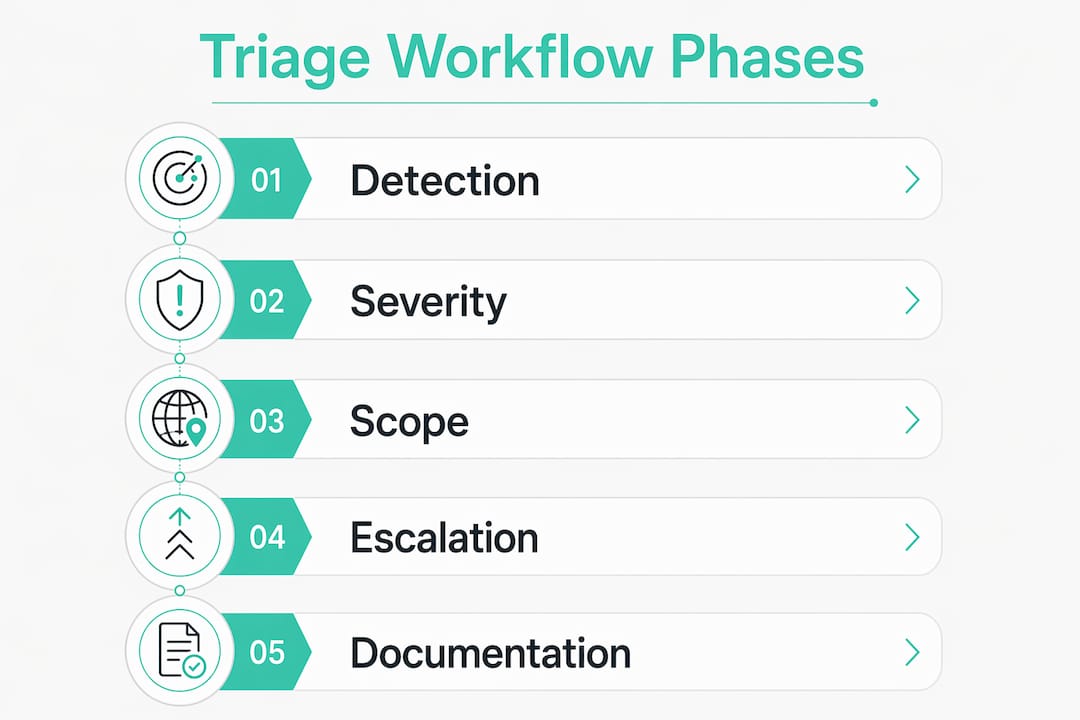
Phase 3: Scope assessment
Scope assessment answers how far the incident has spread. Analysts check which assets are affected, whether lateral movement has occurred, and what data is at risk. Defining incident scope early prevents under-resourcing a contained event and over-resourcing a minor one.
Phase 4: Escalation
Escalation routes the incident to the right team with the right context. A SEV0 event triggers the full incident response team, legal counsel, and executive leadership. A SEV3 event may stay with the on-call analyst. Clear escalation paths prevent the common failure of a critical incident sitting in a queue because no one owned the decision.
Phase 5: Initial documentation
Documentation during triage is not administrative overhead. It creates the chain of custody, supports regulatory reporting, and feeds the post-incident review. Every action taken and every decision made must be logged with a timestamp and a rationale.
| Phase | Goal | Output |
|---|---|---|
| Detection and ingestion | Validate signal as real or benign | Confirmed alert or closed ticket |
| Severity evaluation | Assign SEV0–SEV4 tier | Severity classification |
| Scope assessment | Determine blast radius | Affected asset list |
| Escalation | Route to correct responders | Assigned incident owner |
| Initial documentation | Record actions and rationale | Triage log entry |
Which tools and contextual data improve triage accuracy?
Triage accuracy depends on the quality of contextual data available at the moment of decision. An alert without context is just noise. An alert enriched with asset criticality, business owner, user role, and geographic location becomes a decision.
The following tools and data types form the foundation of a modern triage workflow:
- SIEM platforms (Microsoft Sentinel, Splunk, IBM QRadar): aggregate and correlate log data across the environment
- EDR tools (CrowdStrike Falcon, SentinelOne, Microsoft Defender for Endpoint): provide endpoint telemetry and process-level visibility
- SOAR platforms (Palo Alto XSOAR, Splunk SOAR): automate enrichment, run playbooks, and standardise containment steps
- Identity and access management alerts: flag anomalous authentication, privilege escalation, and lateral movement
- Threat intelligence feeds: add external context such as known malicious IPs, indicators of compromise, and actor TTPs
- Asset criticality registers: tell analysts whether the affected system is a production database or a test workstation
- Change management data: confirm whether unusual activity aligns with a planned maintenance window
SOAR platforms reduce the manual enrichment burden significantly. When a SOAR playbook automatically pulls asset ownership, checks the IP against threat intelligence, and confirms no change ticket exists, the analyst receives a pre-enriched case rather than a raw alert. That shift cuts triage time from minutes to seconds on routine events.
Pro Tip: Tune your SIEM rules quarterly. Alert fatigue is not a volume problem. It is a precision problem. Every false positive that reaches an analyst erodes trust in the tooling and slows genuine threat response.
How to implement best practices and avoid common triage pitfalls
The single most damaging triage mistake is treating all alerts as high severity. Alert fatigue from over-escalation desensitises teams and causes genuine SEV0 events to receive the same dulled response as routine noise. The fix is a business-impact severity matrix that scores incidents on operational disruption, data sensitivity, regulatory exposure, and reputational risk, not technical indicators alone.
The following practices define high-performing triage teams:
- Use a business-impact severity matrix. Score every incident on business risk, not just technical severity. A misconfigured firewall rule on a non-critical server is not a SEV1, even if it looks alarming in isolation.
- Keep workflows simple. Incident response plans that are crystal clear to follow under pressure outperform complex frameworks that analysts abandon mid-breach. One page of decision logic beats a 40-page policy document.
- Log decisions, not just actions. Record why you classified an event as SEV2 rather than SEV1. That rationale is what regulators, legal teams, and post-incident reviewers need. Actions without reasoning are incomplete records.
- Run tabletop exercises regularly. Documentation alone does not prepare teams. Non-technical drills that simulate real breach conditions expose gaps in escalation paths and communication chains before a real incident does.
- Coordinate with change management. Checking triage items against planned maintenance schedules prevents unnecessary escalations triggered by authorised activity. A patch deployment at 02:00 looks identical to a threat actor moving laterally if no one checks the change log.
- Audit benign closures. False negatives in triage are more dangerous than false positives. An alert dismissed as benign that was actually an early intrusion sign is a silent exposure. Review closed-as-benign tickets weekly to catch patterns that individual analysts miss.
Pro Tip: Coordinate with your change management team before every major maintenance window. Brief your SOC analysts on what activity to expect. This single habit eliminates a significant proportion of unnecessary escalations and preserves analyst attention for genuine threats.
The incident response readiness assessment is a practical tool for validating whether your current workflow holds up under realistic conditions. Run it before a real incident forces the test.
How do regulations affect triage documentation and escalation?
Regulatory requirements now directly shape how triage workflows are designed, not just how incidents are reported after the fact. SEC rules require disclosure of material cybersecurity incidents within four business days. That deadline starts from the moment an incident is determined to be material, which means the triage phase must include a materiality assessment trigger.
For publicly traded companies, the triage workflow must answer a specific question at the severity evaluation phase: does this incident meet the threshold for material business impact? If the answer is yes or uncertain, the escalation path must include legal counsel and the executive team, not just the security operations centre.
The practical implication is that triage documentation must be court-ready from the first log entry. Timestamps, decision rationale, and chain-of-custody records are not optional extras. They are the evidence that demonstrates compliance with disclosure obligations.
| Regulation | Disclosure trigger | Timeline | Documentation requirement |
|---|---|---|---|
| SEC cybersecurity rules | Material incident determination | 4 business days | Board-level disclosure, Form 8-K |
| UK GDPR / Data Protection Act 2018 | Personal data breach | 72 hours to ICO | Nature, scope, and remediation steps |
| NIS2 Directive (EU) | Significant incident affecting essential services | 24 hours initial, 72 hours full report | Impact assessment, affected systems |
| PCI DSS | Cardholder data compromise | Immediate notification to card brands | Forensic investigation records |
The NIS2 Directive, which came into full effect across EU member states, adds particular pressure for organisations operating in critical infrastructure sectors. A triage workflow that cannot produce a structured incident report within 24 hours of detection is non-compliant by design.
Key takeaways
A high-performing incident response triage workflow requires five sequential phases, a business-impact severity matrix, decision logging, and regulatory disclosure triggers built into the escalation path.
| Point | Details |
|---|---|
| Five core phases | Detection, severity evaluation, scope assessment, escalation, and documentation must run in sequence. |
| Business-impact severity matrix | Score incidents on operational and regulatory risk, not technical indicators alone, to prevent alert fatigue. |
| Decision logging | Record the rationale behind every classification to support post-incident reviews and regulatory inquiries. |
| Regulatory integration | Build materiality assessment and disclosure triggers into the escalation phase for SEC, UK GDPR, and NIS2 compliance. |
| Continuous improvement | Audit benign closures weekly and run tabletop exercises regularly to catch gaps before a real breach does. |
Triage is uncertainty management, not queue management
The teams I see struggle most with triage treat it as a ticket-sorting exercise. They measure success by how fast alerts move through the queue. The teams that perform best treat it as what it actually is: structured uncertainty management under time pressure, where every decision carries downstream consequences.
The decision log is the most undervalued artefact in incident response. Analysts focus on containment actions, which is correct, but the reasoning behind those actions is what makes post-incident reviews genuinely useful. When you can reconstruct not just what happened but why each decision was made, you identify the exact point where the workflow needs improvement.
False negatives concern me more than false positives. A false positive wastes an hour. A false negative gives a threat actor days or weeks of undetected access. Regular audits of benign closures are not a nice-to-have. They are the mechanism by which your detection capability actually improves over time.
The workflows that hold up under real breach conditions share one characteristic: simplicity. Not because the problems are simple, but because analysts under pressure revert to what they can execute without thinking. A clear, one-page decision tree beats a comprehensive policy document that no one reads during an active incident.
— Makkari
How Makkarisecurity supports your triage capability
Makkarisecurity specialises in Digital Forensics and Incident Response across the UK, Gibraltar, and Europe. When a breach is active, the team deploys a proprietary forensic engine that delivers live memory capture and cross-verified results, giving your triage team accurate scope data within hours rather than days.
The incident response and DFIR services include retainer arrangements that place expert analysts on standby before an incident occurs, so your triage workflow has immediate specialist support when severity escalates. Makkarisecurity also provides breach counsel and forensic support for organisations facing regulatory disclosure obligations, ensuring that triage documentation meets the evidentiary standards required by the SEC, ICO, and NIS2 frameworks. The Eviction Pledge guarantees that once a threat actor is removed, they will not return for a minimum of 60 days, or the engagement is provided at no charge.
FAQ
What is an incident response triage workflow?
An incident response triage workflow is a repeatable decision process that maps security alerts to priority, ownership, and remediation steps. It covers five phases: detection, severity evaluation, scope assessment, escalation, and initial documentation.
What severity levels are used in triage?
Standard triage frameworks use SEV0 through SEV4. SEV0 represents a critical, active threat requiring immediate action, while SEV4 represents low-impact events that can be addressed during normal working hours.
How does triage differ from full incident response?
Triage is the front-end classification and routing process. Full incident response covers containment, eradication, recovery, and post-incident review. Triage feeds the right information to the right responders so the full response can begin without delay.
Why do regulations affect the triage process?
Regulations such as SEC cybersecurity rules and UK GDPR impose strict disclosure deadlines from the point of incident determination. Triage must include a materiality assessment trigger so that legal and executive escalation begins within the required timeframe.
How do you reduce alert fatigue in triage workflows?
Use a business-impact severity matrix rather than technical severity alone, and tune SIEM rules regularly to reduce false positives. Prioritising alerts by business impact prevents teams from treating every alert as critical and preserves analyst focus for genuine threats.