
TL;DR:
- Incident response scope establishes the full operational boundary, including event types, authority, teams, and regulatory obligations. It spans the entire lifecycle from preparation to post-incident review and must be regularly updated based on real incidents and organizational changes. Clear scope ensures coordinated responses, accurate evidence preservation, and timely legal and regulatory notifications during security breaches.
Incident response scope is defined as the complete set of parameters that specify which security events are covered, who holds authority to act, which lifecycle phases are included, and what regulatory obligations apply. Scope also defines involved teams, communication workflows, and evidence preservation for an operational response. Without a precisely drawn scope, your incident response plan is a document rather than an operational system. This guide breaks down every component of incident response scope, from event classification to post-incident review, so you can build a programme that functions under real pressure.
What is incident response scope and what does it include?
Incident response scope is the governing boundary of your entire response programme. It answers four foundational questions before an incident ever occurs: what events trigger a formal response, who has the authority to declare and manage that response, which teams and external parties are involved, and what obligations must be fulfilled. Getting this right is the difference between a coordinated response and an improvised one.
The components of a well-defined scope fall into several distinct categories:
- Event and incident classification. Scope must distinguish between a security event (any observable occurrence) and a confirmed incident (an event with verified adverse impact). This classification threshold determines when legal preservation workflows and regulatory notifications begin.
- Decision authority and escalation paths. Scope names who can declare an incident, who can authorise containment actions such as isolating a server, and who escalates to executive leadership or legal counsel.
- Teams in scope. A complete scope names IT security, legal, PR, HR, and any external vendors or specialist firms. Leaving a team undefined means they receive no notification and take no coordinated action.
- Regulatory and notification obligations. UK GDPR requires notification within 72 hours, and NIS2 requires an early warning within 24 hours. Scope must enumerate which jurisdictions apply and what the specific timelines are.
- Communication workflows. Scope defines who communicates with whom, through which channels, and in what sequence. This matters especially when primary communication tools such as email are compromised.
- Evidence preservation. Scope specifies when and how evidence collection begins, who maintains chain-of-custody, and what documentation standards apply.
Pro Tip: Write your event classification threshold as a single, testable sentence. If your team cannot agree whether a given event crosses the threshold within 60 seconds, the definition is too vague.
A scope that omits any of these elements creates gaps that threat actors and legal disputes will exploit. Treat each component as a mandatory field, not an optional addition.

How does incident response scope align with the standard lifecycle?
Incident response scope does not cover a single phase. It spans the entire lifecycle from preparation through to post-incident review. NIST's incident response lifecycle organises this into four phases: Preparation, Detection and Analysis, Containment/Eradication/Recovery, and Post-Incident Activity. ISO 27035 uses a comparable structure with Prepare, Detect and Report, Assess and Decide, Respond, and Lessons Learned. Both frameworks confirm that scope must be end-to-end.
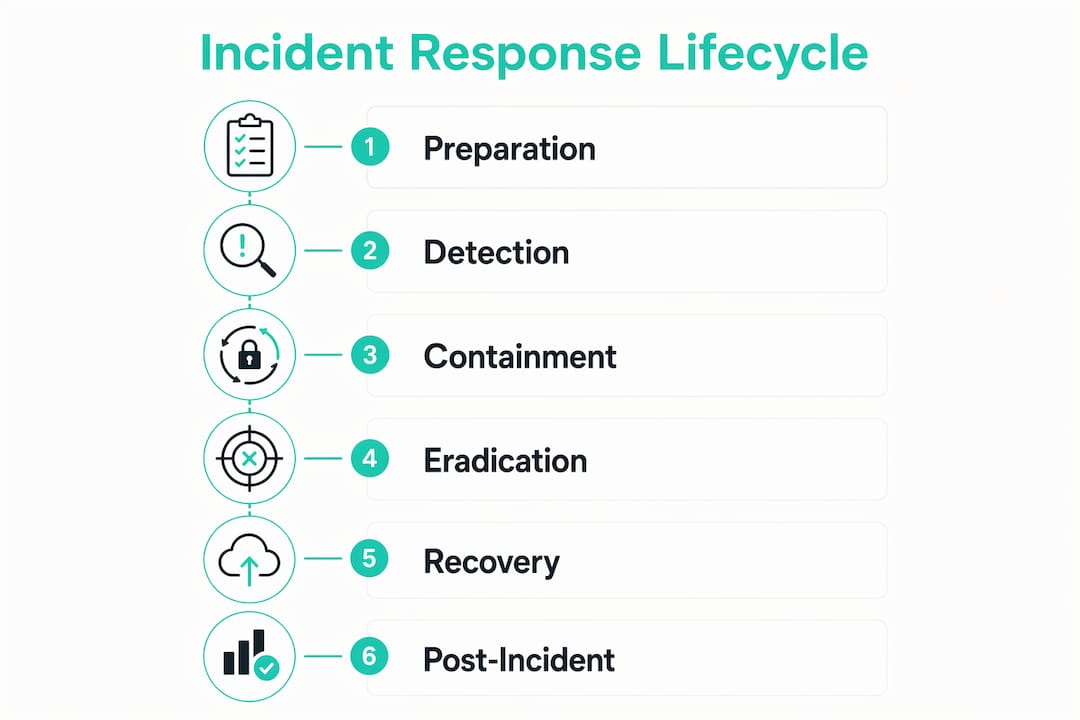
The table below compares how NIST and ISO 27035 map to scope requirements:
| Lifecycle phase | NIST SP 800-61 | ISO 27035 | Scope requirement |
|---|---|---|---|
| Preparation | Preparation | Prepare | Define teams, tools, authority, and training |
| Detection | Detection and Analysis | Detect and Report | Set classification thresholds and notification triggers |
| Response | Containment, Eradication, Recovery | Assess, Decide, Respond | Pre-authorise containment actions and escalation paths |
| Review | Post-Incident Activity | Lessons Learned | Mandate after-action reviews and evidence retention |
Organisations that define scope only for the detection and containment phases consistently struggle with two problems. First, they have no pre-agreed preparation baseline, so teams arrive at an incident with different assumptions about authority. Second, they have no formal post-incident obligation, so lessons are never captured and the same gaps recur. Documentation, timelines, and after-action reviews capture gaps and enable process improvement. Including post-incident activity in scope is not administrative overhead. It is the mechanism through which your programme matures.
Pro Tip: Map your scope document directly to your chosen framework's phases. A one-page matrix showing which scope element applies to which phase gives new team members immediate orientation and reduces ambiguity during an active incident.
How does scope differ from playbooks and runbooks?
The distinction between scope, playbooks, and runbooks is one of the most frequently misunderstood aspects of incident management. Confusing them leads to plans that are either too vague to execute or too rigid to adapt.
Incident response plan scope defines what, when, and who. Playbooks define how to respond to a specific incident type such as ransomware or business email compromise. Runbooks provide the step-by-step technical execution for a specific task within a playbook, such as isolating a host in Microsoft Defender for Endpoint. Each layer serves a different purpose and a different audience.
Consider the practical difference:
- Scope states that ransomware events affecting production systems constitute a declared incident, that the CISO holds declaration authority, and that legal counsel must be notified within two hours.
- A ransomware playbook states that upon declaration, the IR team isolates affected segments, preserves memory images, and contacts the external DFIR retainer.
- A runbook provides the exact CLI commands or console steps to isolate a host in CrowdStrike Falcon or to capture a memory image using Magnet AXIOM.
This hierarchy matters for scope definition because scope governs the boundaries within which playbooks and runbooks operate. If scope does not pre-authorise network segmentation, a playbook cannot instruct a technician to isolate a segment without first seeking approval. That approval delay, measured in minutes during an active breach, can determine whether ransomware encrypts ten servers or ten thousand. Your incident response readiness assessment should verify that scope, playbooks, and runbooks are aligned before an incident occurs, not during one.
What are common challenges in setting incident response scope?
Defining scope is straightforward in theory. In practice, several recurring challenges reduce its operational effectiveness.
-
Ambiguous incident definitions. When the threshold between a potential and a confirmed incident is unclear, teams delay evidence preservation and regulatory notifications. This threshold is often the most operationally important detail in scope, yet many organisations leave it undefined or expressed in subjective language such as "significant impact."
-
Insufficient authority delegation. Scope that requires executive sign-off for every containment action creates bottlenecks. Mature IR programmes pre-authorise decisions such as segment shutdowns or engaging external counsel to avoid delays during the critical first hour.
-
Ignoring operational dependency chains. Identity systems, backups, logging, and communication channels must be included in scope because incidents frequently impair these resources. A team that cannot access its logging platform or communicate via its standard channels is effectively blind and silent.
-
Scope that is too narrow. Limiting scope to network intrusions misses insider threats, cloud misconfigurations, and supply chain compromises. Each of these requires different teams, different regulatory considerations, and different evidence preservation approaches.
-
Scope that is too broad. Declaring every phishing email a formal incident exhausts response capacity and desensitises teams to genuine threats. Scope must include severity tiers that route low-severity events to standard IT processes and reserve formal incident declaration for confirmed, high-impact events.
"The scope document is not a compliance artefact. It is the operational contract your team relies on at 2am when the CISO is unreachable and a decision must be made in the next five minutes."
Evidence management within scope deserves particular attention. Post-incident learning and evidence preservation extend scope beyond immediate containment. Scope must specify retention periods, chain-of-custody standards, and who holds responsibility for court-admissible documentation. For organisations in regulated sectors or those operating under UK GDPR, this is not optional.
How to practically define and implement incident response scope
Translating scope theory into a working document requires a structured approach. The following steps reflect best practice for organisations building or revising their incident response framework.
- Inventory assets, data types, and teams. Start with a complete list of systems, data classifications, and business functions. Scope cannot cover what it does not know exists. Include cloud environments, SaaS platforms, and third-party integrations.
- Define measurable trigger conditions. Write incident declaration criteria as observable, testable conditions. "Confirmed unauthorised access to a system containing personal data" is testable. "A serious security event" is not.
- Assign roles and responsibilities explicitly. Name the incident commander, the legal liaison, the communications lead, and the technical lead. Assign backups for each role. Scope that names job titles rather than individuals survives staff turnover.
- Pre-authorise critical decisions. Document which containment actions are pre-approved and at what severity level. This removes the approval bottleneck that costs organisations critical response time. Your cyber incident scope determination guide provides a practitioner-level framework for this step.
- Integrate regulatory obligations. Map each incident type to its applicable notification requirements. A data breach affecting UK residents triggers UK GDPR timelines. An incident affecting critical national infrastructure may trigger NIS2 obligations. Both must appear in scope.
- Schedule regular reviews. Scope becomes outdated as organisations grow, adopt new technology, or face new regulatory requirements. A minimum annual review, supplemented by a review after every declared incident, keeps scope aligned with operational reality.
Pro Tip: After each incident, run a 30-minute scope review alongside your after-action review. Ask one question: did any part of the response fall outside the defined scope? If yes, update the scope document before the next incident occurs.
Incident response plans function as active operational systems, not static compliance documents. Treat scope as a living record that reflects your current environment, not the environment you had when you first wrote the plan.
Key takeaways
Incident response scope is the operational contract that determines whether your team responds with precision or confusion when a breach occurs.
| Point | Details |
|---|---|
| Scope defines the full boundary | It covers event types, authority, teams, regulatory obligations, and lifecycle phases end-to-end. |
| Classification thresholds are critical | The confirmed versus potential incident threshold triggers legal preservation and notification workflows. |
| Pre-authorised decisions save time | Mature programmes authorise containment actions in advance to eliminate approval delays during the first hour. |
| Scope governs playbooks and runbooks | Scope sets the what, when, and who; playbooks and runbooks handle the how for specific incident types. |
| Scope requires regular review | Update scope after every declared incident and at minimum annually to reflect operational changes. |
The uncomfortable truth about incident response scope
From our experience responding to breaches across the UK, Gibraltar, and Europe, the single most common failure we encounter is not a technical one. It is a scope failure. Organisations invest in detection tooling, hire skilled analysts, and build playbooks for every major threat type. Then an incident occurs and the first 90 minutes are consumed by a single question: who is authorised to take this action?
We have seen organisations delay network isolation for over an hour because the scope document required sign-off from a board member who was travelling. We have seen legal notifications missed because the scope did not specify which team owned the regulatory workflow. These are not edge cases. They are the norm in organisations that treat scope as a compliance checkbox rather than an operational foundation.
The most effective scopes we have reviewed share one characteristic: they are written by people who have responded to real incidents, not by people who have only read about them. They contain specific names, specific thresholds, and specific pre-authorisations. They are tested through tabletop exercises at least twice a year. And they are updated within two weeks of every declared incident, without exception.
Scope is not the most technically demanding part of incident response. It is, however, the part that determines whether everything else works.
— Makkari
How Makkarisecurity supports your incident response scope
Makkarisecurity works directly with organisations across the UK, Gibraltar, and Europe to build and validate incident response programmes that function under real breach conditions. Our breach counsel and panel support service integrates legal and operational guidance directly into your scope definition, covering regulatory notification workflows, evidence preservation standards, and authority delegation. Our incident response and digital forensics capabilities are built on a proprietary forensic engine developed over five years, delivering live memory capture and cross-verified results. If your scope needs testing, validation, or a complete rebuild, our team is ready to engage.
FAQ
What is incident response scope in simple terms?
Incident response scope defines which security events trigger a formal response, who holds authority to act, which teams are involved, and what regulatory obligations apply. It is the governing boundary of your entire incident response programme.
How does scope relate to an incident response plan?
Scope is the foundational section of an incident response plan. It sets the authority structure and boundaries within which all playbooks, runbooks, and response procedures operate.
Why does the incident classification threshold matter so much?
The threshold distinguishing a confirmed incident from a potential one determines when evidence preservation and regulatory notifications must begin. An unclear threshold causes delays that can result in missed legal deadlines and lost forensic evidence.
What regulatory requirements should incident response scope include?
Scope must enumerate all applicable jurisdictions and their notification timelines. UK GDPR requires notification within 72 hours of a confirmed personal data breach, and NIS2 requires an early warning within 24 hours for significant incidents affecting essential services.
How often should incident response scope be reviewed?
Scope should be reviewed at minimum annually and after every declared incident. Organisations that grow, adopt new technology, or face new regulatory requirements may need more frequent updates to keep scope aligned with their actual environment.