
TL;DR:
- Network segmentation enhances incident response by providing predefined, enforceable boundaries that limit attacker lateral movement. Incorporating segmentation controls into each IR phase allows for faster containment, detailed investigation, and precise recovery. Regular validation and continuous monitoring ensure segmentation policies remain effective and reflective of actual network architecture.
Network segmentation incident response is defined as the deliberate use of segmented network architecture to contain, investigate, and recover from cybersecurity incidents through predefined isolation controls and policy enforcement. Rather than treating segmentation as a passive infrastructure choice, effective incident response (IR) teams integrate it directly into their response workflows. Frameworks including NIST SP 800-61 Rev 3, CISA's zero trust microsegmentation guidance, and Cisco's segmentation cycle all confirm that segmentation limits attack spread by blocking free lateral movement and maintaining threats within defined boundaries. For IT professionals and cybersecurity specialists, this means faster containment, clearer scope determination, and more repeatable recovery.
What is network segmentation incident response?
Network segmentation incident response is the practice of mapping segmentation controls directly to each phase of the IR lifecycle: detection, containment, eradication, and recovery. The industry term for the underlying architecture is network segmentation, and when applied within IR workflows, it transforms containment from an ad hoc firewall change into a repeatable, policy-driven action.

Segmentation fundamentally decides who can communicate with whom, converting a free-flowing internal network into regulated zones with enforced policies. This matters enormously during an active incident, because every second an attacker moves laterally is additional scope, additional evidence to collect, and additional recovery cost. Predefined segments give responders concrete boundaries to enforce immediately, without waiting for emergency change approvals.
NIST SP 800-61 Rev 3 establishes that IR spans detection, containment, eradication, and recovery, and segmentation controls provide repeatable, concrete actions at each stage rather than improvised measures. This is the core value proposition: consistency under pressure. When your team is responding to a ransomware event at 02:00, a documented segmentation playbook is worth more than any amount of post-incident theorising.
How does network segmentation enhance incident containment and investigation?
Segmentation enhances containment by providing pre-built isolation boundaries that responders can activate without designing controls from scratch during a live incident. The operational mechanisms are specific and worth understanding in detail.
- Zone isolation as a containment boundary. When a segment is isolated, traffic between it and adjacent zones is blocked at the enforcement point. This stops an attacker from pivoting from a compromised workstation to a domain controller or a payment processing server. The boundary was designed before the incident; the responder simply enforces it.
- Reduced blast radius. Cisco's segmentation cycle creates control points restricting the blast radius and provides actionable visibility data supporting detection of unusual behaviour. A well-segmented network means a compromised segment contains the damage, rather than the entire flat network becoming the attacker's playground.
- Telemetry for scope determination. Segmentation enforcement points generate logs and flow data. During an investigation, this telemetry tells you which segments saw traffic from the compromised host, which policies were hit, and where the attacker attempted to move. This is the difference between a two-hour scope determination and a two-day one.
- Microsegmentation for granular control. CISA states that microsegmentation reduces attack surface, limits lateral movement, and enhances visibility by isolating smaller groups of resources. For IR teams, this means containment precision at the workload level rather than the subnet level.
- Repeatable controls versus ad hoc changes. Without segmentation, containment often means emergency firewall rules written under pressure, which are inconsistent, poorly documented, and frequently misconfigured. Predefined segments make containment a documented, auditable action.
Pro Tip: When building your IR playbook, map each segment to a named containment action. For example: "If Segment B is compromised, enforce Policy Set 4 and isolate from Segments A and C." This removes decision fatigue during a live incident.
Understanding how DFIR operates during an active attack makes the value of pre-built segmentation boundaries even clearer. The faster you can isolate, the less forensic evidence is overwritten by continued attacker activity.
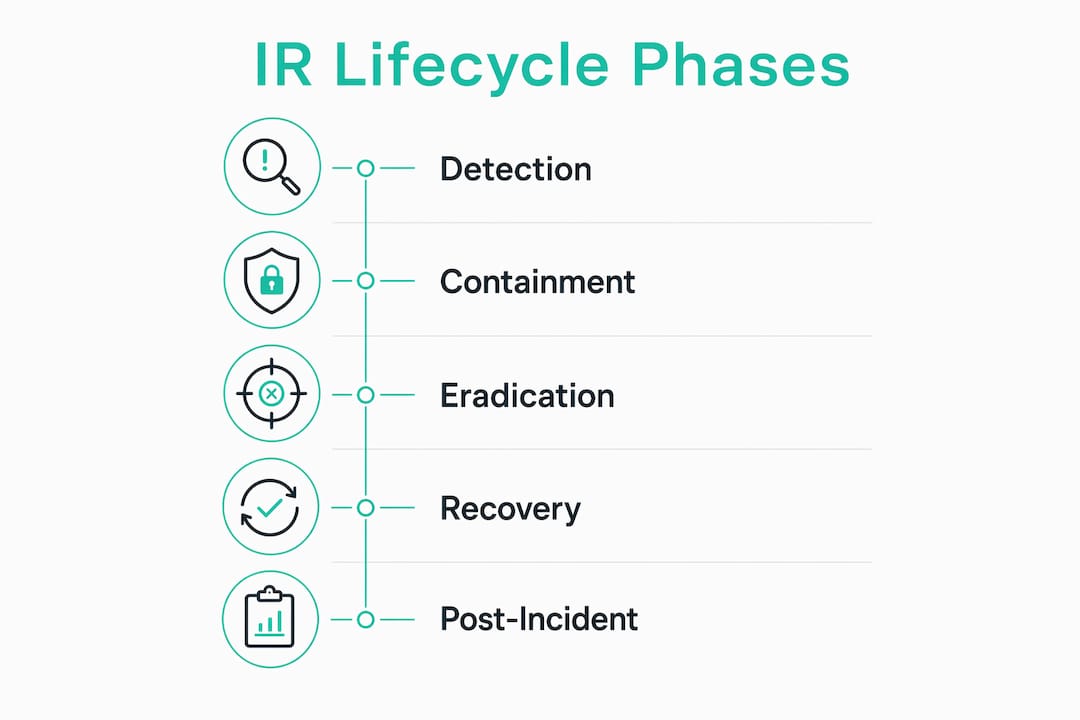
What are the IR lifecycle phases supported by segmentation controls?
Segmentation supports every phase of the NIST SP 800-61 Rev 3 IR lifecycle. The mapping is direct and practical.
-
Detection. Segmentation enforcement points generate flow telemetry and policy violation alerts. Anomalous traffic attempting to cross a segment boundary, such as a workstation trying to reach a database segment it has never accessed, is a high-fidelity detection signal. This is not a replacement for a SIEM or EDR, but it is a layer that catches lateral movement attempts that endpoint tools sometimes miss.
-
Containment. This is where segmentation delivers its clearest value. Containment via segment isolation and policy enforcement is concrete and repeatable. The responder enforces the pre-planned isolation policy for the affected segment, blocking the attacker's ability to move further. This is documented, consistent, and reversible.
-
Eradication. Once the attacker's tools and persistence mechanisms are removed, segmentation policies can be used to enforce least-privilege access, blocking any residual command-and-control paths. If the attacker planted a backdoor in a specific segment, enforcing strict egress controls on that segment cuts the communication channel even before the backdoor is fully identified and removed.
-
Recovery. Recovery is where segmentation is most frequently mishandled. Recovery must include revalidation that segmentation policy and allowed flows match the post-incident intended state. Restoring a system to a segment without verifying that the segmentation policy is correct can reintroduce the attacker's re-entry vector. This step is non-negotiable.
-
Post-incident review. Segmentation telemetry provides a forensic record of attacker movement. Reviewing this data during the lessons-learned phase reveals gaps in segmentation design, such as segments that were too broad or policies that were too permissive, and informs the next iteration of the architecture.
Aligning your incident response SLA commitments with these phases ensures that containment and recovery timelines are realistic given your segmentation architecture.
How does microsegmentation differ from traditional segmentation in IR?
The distinction between traditional network segmentation and microsegmentation is one of granularity and control precision, and it has direct consequences for IR effectiveness.
| Dimension | Traditional segmentation | Microsegmentation |
|---|---|---|
| Granularity | Subnet or VLAN level | Individual workload or application level |
| Enforcement point | Network perimeter or core switch | Host-based or hypervisor-based policy engine |
| IR containment precision | Segment-wide isolation | Workload-specific isolation |
| Lateral movement restriction | Limits movement between subnets | Limits movement between individual hosts |
| Telemetry detail | Flow-level between segments | Process-level and connection-level per workload |
| Implementation complexity | Moderate | High |
Traditional segmentation, using VLANs and firewall zones, provides meaningful containment boundaries but operates at a coarse level. If a segment contains 200 workstations and one is compromised, isolating the segment takes 199 clean machines offline with it. Microsegmentation, as described in CISA's zero trust guidance, allows you to isolate the single compromised workload while the rest of the segment continues operating.
For IR, microsegmentation enables segment-specific playbooks that accelerate scoping. Instead of asking "which subnet is affected?", you ask "which workload is affected?" and enforce a policy against that specific host. The investigation scope is tighter from the outset.
The implementation challenge is real. Microsegmentation requires detailed knowledge of application communication flows, a policy engine capable of workload-level enforcement, and ongoing maintenance as the environment changes. Organisations that deploy microsegmentation without this groundwork often find their policies are too permissive to be useful or too restrictive to be operational.
Pro Tip: Before deploying microsegmentation, run a 30-day visibility-only mode using tools such as Illumio or VMware NSX to map actual application communication flows. Policies built on observed behaviour are far more accurate than policies built on assumptions.
Practical guidelines for integrating segmentation into IR strategies
Embedding segmentation into your IR workflows requires deliberate planning before an incident occurs. These guidelines reflect what actually works in practice.
- Pre-plan containment actions against named segments. Your IR playbook should specify, for each segment, the exact isolation action and the authority required to execute it. Vague instructions such as "isolate the affected area" are useless at 02:00. Named segments with named policies are not.
- Align segmentation policies with business function. Segments should reflect business processes, not just technical topology. A payment processing segment, a developer workstation segment, and a guest Wi-Fi segment each carry different risk profiles and require different containment thresholds. Misaligned segmentation creates either over-isolation (operational disruption) or under-isolation (insufficient containment).
- Implement continuous monitoring of segmentation enforcement. Segmentation policies drift. Firewall rules are added for temporary purposes and never removed. Segmentation boundaries tied to telemetry confirm that enforcement is actually occurring, not just configured. Validate enforcement weekly, not annually.
- Correlate segmentation telemetry with forensic evidence. During an investigation, segmentation logs are primary evidence. They establish attacker movement timelines, confirm which systems were accessed, and support chain-of-custody requirements. Treat segmentation telemetry with the same rigour as endpoint logs and memory captures.
- Review and update segmentation controls post-incident. Every incident reveals something about your segmentation design. A segment that was too broad, a policy that permitted unexpected traffic, or a recovery step that inadvertently reopened a path. The lessons-learned phase must include a structured review of segmentation architecture, not just IR process.
Detailed guidance on incident scope determination explains how segmentation boundaries directly accelerate the scoping process during the first hours of an incident, which is when containment decisions have the greatest impact.
Key takeaways
Network segmentation incident response is most effective when segmentation controls are pre-mapped to IR phases, telemetry is treated as forensic evidence, and recovery includes mandatory revalidation of all segmentation policies.
| Point | Details |
|---|---|
| Segmentation maps to IR phases | Containment, eradication, and recovery each have specific segmentation actions that must be pre-planned. |
| Telemetry is forensic evidence | Segmentation flow data establishes attacker movement timelines and supports chain-of-custody requirements. |
| Microsegmentation improves precision | Workload-level isolation reduces operational disruption during containment compared to subnet-level isolation. |
| Recovery requires policy revalidation | Restoring systems without revalidating segmentation policies can reintroduce attacker re-entry vectors. |
| Drift undermines enforcement | Segmentation policies must be continuously monitored; annual reviews are insufficient for live IR readiness. |
The uncomfortable truth about segmentation in incident response
From Makkari's experience responding to breaches across the UK and Europe, the most common failure is not a lack of segmentation. It is segmentation that exists on paper but has never been validated in practice.
Organisations invest in VLAN architecture, document their segmentation policies, and then spend three years adding firewall exceptions for business requests without reviewing the cumulative effect. By the time an incident occurs, the segmentation that was supposed to contain the blast radius has been eroded by 47 undocumented exceptions and three legacy systems that "need access to everything."
The return-to-visibility loop that Cisco's segmentation cycle describes is not a nice-to-have. It is the mechanism by which you confirm that your segmentation is actually enforcing what you think it is. Without it, you are relying on architecture that may not reflect reality.
Microsegmentation is genuinely powerful when combined with strong monitoring and accurate flow mapping. But deploying it without that foundation creates a false sense of security that is arguably worse than no segmentation at all. The organisations that handle incidents most effectively are those that treat segmentation as a living control, not a one-time deployment.
The advice to review segmentation post-incident is correct but incomplete. You should also be reviewing it quarterly, stress-testing it with tabletop exercises, and treating every exception request as a potential IR liability.
— Makkari
How Makkari Security supports segmentation-based incident response
Makkarisecurity specialises in Digital Forensics and Incident Response (DFIR), and segmentation telemetry is a core component of how we scope and contain breaches. When we engage during an active incident, we correlate segmentation flow data with live memory captures from our proprietary forensic engine to establish attacker movement timelines with precision.
Our incident response and DFIR capabilities include containment support that works with your existing segmentation architecture, not around it. For organisations that need ongoing assurance, our IR retainer provides pre-planned containment playbooks aligned to your specific segmentation design. Our breach counsel and panel support delivers court-admissible forensic evidence drawn directly from segmentation telemetry and memory captures. Contact Makkarisecurity to discuss how we can integrate with your segmentation architecture before the next incident.
FAQ
What is network segmentation in cybersecurity?
Network segmentation is the practice of dividing a network into distinct zones with enforced communication policies, restricting which systems can communicate with which. It reduces attack surface, limits lateral movement, and provides enforcement points that generate telemetry for detection and investigation.
How does segmentation support incident containment?
Segmentation provides pre-built isolation boundaries that responders can enforce immediately during an incident, blocking attacker lateral movement without requiring emergency firewall changes. Predefined segment isolation makes containment a repeatable, documented action rather than an improvised one.
Why is policy revalidation critical during recovery?
Restoring systems to a network without revalidating segmentation policies can reintroduce the attacker's re-entry paths, particularly if persistence mechanisms were planted in communication flows that recovery inadvertently reopens. NIST SP 800-61 Rev 3 identifies this as a specific risk in segmented IR recovery.
What is the difference between microsegmentation and traditional segmentation for IR?
Traditional segmentation isolates at the subnet or VLAN level, while microsegmentation isolates at the individual workload level. For IR, microsegmentation enables more precise containment and tighter scope determination, though it requires significantly more implementation effort and ongoing maintenance.
How should segmentation telemetry be used during a forensic investigation?
Segmentation flow data establishes attacker movement timelines, identifies which systems were accessed, and confirms which policies were triggered. This telemetry should be collected and preserved with the same chain-of-custody rigour as endpoint logs, as it constitutes primary forensic evidence of attacker behaviour.