
TL;DR:
- The cyber claim investigation process involves multiple phases from incident detection to settlement, requiring swift notification and thorough evidence preservation. Delays or gaps in documentation at any stage can lead to claim denial or reduced settlement amounts. Proper coordination with breach coaches and panel-approved forensic vendors enhances the chances of a successful claim outcome.
The cyber claim investigation process is defined as the structured, multi-phase sequence of actions taken from the moment a cybersecurity incident is detected through to final settlement of the insurance claim. It encompasses incident triage, forensic evidence preservation, insurer notification, claims filing, adjuster review, and settlement negotiation. For legal professionals, insurance adjusters, and corporate compliance teams, understanding each phase is not optional. Errors at any stage, from late notification to premature system rebuilding, can result in partial or total claim denial. The cyber insurance claim process in 2026 demands both speed and procedural precision in equal measure.
What is the cyber claim investigation process and its key phases?
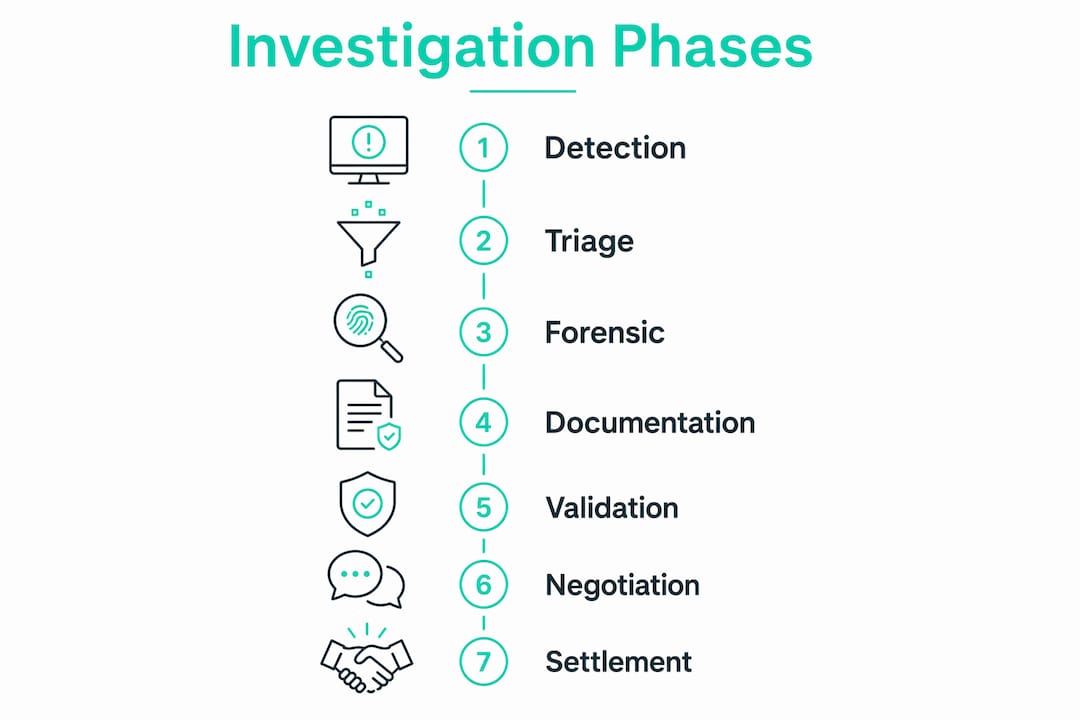
The cyber claim investigation process unfolds through seven distinct chronological phases, from detection to final payment. Complex cases span 3 to 12 months or longer, with ransomware incidents routinely extending to 18 months. That range reflects the volume of technical, legal, and financial verification required before an insurer will release funds.
| Phase | Typical timeframe | Key actions |
|---|---|---|
| Detection and triage | 0–24 hours | Identify the incident, activate the incident response plan, isolate affected systems |
| Insurer notification | 24–72 hours | Contact the insurer's 24/7 hotline, engage the breach coach, log the notification timestamp |
| Incident response | 1–30 days | Deploy forensic investigators, contain the threat, preserve volatile evidence |
| Claims filing | 7–60 days | Submit proof of loss, forensic reports, financial records, and incident timeline |
| Adjuster review | 30–120 days | Insurer validates documentation, reviews forensic findings, checks policy compliance |
| Settlement negotiation | 60–180 days | Parties negotiate business interruption losses, cost reasonableness, and sublimits |
| Payment and closure | 90–365+ days | Final payment issued; remediation confirmed and documented |
Each phase feeds directly into the next. A delay in notification compresses the time available for forensic capture. A gap in forensic documentation weakens the adjuster's ability to validate causation. The phases are interdependent, not independent.
Why prompt notification and evidence preservation matter most
Failing to notify the insurer within the 24–72 hour notification window is one of the most common causes of claim denial. Most policies specify that notification must go through the insurer's dedicated incident hotline, not through internal IT channels or a general customer service line. The timestamp of that call becomes a matter of record.
Evidence preservation is equally time-critical. Volatile memory holds decrypted content, session tokens, and live process data that disappear the moment a system is powered down or reimaged. Insurers rely on that data to verify the attack vector and define the breach scope. Without it, causation becomes contested and claims become vulnerable.
The steps that protect both notification compliance and evidence integrity include:
- Activating your incident response plan immediately upon detection, before any remediation work begins
- Calling the insurer's 24/7 hotline and recording the time, the name of the representative, and the reference number provided
- Engaging the breach coach, who is typically a specialist attorney whose communications carry legal privilege
- Instructing IT teams to isolate, not wipe, affected systems pending forensic capture
- Using only panel-approved forensic vendors coordinated by the breach coach to avoid cost disallowance
- Logging every action taken on affected systems with timestamps and the names of personnel involved
Pro Tip: Never allow IT staff to reimage or rebuild a compromised server before a qualified forensic investigator has completed a full memory and disk capture. Premature wiping destroys the volatile evidence that insurers need to validate your claim.
The breach coach's role extends beyond legal privilege. They co-ordinate the forensic firm, manage regulatory notification obligations, and act as the single point of contact between the insured, the insurer, and any external counsel. Bypassing that structure, even with good intentions, creates procedural gaps that adjusters will scrutinise.
How is the forensic investigation conducted and documented?
Digital forensics in a cyber claim context follows four iterative phases: Acquisition, Ingestion, Analysis, and Reporting. These phases are not strictly linear. Investigators cycle back through earlier stages when new evidence surfaces, applying quality gates at each transition to verify data integrity.
The four forensic phases in practice
- Acquisition. Investigators capture live memory using specialist tools before touching disk storage. This preserves volatile data including running processes, network connections, and encryption keys. Every acquired image is cryptographically verified using SHA-256 hashing to confirm it has not been altered.
- Ingestion. Acquired data is loaded into a forensic analysis environment. Chain-of-custody logs record every action taken on the evidence, including who accessed it, when, and for what purpose. These logs are mandatory for court admissibility and insurer acceptance.
- Analysis. Investigators reconstruct the attack timeline, identify the initial access vector, trace lateral movement, and determine the scope of data exfiltration or encryption. Malware samples are catalogued and attributed where possible. This phase produces the factual basis for the insurer's coverage determination.
- Reporting. The forensic report documents findings in a format accessible to both technical and non-technical audiences. It includes the attack timeline, affected systems, data categories involved, and a clear statement of causation. This report becomes the central exhibit in the claims file.
The documentation standards applied throughout this process directly affect claim outcomes. Detailed incident logs, timestamped chain-of-custody records, and a clear forensic report give adjusters the evidence they need to validate coverage without ambiguity. A practical guide to forensic analysis after a breach provides further detail on each stage for teams preparing their own documentation.
What scrutiny do claims adjusters apply during a cyber claim?

Adjusters validate three things above all else: that the incident falls within policy coverage, that the insured complied with warranted security controls, and that the claimed losses are reasonable and documented. Discrepancies between pre-incident security questionnaires completed at underwriting and the actual security posture found during investigation are a primary cause of denial for material misrepresentation. That gap is more common than most compliance teams expect.
The controls most frequently reviewed include multi-factor authentication deployment, backup testing frequency and isolation, patch management cadence, and endpoint detection coverage. If the application stated that MFA was enforced across all remote access and the forensic investigation reveals an unprotected VPN endpoint, the insurer has grounds to contest the claim.
| Common denial reason | Mitigation strategy |
|---|---|
| Late notification | Activate the incident response plan immediately; call the insurer hotline within 24 hours |
| Material misrepresentation | Audit actual controls against underwriting application answers before renewal |
| Unapproved vendor costs | Use only breach coach-coordinated, panel-approved forensic and legal firms |
| Insufficient documentation | Maintain detailed incident logs, chain-of-custody records, and financial loss schedules from day one |
| Excluded incident type | Review policy exclusions before an incident; confirm ransomware and social engineering sub-limits |
Business interruption calculations attract particular scrutiny. Business interruption losses are frequently undercounted and form the largest portion of most cyber claims. Adjusters will examine revenue figures, overtime costs, temporary workaround expenses, and productivity losses against the policy's indemnity period and sub-limits. Gaps in financial documentation translate directly into reduced settlements.
How to prepare and submit a formal claim
A formal cyber insurance claim requires a specific set of documents assembled in a clear, organised format. Adjusters process multiple claims simultaneously. A well-structured submission accelerates review and reduces the number of information requests that extend the timeline.
The core components of a complete claim submission are:
- Proof of loss form completed in full, with the incident date, discovery date, and notification date clearly stated
- Forensic investigation report from a panel-approved firm, including the attack timeline, causation statement, and affected system inventory
- Incident timeline documenting every action taken from detection through containment, with timestamps and responsible parties named
- Financial loss schedule covering lost revenue, overtime, temporary measures, third-party costs, and regulatory fines where applicable
- Supporting financial statements such as profit and loss accounts, payroll records, and invoices for all remediation expenditure
Settlement negotiations typically focus on three contested areas: the length of the business interruption period, the reasonableness of individual cost items, and the application of deductibles and sub-limits. For claims exceeding six figures, engaging a public adjuster or specialist cyber claims consultant to represent the insured's position is standard practice.
Pro Tip: Start a dedicated claims cost log on the day of detection. Record every expense, every hour of lost productivity, and every third-party invoice as it occurs. Reconstructing financial losses weeks later from memory produces incomplete records that adjusters will discount.
Key takeaways
The cyber claim investigation process succeeds or fails on the quality of evidence preserved, the speed of notification, and the accuracy of documentation submitted at every phase.
| Point | Details |
|---|---|
| Notify within 24–72 hours | Late notification is a leading cause of denial; use the insurer's dedicated hotline, not internal IT channels. |
| Preserve volatile evidence first | Capture live memory before any remediation; premature reimaging destroys the data insurers need for causation. |
| Use panel-approved vendors | Only breach coach-coordinated forensic firms guarantee cost reimbursement and legal privilege. |
| Match controls to your application | Discrepancies between underwriting answers and actual security posture risk denial for material misrepresentation. |
| Document losses from day one | A dedicated cost log started at detection produces the financial evidence needed for business interruption claims. |
The tension at the heart of every cyber claim
From the front line of incident response, the single most consistent failure I see is not technical. It is the decision made in the first two hours after detection to prioritise getting systems back online over preserving the evidence that will support the claim.
The pressure is understandable. A business with encrypted servers is losing revenue by the minute. The instinct is to restore. But that instinct, acted on before forensic capture is complete, routinely costs organisations more in disputed or denied claims than the downtime itself would have cost in lost revenue.
The breach coach exists precisely to manage that tension. They hold the authority to tell a board that remediation must wait, and they do so with the insurer's backing. Organisations that engage the breach coach within the first hour consistently achieve better claim outcomes than those that treat the coach as a formality to be engaged after the technical work is done.
The second pattern I see repeatedly is the gap between what was stated on the underwriting application and what the forensic investigation reveals. Compliance teams often complete renewal questionnaires without verifying the current state of controls. When an adjuster's forensic review finds that MFA was not enforced on a system the application described as protected, the claim is at risk regardless of how well everything else was handled. Accurate pre-incident documentation is as important as accurate post-incident documentation.
Cyber insurance is a final safety net, not a substitute for mature internal security. The burden of proof sits with the insured. Every phase of the investigation process is an opportunity to either support or undermine that proof.
— Makkari
How Makkarisecurity supports cyber claim investigations
Makkarisecurity provides Digital Forensics and Incident Response (DFIR) services built specifically for the demands of the cyber claim investigation process. The proprietary forensic engine delivers live memory capture and cross-verified results, producing court-admissible evidence that satisfies both insurer and regulatory requirements.
For insurance adjusters and legal teams, Makkarisecurity operates as a panel-approved DFIR partner with a documented zero re-breach record and the Eviction Pledge: once a threat actor is evicted, they will not return for a minimum of 60 days or the engagement is at no charge. The breach counsel and panel support service provides privileged, insurer-coordinated incident response from the first hour of detection through to final claim closure. For organisations in the UK, Gibraltar, and broader Europe, Makkarisecurity is the partner that protects both the business and the claim.
FAQ
What is the cyber claim investigation process?
The cyber claim investigation process is the structured sequence of phases from incident detection through forensic investigation, claims filing, adjuster review, and settlement. It typically spans 3 to 12 months depending on incident complexity.
How long does a cyber insurance claim take to settle?
Settlement timelines range from 90 days for straightforward incidents to 365 days or more for complex ransomware cases. The negotiation phase alone can run 60–180 days.
What happens if you miss the notification deadline?
Missing the 24–72 hour notification window is one of the most common grounds for claim denial. Policies require notification through the insurer's dedicated hotline, and the timestamp is treated as a matter of record.
Why do cyber claims get denied?
The most frequent denial reasons are late notification, material misrepresentation of security controls, use of unapproved vendors, and insufficient financial documentation. Discrepancies between underwriting application answers and actual controls found during investigation are a primary trigger.
What is the role of the breach coach in a cyber claim?
The breach coach is typically a specialist attorney who co-ordinates the forensic investigation, manages regulatory notifications, and creates legally privileged communications. Engaging the breach coach immediately upon detection protects both the claim and any subsequent litigation.