
TL;DR:
- Cyber insurance incident response clauses specify how organizations access expert assistance and funding during a cyber breach. Proper understanding and pre-approval of vendor panel and sublimits are essential to prevent claim denials and coverage gaps. Preparing in advance ensures compliance with notification timelines and operational obligations, reducing financial and legal risks.
Cyber insurance incident response clauses are contractual provisions that define exactly how an insured organisation receives expert assistance and financial protection the moment a cyber incident is confirmed. These clauses govern access to a pre-vetted panel comprising forensic investigators, legal breach counsel, and PR specialists via a 24/7 incident hotline, triggered upon notification. Understanding the types of cyber insurance incident response clauses matters because each clause type carries distinct operational obligations, financial caps, and compliance requirements. Forensic IR costs can range from $50,000 to $500,000 per incident, with policy aggregates sitting between $500,000 and $2,000,000. That financial exposure makes clause selection a core part of any cyber risk management strategy.
What are the main types of cyber insurance incident response clauses?
Cyber insurance policies bundle several distinct clause types, each controlling a different aspect of the incident response process. Risk managers who treat these as interchangeable miss the operational detail that determines whether a claim succeeds or fails.
- Consent and Cooperation Clause. This clause requires the insured to notify the insurer and receive written consent before engaging external vendors, making public statements, or incurring response costs. Violations of notice requirements are among the most common causes of claim disputes and outright denials.
- Notification Clause. This clause sets the reporting window. Most policies require notification within 60 to 72 hours of discovering a potential incident. Missing that window can void coverage and remove the insurer's duty to defend.
- Panel Vendor Clause. This clause specifies whether the insured must use insurer-selected forensic and legal firms, or whether they may engage their own preferred providers. The distinction directly affects investigation quality and response speed.
- Ransomware Extortion Clause. This clause covers ransom payments and negotiation costs, subject to OFAC compliance. Insurers typically mandate approved negotiators who verify decryption tool functionality before authorising any payment.
- Financial Cap Clause (Sublimits). This clause places specific monetary caps on individual incident response services such as breach notification, PR, and ransomware negotiation. These caps are often substantially lower than the full policy limit.
- Business Interruption Clause. This clause covers revenue loss and recovery costs during the period of disruption. It interacts directly with IR service delivery timelines, so delays in engaging panel vendors can reduce the covered period.
Pro Tip: Map each clause type against your existing incident response plan before renewal. Gaps between your internal procedures and policy obligations are far cheaper to fix at underwriting than during an active breach.
How do panel vendor requirements affect incident response?

The panel vendor clause is the most overlooked requirement in most cyber policies. Organisations focus on coverage limits and miss the operational constraint that determines who actually responds to their breach.
Insurer panels typically include pre-accredited forensic firms, legal breach counsel, and crisis communications agencies. Using panel firms carries clear benefits:
- Speed of mobilisation. Panel firms hold standing agreements with insurers, so engagement is faster than cold-sourcing a vendor mid-incident.
- Known cost structures. Insurers negotiate fixed or capped rates with panel vendors, which reduces disputes over billable hours during claims.
- Accreditation assurance. Panel firms meet insurer-defined quality standards, which supports claim approval and chain-of-custody integrity in any subsequent legal proceedings.
The risk of self-selecting vendors is significant. Most cyber policies mandate use of insurer-approved forensics and IR vendors. Engaging an unapproved firm without prior consent typically results in those costs being excluded from the claim entirely.
The practical solution is to negotiate an authorised vendor endorsement before any incident occurs. This endorsement names your preferred forensic or legal provider as an approved option under the policy. Makkarisecurity, for example, works directly with insurers across the UK and Europe to secure panel inclusion for policyholders who require specialist DFIR capability. Understanding DFIR during an active attack helps risk managers articulate exactly why a specialist provider belongs on their approved list.
Pro Tip: Request a written list of your insurer's current panel vendors at policy inception. Confirm that at least one forensic firm and one legal breach counsel on that list hold relevant UK or European jurisdiction experience.
What operational obligations do incident response clauses impose?
Incident response clauses do not simply grant coverage. They impose a series of time-sensitive obligations that, if missed, can void the claim entirely.
- Notify the insurer immediately. Notification within 60 to 72 hours of discovery is the standard requirement. This triggers coverage, initiates breach management, and activates the insurer's legal protections.
- Obtain consent before acting. The Consent and Cooperation Clause requires written insurer approval before engaging vendors, paying ransoms, or issuing public statements. Acting unilaterally, even with good intentions, risks automatic claim denial.
- Use approved vendors. Engaging unapproved forensic or legal firms without prior endorsement is a common and costly error. Document every vendor engagement and confirm approval in writing.
- Comply with OFAC and regulatory requirements. Ransomware clauses require that all payments and negotiations comply with Office of Foreign Assets Control sanctions. Insurers will not cover payments to sanctioned entities under any circumstances.
- Maintain documentation throughout. Record every action taken, every vendor engaged, and every communication with the insurer. This record forms the evidentiary basis for the claim and supports any chain-of-custody requirements in legal proceedings.
- Keep policy documents accessible offline. Compliance experts recommend maintaining an offline copy of the policy to ensure rapid access to notification procedures when systems are compromised. A policy stored only in a cloud environment may be inaccessible during a ransomware attack.
The operational impact is immediate. Notification triggers panel deployment, which means the quality of your first 72 hours depends entirely on how well your team understands these obligations before an incident occurs. Reviewing your incident response retainer against these clause requirements is a practical starting point.
How do financial cap clauses influence protection and planning?
A financial cap clause, known in policy wording as a sublimit, is a specific monetary ceiling applied to individual incident response expense categories. The full policy limit does not apply uniformly across all services. Each service category carries its own cap, and those caps can be exhausted quickly.
| Coverage category | Typical sublimit range | Key risk |
|---|---|---|
| Breach notification costs | $100,000 to $250,000 | Per-record costs exhaust limits fast |
| Ransomware negotiation and payment | $250,000 to $500,000 | Often lower than full policy aggregate |
| PR and crisis communications | $50,000 to $150,000 | Excluded in lower-tier policies |
| Forensic investigation | $100,000 to $500,000 | Complex breaches exceed caps rapidly |
| Legal breach counsel | $100,000 to $300,000 | Regulatory investigations increase costs |
A breach affecting 50,000 customers can exhaust a $250,000 notification sublimit rapidly due to per-record notification costs. That figure does not include forensic investigation, legal fees, or PR support. Each of those draws from its own separate cap.
PR and crisis communication costs are often covered under sublimits and may be excluded in lower-tier policies entirely. Organisations that assume reputational harm management is covered without checking the policy wording regularly discover the gap at the worst possible moment.
The correct approach is to review sublimit values during underwriting, not after a breach. Align each cap against your organisation's realistic exposure. A business holding records for 200,000 customers needs a notification sublimit that reflects per-record notification costs at scale. Understanding the full financial impact of a cyber incident helps quantify what each sublimit should realistically cover.
Pro Tip: Ask your broker to model a realistic breach scenario against your current sublimit values. If the modelled costs exceed any single cap, negotiate that cap upward before binding the policy.
Key takeaways
Effective cyber insurance incident response coverage depends on understanding each clause type and its operational implications before an incident occurs.
| Point | Details |
|---|---|
| Clause types are distinct | Consent, notification, panel vendor, ransomware, and sublimit clauses each impose separate obligations. |
| Notification windows are strict | Reporting within 60 to 72 hours of discovery triggers coverage and legal protections. |
| Panel vendor approval is critical | Self-selecting unapproved vendors typically results in those costs being excluded from the claim. |
| Sublimits cap individual services | Each IR service category carries its own financial ceiling, often well below the full policy limit. |
| Pre-incident preparation is decisive | Negotiating vendor endorsements and reviewing sublimits at underwriting prevents gaps during a live breach. |
Makkari's perspective on managing these clauses
The most consistent failure I see is organisations purchasing cyber insurance without reading the incident response clauses in detail. They focus on the headline policy limit and assume coverage will flow naturally when needed. It does not work that way.
Each clause type creates a specific obligation. The Consent and Cooperation Clause is not a formality. Violating it by engaging a forensic firm without insurer approval, even a highly qualified one, can void the entire claim for those costs. That is a preventable loss.
Cross-disciplinary collaboration is non-negotiable here. Risk managers, compliance officers, legal counsel, and IT security teams all need to understand the notification timeline and vendor approval process before an incident. The 72-hour notification window does not pause while you locate the policy document or identify the right internal contact.
Pre-negotiating authorised vendor endorsements is the single most underused tool available to risk managers. Most insurers will accept a named endorsement if the vendor meets their accreditation criteria. Securing that endorsement costs nothing at underwriting and eliminates a major source of claim disputes.
The 2026 trend worth watching is increased insurer flexibility on panel composition, driven by policyholder demand for specialist DFIR capability. That flexibility comes with conditions, so document every approval and keep the correspondence on file.
— Makkari
How Makkarisecurity supports incident response under cyber insurance
Makkarisecurity operates as a specialist Digital Forensics and Incident Response provider, working directly with insurers across the UK, Gibraltar, and Europe to support policyholders within their coverage terms.
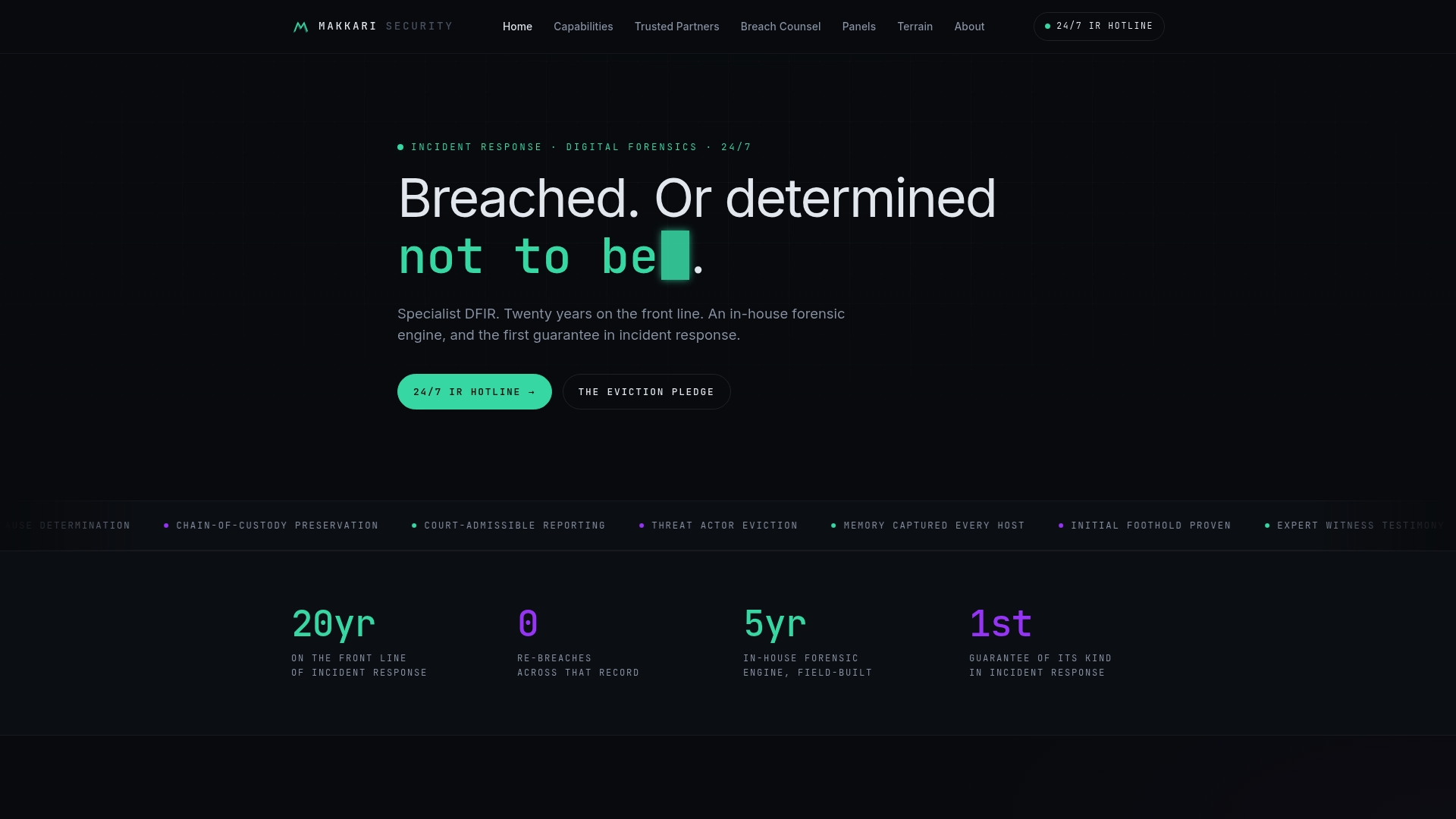
Makkarisecurity's breach counsel and panel support services deliver court-admissible forensic evidence, chain-of-custody documentation, and expert witness testimony aligned with insurer requirements. The proprietary forensic engine provides live memory capture and cross-verified results, meeting the accreditation standards required for insurer panel inclusion. The Eviction Pledge guarantees that once a threat actor is evicted, they will not return for a minimum of 60 days, or the client pays nothing. Explore the full range of incident response capabilities to understand how Makkarisecurity integrates with your policy obligations from the first notification call.
FAQ
What is a cyber insurance incident response clause?
A cyber insurance incident response clause is a contractual provision that defines how an insured organisation accesses expert assistance, financial coverage, and legal protections during a cyber incident. These clauses govern vendor selection, notification timelines, and expense caps.
What happens if you miss the notification window?
Failing to notify your insurer within the required window, typically 60 to 72 hours, can result in claim denial and loss of the insurer's duty to defend. Notification triggers coverage, so speed is critical.
Can you use your own forensic firm under a panel vendor clause?
You can use a preferred forensic firm if you negotiate an authorised vendor endorsement before the incident occurs. Engaging an unapproved vendor without prior consent typically results in those costs being excluded from the claim.
What are sublimits in a cyber insurance policy?
Sublimits are specific financial caps applied to individual incident response expense categories such as breach notification, ransomware negotiation, and PR. They are separate from and often substantially lower than the full policy limit.
How do ransomware clauses interact with OFAC compliance?
Ransomware clauses require that all payments and negotiations comply with OFAC sanctions regulations. Insurers mandate approved negotiators who verify decryption tool functionality and confirm the recipient is not a sanctioned entity before authorising any payment.