
TL;DR:
- A cyber incident response contract is a legally binding agreement that defines how a vendor will handle breach detection, containment, and remediation. Proper negotiation of SLAs, scope, legal protections, and operational proof—such as rehearsals and cryptographic data exports—are essential to ensure effective breach management. Aligning contracts with cyber insurance and requiring measurable, detailed clauses prevent costly delays and operational failures during incidents.
A cyber incident response contract is a legally binding service agreement that defines exactly how a vendor will detect, contain, and remediate a breach on your behalf. Getting these agreements right before an incident occurs is the single most consequential decision your security and legal teams will make together. IR retainers reduce average breach costs by £1.18 million or more, yet 32% of organisations still face coverage gaps when an incident actually strikes. To negotiate cyber incident response contracts effectively, you must understand service level agreements (SLAs), OFAC sanction screening, retainer structures, and the legal protections that separate a useful contract from a liability.
What key contract terms must you negotiate in cyber incident response agreements?
The industry term for these arrangements is an incident response retainer, and the contract terms within them determine your organisation's fate during a breach. Vague language costs money. Specific, measurable clauses save it.
Service Level Agreements
Standard SLAs commit to 1-hour acknowledgement and containment within 2–4 hours. That sounds reassuring until you read the small print and discover "business hours only." Always negotiate explicit 24/7 coverage with tiered response windows. A 1-hour acknowledgement during a Sunday morning ransomware attack is worth nothing if it only applies Monday to Friday.
Pre-purchased Retainer Hours
Retainer structures vary significantly across vendors. Negotiate the following terms explicitly:
- Rollover policy: Unused hours should convert to credit or roll forward. Vendors who forfeit unused hours at year-end have a financial incentive not to help you prepare.
- Surge billing rates: Surge rates range from 50–150% above retainer rates, and some firms bill in 4-hour blocks. A 90-minute call billed as 4 hours at surge rate is a material cost. Cap surge rates contractually.
- Billing increments: Demand 15-minute or 30-minute billing increments, not hourly or 4-hour blocks.
Breach Notification Obligations
Replace any clause using "commercially reasonable" notification timelines with a fixed deadline. GDPR Article 33 requires 72-hour notification to supervisory authorities, and 48 hours is increasingly the enterprise standard. Your vendor must commit to notifying you within a defined window so your legal team can meet regulatory deadlines.
Scope Exclusions
Confirm in writing what the contract does not cover. Forensic deep-dives, ransom negotiation, public relations handling, and regulatory liaison are frequently excluded from base retainers. Each must be scoped and priced separately or included explicitly.
Legal Protections
Legal counsel consistently flags the risk of accepting broad liability cap carve-outs. Insist on warranties and timely notification clauses that protect your organisation. Audit rights, data portability timelines, and indemnity provisions are non-negotiable for any contract handling sensitive data.
Pro Tip: Request a redlined version of the vendor's standard contract before your first negotiation call. Reviewing their defaults tells you exactly where they will resist and where you have leverage.
How do you assess a vendor's operational maturity before signing?
Procurement should focus on operational maturity over marketing claims. A vendor's brochure is not evidence of capability. Verifiable, testable proof is. Before signing any incident response service agreement, run through this assessment process:
- Demand testable data exports. Ask for cryptographic fingerprints of forensic outputs. Operational maturity includes cryptographic proof and audit rights. If a vendor cannot produce these on request, their chain-of-custody will not hold up in court.
- Require documented rollback plans. Zero-downtime migration rehearsals and rollback procedures must be documented and available for review. Ask to see them, not just a summary.
- Review incident runbooks. Transparent runbooks show you exactly how the vendor responds to specific threat types. A vendor without documented runbooks is improvising during your crisis.
- Clarify OFAC screening timelines. OFAC sanction screening can take 24–48 hours at firms using separate legal teams. Under ransomware payment deadlines, that delay is operationally catastrophic. Vendors who handle screening internally, under 2 hours, offer a measurable advantage.
- Avoid proprietary lock-in. If your forensic data lives in a vendor's proprietary format, you cannot switch providers without losing evidence continuity. Demand open, portable data formats from day one.
- Request a mock incident rehearsal. A tabletop exercise before contract signing is the most reliable way to assess how a vendor actually performs under pressure.
"Procurement teams that demand verifiable rehearsals and testable data before signing are the ones who avoid discovering their vendor's limitations during a live breach." — 2026 Cloud Security Procurement guidance
You can also review Makkarisecurity's vendor assessment criteria to understand what operational transparency looks like in practice.
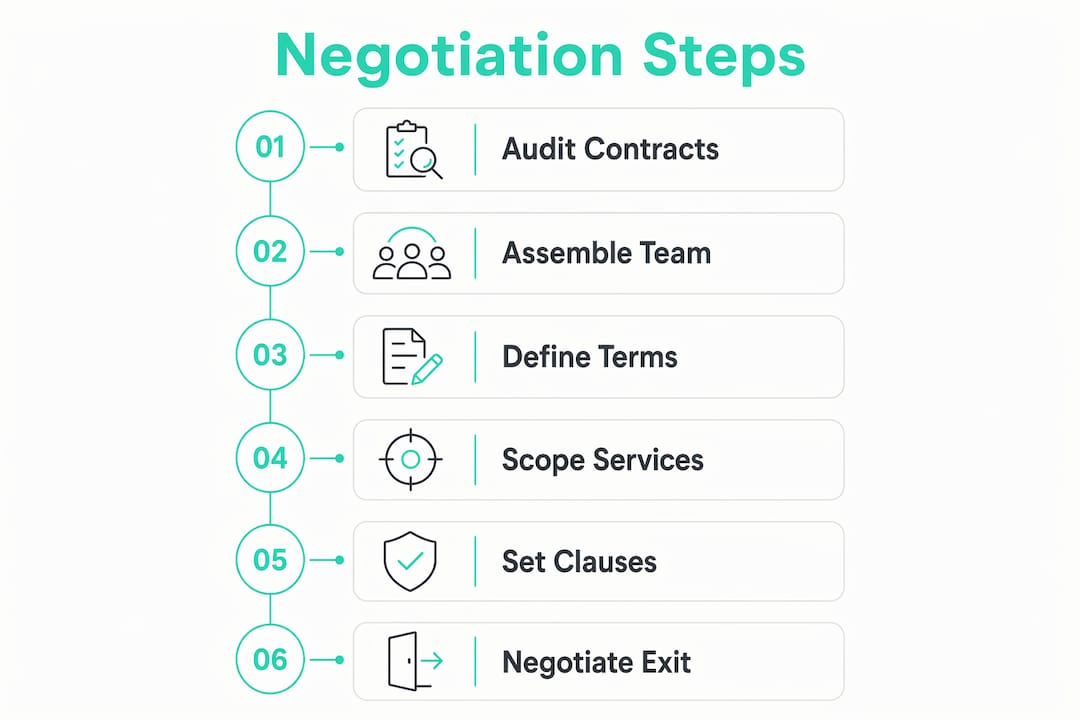
What is the step-by-step process for negotiating these contracts?
A structured approach to cybersecurity contract negotiation prevents the gaps that surface only when an incident is already under way. Follow this sequence before you sign anything.

Step 1: audit your existing contracts and insurance
Review your current cyber insurance policy first. Failing to align IR contracts with cyber insurance panel vendors can invalidate your retainer entirely, forcing crisis-time procurement at full market rates. Confirm which vendors your insurer approves and whether your preferred IR firm is on that panel.
Step 2: assemble a cross-functional negotiation team
Bring legal, security, procurement, and senior management into the negotiation. Legal counsel owns liability caps and indemnity language. Security owns SLA requirements and technical scope. Procurement owns cost controls and billing terms. No single function should negotiate alone.
Step 3: define your non-negotiables
Set clear goals before the first vendor call. Use a comparison table to weigh offerings:
| Contract Element | Minimum Acceptable | Preferred Standard |
|---|---|---|
| Acknowledgement SLA | 2 hours, 24/7 | 1 hour, 24/7 |
| Containment SLA | 4 hours | 2 hours |
| Breach notification to client | 72 hours | 48 hours |
| Surge billing cap | 100% above retainer | 50% above retainer |
| Billing increment | 30 minutes | 15 minutes |
| OFAC screening | 24 hours | Under 2 hours |
Step 4: scope proactive services explicitly
Planning, tabletop exercises, and annual reviews are billable, high-value services. They must be explicitly scoped in the contract, not assumed as free additions to a reactive retainer. Vendors who treat these as complimentary often deprioritise them. Pay for them properly and hold vendors accountable to delivery.
Step 5: confirm ransomware and sanctions clauses
For ransomware incidents, the contract must clearly delineate roles across your IR firm, legal counsel, and insurer. Ambiguity about who authorises payment and who conducts OFAC screening creates delays that threat actors exploit.
Step 6: negotiate exit terms
Agree data deletion timelines, portability formats, and transition assistance before signing. Exiting a vendor mid-incident or post-breach without these terms in place is a legal and operational problem you do not want to solve under pressure.
Pro Tip: Ask your IR vendor to walk you through their last three incident responses at a high level. The specificity of their answers reveals more about operational capability than any contract clause.
What are the most common mistakes in incident response contract negotiations?
Even experienced legal and security teams make avoidable errors in cyber incident management contracts. These are the mistakes that cost organisations the most.
- Misalignment with cyber insurance. Your insurer may mandate specific panel vendors. Using a non-panel firm can void coverage entirely. Confirm panel status before signing any retainer.
- Treating retainers as free services. Organisations that do not scope annual reviews and tabletop exercises into their contracts rarely receive them. These services require budget and contractual commitment.
- Ignoring surge rate caps. Many organisations overlook surge rate caps and billing increments until they receive an invoice for a 90-minute call billed as 4 hours at 150% of the retainer rate. Cap both the rate and the billing increment in writing.
- Accepting vague notification language. "Commercially reasonable" is not a deadline. It is a legal grey area that benefits the vendor, not you. Replace it with a fixed number of hours.
- Overlooking OFAC delays. An OFAC screening delay of 24–48 hours during a ransomware incident can cause a payment deadline to expire, triggering data publication by the threat actor. Confirm the vendor's screening process and timeline before signing.
- Skipping operational maturity checks. A vendor's ISO 27001 certification does not confirm they can perform under pressure. Demand rehearsals, runbooks, and testable outputs as evidence.
You can use Makkarisecurity's incident response readiness checklist to audit your current contract position against these criteria.
Key takeaways
Effective cybersecurity contract negotiation requires measurable SLAs, explicit scope definitions, insurance alignment, and verified vendor capability before any incident occurs.
| Point | Details |
|---|---|
| Fix SLA timelines contractually | Require 1-hour acknowledgement and 2–4 hour containment with confirmed 24/7 coverage. |
| Cap surge billing in writing | Limit surge rates to 50–100% above retainer and mandate 15–30 minute billing increments. |
| Align with cyber insurance first | Confirm your IR vendor is on your insurer's approved panel before signing any retainer. |
| Demand operational maturity proof | Require runbooks, cryptographic data exports, and a tabletop rehearsal before contract signature. |
| Scope proactive services explicitly | Budget for and contractually commit to annual reviews, planning sessions, and tabletop exercises. |
What we have learned negotiating these contracts in practice
The contracts we see most often fail organisations are not the ones with bad intentions. They are the ones written in good faith but without operational specificity. A clause that says "the vendor will respond promptly" is not a service level agreement. It is a placeholder that protects no one.
What actually works is treating the contract as a rehearsal script. Every clause should answer the question: what happens at 2am on a bank holiday when your ERP system is encrypted? If the contract cannot answer that question with a number, a name, or a defined process, it is not finished.
The OFAC screening issue is one that surprises legal teams consistently. Most assume their IR vendor handles sanctions checks internally and quickly. Many do not. A 48-hour delay waiting for a separate legal team to clear a ransomware payment is not a theoretical risk. We have seen it create real operational failures. Ask the question directly in your first vendor meeting, not after you have signed.
The other area where we see consistent underinvestment is proactive services. Organisations pay for a retainer, feel protected, and then discover at the point of an incident that their vendor has never actually tested their environment. Tabletop exercises are not a luxury. They are the mechanism by which you find out whether your contract is worth the paper it is written on.
Finally, the alignment between IR contracts and cyber insurance is not a procurement detail. It is a coverage question. If your insurer's panel does not include your preferred vendor, you face a choice between your insurance payout and your preferred response team. Make that decision before the breach, not during it.
— Makkari
How Makkarisecurity supports your incident response contract readiness
Makkarisecurity specialises in Digital Forensics and Incident Response across the UK, Gibraltar, and Europe. Our breach counsel and panel support service is built for organisations that need court-admissible DFIR alongside contractual clarity. We work with legal teams and business leaders to structure IR retainer agreements that hold up under regulatory scrutiny and operational pressure. Our proprietary forensic engine delivers live memory capture and cross-verified results, and our Eviction Pledge guarantees that once a threat actor is evicted, they will not return for a minimum of 60 days or you will not be charged. To understand the full scope of our incident response capabilities, including pre-negotiated retainers and tabletop exercises, speak with our team directly.
FAQ
What is an incident response retainer agreement?
An incident response retainer is a pre-negotiated contract that gives your organisation priority access to a cybersecurity firm's resources during a breach. It defines SLAs, billing terms, scope, and legal obligations before an incident occurs.
How do slas differ between 24/7 and business hours IR contracts?
Standard SLAs offer 1-hour acknowledgement under 24/7 contracts versus longer windows under business hours agreements. For organisations with critical infrastructure, 24/7 coverage is the required standard.
Why does OFAC screening matter in ransomware incidents?
OFAC screening determines whether a ransomware payment would violate US sanctions law. Vendors with slow internal screening processes, taking 24–48 hours, can cause payment deadlines to expire, triggering data publication by the threat actor.
How should IR contracts align with cyber insurance?
Your IR vendor must appear on your insurer's approved panel, or your retainer may be invalidated during a claim. Confirm panel status and coverage alignment before signing any incident response service agreement.
What proactive services should be scoped in an IR retainer?
Tabletop exercises, annual contract reviews, and threat planning sessions must be explicitly scoped and budgeted. Treating these as free add-ons to a reactive retainer means they rarely get delivered.