
TL;DR:
- Digital forensics involves collecting, preserving, and analysing digital evidence after a data breach to understand intrusion methods and impact. Proper procedures, including immediate memory capture and multi-source evidence collection, ensure admissible findings and regulatory compliance. Effective investigation requires iterative analysis, chain-of-custody documentation, and awareness of cloud and on-premises challenges.
Digital forensics after a data breach is the structured process of collecting, preserving, and analysing digital evidence to determine how an intrusion occurred, what was accessed, and what must be remediated. Known formally as Digital Forensics and Incident Response (DFIR), this discipline sits at the intersection of technical investigation and legal defensibility. Organisations that conduct forensic analysis after a data breach without a defined methodology risk destroying evidence, missing attacker persistence, and failing regulatory obligations. Under UK and EU law, GDPR breach notification requires supervisory authorities to be informed within 72 hours of awareness. That clock makes forensic rigour not just good practice but a compliance necessity.
What prerequisites and tools are needed to conduct forensic analysis effectively
A defensible forensic investigation starts by confirming the incident and immediately preserving both volatile and non-volatile evidence before any analysis begins. Skipping this step is the single most common cause of inadmissible findings. The goal at this stage is to freeze the environment as close to its compromised state as possible.
Foundational prerequisites include:
- Incident confirmation and initial scoping. Verify that a breach has occurred and define the suspected perimeter of compromise before touching any system.
- Evidence preservation without alteration. Never work directly on original media. All analysis must occur on verified forensic copies.
- Logging baselines. Confirm that SIEM, EDR, firewall, and identity logs are active and retained before collection begins.
- Remote collection capability. Where possible, collect evidence remotely to avoid physical disruption to live systems.
- Chain-of-custody documentation. Record who accessed each piece of evidence, when, and why, from the first moment of collection.
The toolset for a forensic investigation spans several categories. The table below maps each category to its primary function.
| Tool category | Primary function | Examples |
|---|---|---|
| Forensic imaging | Creates bit-for-bit copies of storage media | FTK Imager, dd |
| Memory capture | Acquires volatile RAM contents before shutdown | Magnet RAM Capture, WinPmem |
| Cryptographic hashing | Verifies evidence integrity post-acquisition | SHA-256 utilities, md5sum |
| Log aggregation | Centralises events for correlation | Splunk, Microsoft Sentinel |
| Endpoint analysis | Examines artefacts on compromised hosts | Autopsy, Volatility |
Hash mismatches in forensic evidence require immediate re-acquisition or documented explanation. Hashing alone does not replace chain-of-custody, but together they create a reliability baseline that satisfies regulators, insurers, and courts.
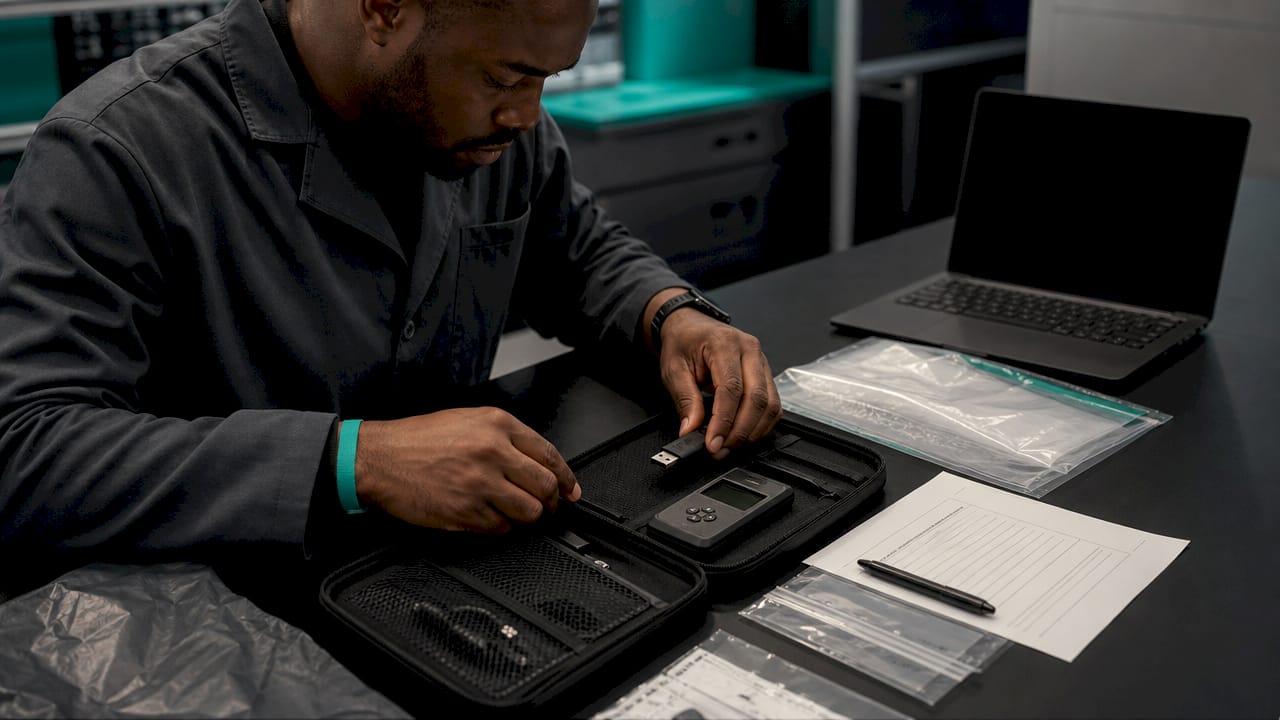
Pro Tip: Establish a pre-incident forensic readiness kit: a USB drive containing your memory capture tool, hashing utility, and a blank chain-of-custody form. When a breach occurs, the first 30 minutes are the most evidence-rich and the most chaotic.
How to collect and preserve forensic evidence after a breach
Evidence collection follows a strict order of volatility. The most transient data must be captured first because it disappears the moment a system is powered down or rebooted.
-
Capture volatile memory. Run your memory acquisition tool against every suspected system before any containment action. Volatile memory holds credentials, encryption keys, running processes, and network connections that are lost permanently on reboot. This is the most time-critical step in the entire process.
-
Document running state. Record active network connections, logged-in users, running processes, and open files. Use native OS commands (netstat, ps, tasklist) and export the output immediately.
-
Acquire forensic disk images. Use FTK Imager or an equivalent tool to create bit-for-bit images of all relevant storage media. Never analyse the original. Work exclusively from verified copies.
-
Hash every image. Generate a SHA-256 hash of each forensic image immediately after acquisition. Verify the hash after every transfer to confirm no alteration has occurred.
-
Export logs from all relevant sources. Collect Windows Event Logs, Syslog, firewall logs, VPN authentication records, cloud audit trails, and SIEM exports. A single compromised endpoint rarely tells the whole story. Multi-source correlation is what separates a partial picture from a complete one.
-
Collect identity and authentication artefacts. Pull Active Directory logs, Azure AD sign-in records, MFA bypass events, and privileged account activity. Attackers frequently abuse identity infrastructure to move laterally.
-
Extend collection to cloud and SaaS environments. Cloud forensics introduces unique challenges around log retention windows and shared responsibility. Collect AWS CloudTrail, Microsoft 365 Unified Audit Logs, or equivalent records before they expire.
-
Seal and label all evidence. Each item must be logged in the chain-of-custody record with a unique identifier, acquisition timestamp, and the name of the acquiring analyst.
Pro Tip: If operational pressure forces an immediate reboot before memory capture, document the decision formally, note the timestamp, and record who authorised it. Undocumented reboots are the most common reason forensic findings are challenged in legal proceedings.
How to reconstruct the attack timeline from forensic data
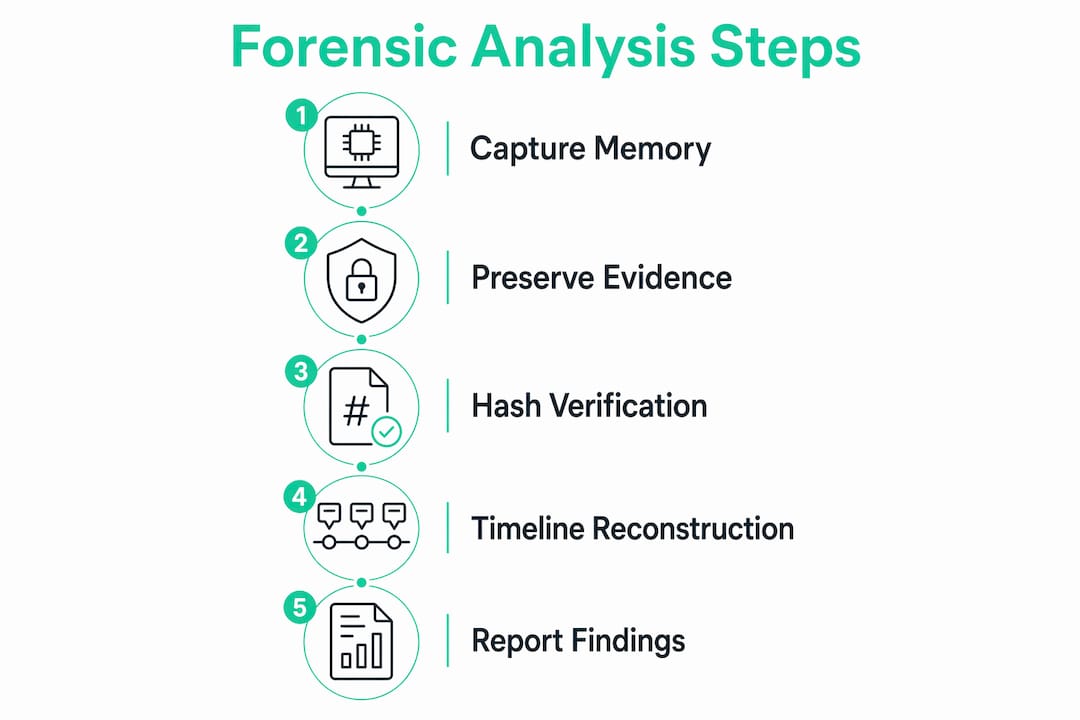
Timeline reconstruction is the analytical core of any cybersecurity post-breach assessment. The primary goal is to reconstruct the attack to understand intrusion and impact, not simply to attribute blame. Attribution is secondary. Understanding the full sequence of attacker actions is what drives effective remediation.
The reconstruction process correlates data from multiple sources into a single chronological view:
- Timestamp correlation. Align log timestamps across systems, accounting for time zone differences and clock skew. A one-minute discrepancy between a firewall log and an endpoint event log can misplace an entire attack phase.
- Initial access identification. Identify the first evidence of attacker presence: a phishing link click, an exploited public-facing application, or a compromised VPN credential. This is the breach origin point.
- Lateral movement mapping. Trace how the attacker moved from the initial foothold to other systems. Look for pass-the-hash, Kerberoasting, or remote service exploitation in authentication and process logs.
- Persistence mechanism detection. Timeline reconstruction maps all modified configuration files, scheduled tasks, and rogue accounts to drive effective remediation. These artefacts confirm whether the attacker established a durable foothold.
- Data exfiltration indicators. Identify large outbound transfers, unusual DNS queries, or cloud storage uploads that correlate with the attacker's presence window.
The table below compares two common approaches to timeline reconstruction.
| Approach | Strengths | Limitations |
|---|---|---|
| Manual log correlation | Full analyst control, highly customisable | Time-intensive, prone to human error at scale |
| SIEM-driven timeline | Fast aggregation, automated alerting | Dependent on log completeness and retention settings |
For digital forensic investigation methods that go beyond basic log review, tools such as Volatility for memory analysis and Autopsy for disk artefact examination provide the depth needed to surface attacker behaviour that logs alone will not reveal.
Common pitfalls and best practices in forensic investigations
Most forensic investigations fail not because of technical gaps but because of procedural ones. The following mistakes are the most damaging and the most preventable.
- Rebooting before memory capture. This destroys volatile evidence permanently. Capturing volatile memory before shutdown is the industry best practice. If containment requires an immediate reboot, document the decision formally.
- Accepting the initial scope as final. Forensic investigations require iterative cycles of collection and analysis. Attackers frequently persist in ways that are not visible in the first pass. Repeated evidence correlation across multiple systems reveals deeper compromise.
- Neglecting chain-of-custody documentation. Chain-of-custody neglect weakens evidentiary reliability even when technical findings are accurate. Every handoff, every copy, and every analysis action must be recorded.
- Collecting from too few sources. Limiting collection to a single endpoint or server produces an incomplete picture. Evidence must span endpoints, servers, network controls, identity systems, cloud environments, and SIEM.
- Conflating containment with eradication. Isolating a compromised host stops the bleeding. It does not confirm the attacker is gone. Eradication requires verified timeline reconstruction and persistence mechanism removal.
"Evidence integrity is procedural. Collecting evidence properly prevents weakening the case before it reaches a regulator, insurer, or court."
For organisations managing cloud forensics challenges alongside on-premises environments, the complexity multiplies. Cloud log retention windows are often short. Collecting cloud audit trails must happen in parallel with on-premises evidence collection, not after.
Key takeaways
A defensible forensic investigation requires volatile memory capture first, multi-source evidence collection, SHA-256 verified imaging, iterative analysis cycles, and documented chain-of-custody throughout.
| Point | Details |
|---|---|
| Capture memory before reboot | Volatile RAM holds credentials and processes lost permanently on shutdown. |
| Hash every forensic image | SHA-256 verification after each transfer confirms evidence has not been altered. |
| Collect across all sources | Endpoints, identity, cloud, network, and SIEM data together reveal the full attack path. |
| Iterate the investigation scope | Initial assessments miss attacker persistence; repeated correlation cycles uncover deeper compromise. |
| Document chain-of-custody | Every evidence handoff must be recorded to maintain admissibility for regulators and courts. |
What I have learned from conducting forensic investigations under pressure
The hardest part of a live breach investigation is not the technical work. It is the pressure to contain fast at the expense of evidence quality. I have seen organisations reboot compromised servers within minutes of detection, destroying the one artefact that would have confirmed the attacker's entry point. That decision, made in good faith, cost weeks of additional investigation time.
The second pattern I see consistently is scope underestimation. Teams identify one compromised workstation and treat it as the full incident. Three weeks later, a second wave of attacker activity surfaces from a cloud tenant that was never examined. Iterative evidence collection is not optional. It is the only way to confirm the attacker is genuinely gone.
Forensic readiness before an incident changes everything. Organisations that have pre-configured logging, retention policies, and a documented incident scope determination process respond faster and produce more defensible findings. The investigation starts the moment a breach is suspected. Every minute before that moment either helps or hinders what comes next.
Clear stakeholder communication matters as much as technical rigour. Legal, compliance, and executive teams need structured updates at defined intervals. Forensic findings presented without context create confusion and delay decisions. The analyst's job is not just to find the truth. It is to communicate it in a way that drives the right response.
— Makkari
Makkarisecurity's forensic and incident response capabilities
Organisations facing a breach need more than technical skill. They need a partner who can preserve evidence, maintain chain-of-custody, and produce findings that hold up to regulatory and legal scrutiny.
Makkarisecurity specialises in DFIR, with a proprietary forensic engine built over five years that delivers live memory capture and cross-verified results. The incident response and forensics services cover the full investigation lifecycle, from initial evidence preservation through timeline reconstruction and court-admissible reporting. For organisations that need forensic readiness before an incident occurs, Makkarisecurity's IR retainer options provide rapid engagement and pre-configured response capabilities. The Eviction Pledge guarantees that once a threat actor is evicted, they will not return for a minimum of 60 days, or the engagement is provided at no charge.
FAQ
What is the first step to conduct forensic analysis after a data breach?
The first step is to capture volatile memory from affected systems before any reboot or containment action. Volatile RAM contains credentials, running processes, and network connections that are permanently lost on shutdown.
How does chain-of-custody affect a forensic investigation?
Chain-of-custody documentation records every access to and transfer of evidence. Without it, technically accurate findings can be challenged or rejected by regulators, insurers, and courts.
Why is SHA-256 hashing used in forensic evidence collection?
SHA-256 generates a unique cryptographic fingerprint of a forensic image. Verifying the hash after every transfer confirms the evidence has not been altered, satisfying the integrity requirements of a defensible investigation.
How long do organisations have to report a data breach under GDPR?
Organisations in the UK and EU must notify supervisory authorities within 72 hours of becoming aware of a personal data breach, unless the risk to individuals' rights and freedoms is unlikely.
What sources should be included in a forensic investigation after a breach?
A complete investigation collects evidence from endpoints, servers, firewalls, identity and authentication systems, EDR platforms, cloud environments, and SIEM. Relying on a single source produces an incomplete picture of attacker activity.