
TL;DR:
- Digital forensics applies a phase-driven approach to legally defendable digital evidence, including identification, preservation, collection, examination, analysis, documentation, and presentation. Proper evidence collection and detailed documentation ensure admissibility in court, with a focus on verified forensic copying and chain-of-custody records. The main investigation failures occur in confusing examination with analysis, neglecting volatile memory, and poor documentation practices.
The forensic analysis process is the disciplined, phase-driven methodology used to identify, preserve, collect, examine, analyse, and present digital evidence in a legally defensible manner. Known formally within the discipline as digital forensics, it sits at the intersection of cybersecurity incident response and legal proceedings. Every phase serves a specific evidentiary purpose. Skipping or compressing any phase risks undermining the entire investigation. For cybersecurity professionals and legal experts managing breach response, understanding how forensic analysis works is not optional. It determines whether your findings hold up in court, satisfy regulators, or simply answer the question: what actually happened?
What are the core phases of the forensic analysis process?
The forensic investigation process consists of seven sequential phases: Identification, Preservation, Collection and Acquisition, Examination, Analysis, Documentation and Reporting, and Presentation. Each phase has a defined purpose and feeds directly into the next. The process is iterative, not strictly linear. New findings during analysis can send investigators back to collection or examination.

The table below summarises each phase, its objective, and the primary activities involved.
| Phase | Objective | Key activities |
|---|---|---|
| Identification | Define scope and locate evidence sources | Asset mapping, triage, scope definition |
| Preservation | Prevent alteration of original evidence | Write-blockers, isolation, access controls |
| Collection and Acquisition | Create verified forensic copies | Bit-for-bit imaging, cryptographic hashing |
| Examination | Extract usable artefacts from raw data | File carving, log parsing, metadata recovery |
| Analysis | Interpret artefacts and reconstruct events | Timeline analysis, hypothesis testing |
| Documentation and Reporting | Record all actions and findings | Chain-of-custody logs, forensic reports |
| Presentation | Communicate findings to stakeholders | Expert witness testimony, written reports |
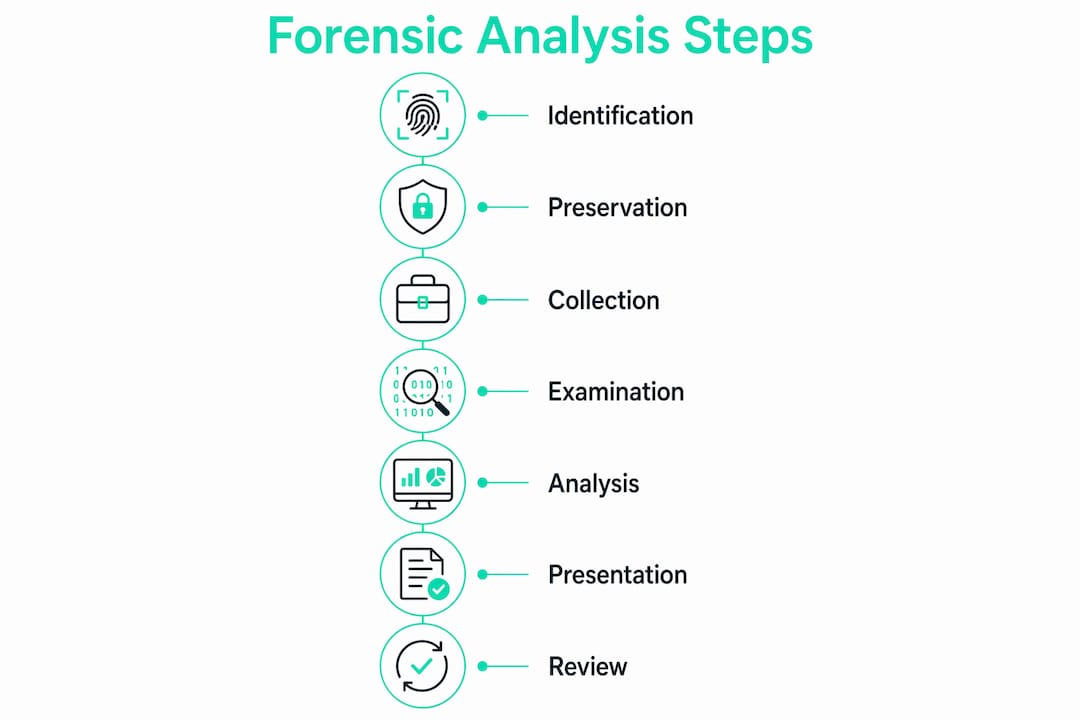
A distinction that practitioners frequently blur is the difference between examination and analysis. Examination filters and organises raw data into usable artefacts. Analysis interprets those artefacts to reconstruct events and build a narrative. Confusing the two produces reports that describe what was found but fail to explain what it means. Timeline reconstruction is the clearest example of analysis at work: connecting individual log entries, file timestamps, and network events into a cause-and-effect sequence that explains attacker behaviour.
Pro Tip: Document every decision made during the examination phase, including what you chose not to examine and why. Courts and opposing counsel will ask.
How is evidence collected and preserved to ensure legal defensibility?
Evidence integrity is the foundation of every forensic investigation. Legally defensible methods require that findings are reproducible and independently reviewable. That standard begins at acquisition and cannot be retrofitted later.
The accepted acquisition method is a bit-for-bit forensic copy verified by cryptographic hashing, most commonly SHA-256. All examination and analysis work occurs on the copy. The original evidence remains untouched. Hash verification confirms the copy is identical to the source. Any alteration, however minor, produces a different hash value and immediately flags a problem.
The steps below represent best practice for acquisition and preservation:
- Isolate the device or system from the network before any acquisition begins to prevent remote access or data modification.
- Capture volatile memory first. Following NIST SP 800-61 Rev. 2, volatile evidence must be captured before disk imaging. RAM holds decrypted credentials, injected code, and active network connections that disappear on shutdown.
- Attach a hardware write-blocker before connecting storage media. ACPO principles require that no action alters data on the original device, and write-blockers operationalise that requirement.
- Create the forensic image using validated imaging tools. Record the tool name, version, and settings used.
- Generate and record hash values immediately after imaging. Label every hash explicitly with the algorithm used, for example: SHA-256: <value>. Unsigned hashes cause verification disputes during review.
- Document the chain of custody from the moment evidence is identified. Record who handled it, when, and why at every transfer point.
Pro Tip: Treat chain-of-custody documentation as risk management, not paperwork. Documentation gaps are operational risks that can cause evidence to be ruled inadmissible, regardless of technical quality.
What techniques and tools support forensic examination and analysis?
Examination converts a raw forensic image into a structured set of artefacts. Analysis turns those artefacts into answers. Both stages require specific techniques and an awareness of the constraints that affect what data is actually recoverable.
Artefact extraction methods
File carving recovers deleted or fragmented files by identifying file signatures in raw data, bypassing the file system entirely. Log parsing extracts event sequences from Windows Event Logs, Syslog, or application logs to establish what processes ran and when. File metadata recovery surfaces creation, modification, and access timestamps that place files within an investigative timeline. For a detailed breakdown of one of the most technically demanding extraction methods, the Makkarisecurity guide on file carving forensics covers the technique thoroughly.
Timeline analysis and hypothesis testing
Timeline analysis is the analytical backbone of most breach investigations. Investigators plot artefacts chronologically across multiple data sources: file system timestamps, registry entries, browser history, and network logs. Hypothesis testing then applies structured reasoning. The investigator proposes a sequence of attacker actions and tests whether the artefact timeline supports or contradicts it. This prevents confirmation bias and produces conclusions that can withstand cross-examination.
Common challenges and mitigations
Forensic professionals regularly encounter obstacles that limit what can be recovered. The following challenges appear across most investigations:
- Encryption. Full-disk encryption renders physical images unreadable without the decryption key. Mitigation: capture volatile memory before shutdown, as the key may reside in RAM.
- Volatile versus non-volatile data. RAM evidence disappears on power-off. Mitigation: prioritise live memory capture for active or compromised endpoints before any other acquisition step.
- Device state and acquisition method selection. Encryption and device state determine whether logical, filesystem, physical, or RAM acquisition is appropriate. The wrong choice can miss critical evidence or be challenged as disproportionate.
- Anti-forensic techniques. Attackers use timestomping, log deletion, and steganography to obscure activity. Mitigation: cross-reference multiple independent data sources rather than relying on a single artefact type.
- Cloud and distributed environments. Evidence may reside across jurisdictions, with limited acquisition rights. The Makkarisecurity overview of cloud forensics challenges addresses the specific constraints investigators face in 2026.
How is forensic analysis documented and presented in legal contexts?
A forensic report is the permanent record of the investigation. It must be accurate enough for a technical peer to reproduce the findings and clear enough for a judge or board member to understand the conclusions. Those two requirements are not in conflict, but they do require deliberate structure.
A complete forensic report contains: the scope and objectives of the investigation; the tools used, including version numbers; all hash values with explicit algorithm labels; a chronological timeline of investigator actions; artefact findings with source locations; analytical conclusions with supporting reasoning; and any limitations or gaps in the evidence. The digital forensic evidence presentation checklist from Makkarisecurity provides a structured template for practitioners building reports for legal scrutiny.
Admissibility standards vary by jurisdiction, but the Daubert criteria in US federal courts and equivalent UK standards both require that methods are scientifically valid, applied correctly, and capable of independent review. Chain-of-custody records and hash verification logs directly satisfy the reproducibility requirement. Gaps in either will be challenged.
Writing for mixed audiences requires a deliberate two-layer approach. Technical findings go into appendices or dedicated technical sections. The executive summary and conclusions use plain language, define acronyms, and avoid assuming prior knowledge. Legal professionals need to understand what the evidence proves, not how SHA-256 works.
Pro Tip: Write your conclusions before your technical sections. Starting with the answer forces you to be clear about what the evidence actually supports, and it exposes gaps in your reasoning before the report is finalised.
Key takeaways
The forensic analysis process is only as defensible as its weakest phase. Rigorous documentation, verified acquisition, and clear separation of examination from analysis determine whether findings survive legal scrutiny.
| Point | Details |
|---|---|
| Seven defined phases | Identification through Presentation each serve a distinct evidentiary purpose and must not be compressed. |
| Volatile memory first | Capture RAM before disk imaging to preserve decrypted credentials and injected code that disappear on shutdown. |
| SHA-256 hash verification | Every forensic copy requires a cryptographic hash with the algorithm explicitly labelled to prevent verification disputes. |
| Examination versus analysis | Examination extracts artefacts; analysis interprets them. Conflating the two weakens report defensibility. |
| Chain of custody as risk management | Documentation gaps can render technically sound evidence inadmissible. Record every transfer and action. |
Where most forensic investigations actually break down
Having worked on the front line of DFIR for years, the failure point I see most consistently is not technical. It is the confusion between examination and analysis. Investigators produce detailed artefact lists and call it analysis. Courts and opposing counsel do not accept a catalogue of findings as a conclusion. They want to know what those findings mean and why that interpretation is correct.
The second most common failure is volatile memory. Teams arrive at a compromised endpoint and reach for the disk image first. By the time they think about RAM, the system has been rebooted or the attacker's injected code has vanished. The role of memory forensics in breach investigations is not a niche consideration. It is the difference between recovering attacker tooling and writing "no malware found on disk" in your report.
Chain-of-custody documentation is the third area where I see teams cut corners under time pressure. The instinct is understandable. When a breach is active, paperwork feels secondary. The problem is that documentation cannot be reconstructed accurately after the fact. Every handoff, every tool run, every decision needs to be recorded in real time. That discipline is what separates a forensic investigation from a technical exercise.
— Makkari
Makkarisecurity's approach to forensic analysis and incident response
Makkarisecurity specialises in Digital Forensics and Incident Response, with a proprietary forensic engine built over five years to deliver speed and verified accuracy across live and post-incident investigations.
Every engagement maintains strict chain-of-custody standards, live memory capture, and cross-verified hash integrity from acquisition through to presentation. Findings are prepared to withstand legal scrutiny, supporting both internal breach management and court-admissible proceedings. Makkarisecurity also offers the Eviction Pledge: once a threat actor is evicted, they will not return for a minimum of 60 days, or the client pays nothing. For organisations in the UK, Gibraltar, and broader Europe that need forensic analysis and incident response they can rely on, the full range of DFIR capabilities is available, along with specialist breach counsel support for legally sensitive investigations.
FAQ
What is the forensic analysis process?
The forensic analysis process is a structured, seven-phase methodology covering identification, preservation, acquisition, examination, analysis, documentation, and presentation of digital evidence. Each phase is designed to maintain evidence integrity and produce findings that are legally defensible and independently reproducible.
What is the difference between examination and analysis in digital forensics?
Examination extracts and organises artefacts from raw forensic data. Analysis interprets those artefacts to reconstruct events and build an evidential narrative. Conflating the two produces reports that describe findings without explaining their significance.
Why must volatile memory be captured before disk imaging?
RAM holds dynamic evidence including decrypted credentials, active network connections, and injected malicious code. This data is lost permanently when a system is powered off, so volatile memory must be acquired first in any live or active-compromise investigation.
What makes a forensic report legally admissible?
A forensic report must document the methods used, tools and versions, all hash values with explicit algorithm labels, a complete chain of custody, and conclusions supported by reproducible reasoning. Gaps in any of these elements can be challenged under admissibility standards such as the Daubert criteria or equivalent UK evidentiary rules.
What is a chain of custody in digital forensics?
Chain of custody is the documented record of who handled evidence, when, and under what conditions at every stage of an investigation. Missing or incomplete chain-of-custody records are operational risks that can cause technically sound evidence to be ruled inadmissible in legal proceedings.