Specialised digital forensic tools outperform generic alternatives because they embed domain-specific analytics, predefined investigative workflows, and automated evidence scoring that generic platforms simply do not provide. Where a general-purpose tool presents raw data and waits for an examiner to interpret it, a specialised tool already knows what questions the investigation needs to answer. The result is faster triage, fewer missed artefacts, and actionable intelligence delivered in hours rather than weeks. Economic analyses of front-end forensic strategies show a return on investment as high as 646:1 when resources are applied precisely to the right evidence at the right time. For incident responders and digital forensics practitioners, that gap between generic breadth and specialised depth is where investigations are won or lost.
Key advantages of specialised forensic tools at a glance:
- Domain-aware analytics that score and filter artefacts automatically, reducing manual review time
- Predefined investigative workflows aligned to specific case types, from intrusion response to child exploitation
- Reduced lab backlogs by ruling out non-relevant devices before they reach the laboratory
- Integration with EDR platforms, cloud systems, and legacy environments for complete coverage
- Investigator protection through targeted previews that limit unnecessary exposure to harmful material
- Faster time to actionable outcomes, with examiners starting from tens of relevant artefacts rather than thousands
What digital forensic tools actually do
Digital forensic tools are software platforms that acquire, parse, and analyse digital evidence from devices, storage media, cloud services, and network systems. Their core functions span the full investigation lifecycle.
- Data acquisition: creating forensically sound images of storage media while preserving hash integrity and metadata
- Artefact extraction: recovering files, logs, registry entries, browser history, and application data
- Timeline generation: correlating events across multiple data sources to reconstruct what happened and when
- Reporting: producing defensible outputs that can withstand scrutiny in legal proceedings or peer review
Generic tools are designed to handle nearly any case type. They parse and display data across a broad range of evidence sources, which makes them flexible but places the analytical burden squarely on the examiner. The examiner must know where to look, what values are suspicious, and which artefacts matter for the specific investigation at hand. That breadth is genuinely useful, but it comes at a cost in speed and accuracy when the case has a defined scope. Understanding the forensic analysis process helps clarify where generic tools serve well and where specialised tools take over.
How specialised and generic tools differ in practice
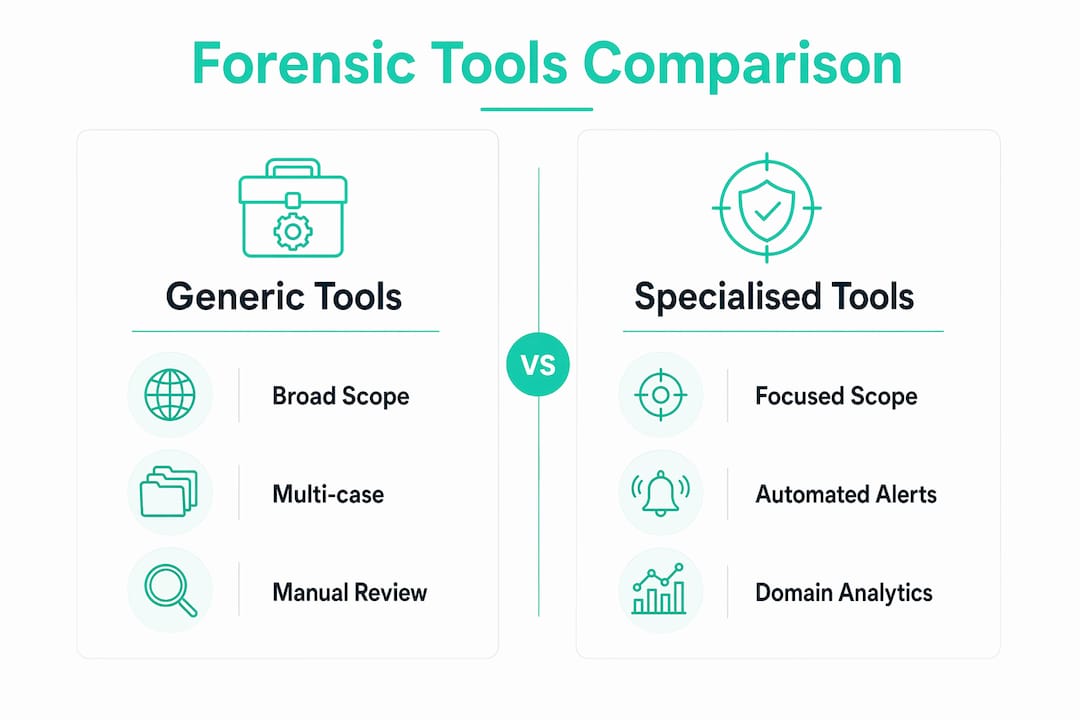
The core distinction is focus. Generic tools parse and display data, relying on the examiner to determine relevance. Specialised tools know the investigative questions in advance and apply analytics to answer them without manual configuration.

| Feature | Generic tools | Specialised tools |
|---|---|---|
| Focus/Scope | Broad, multi-case-type coverage | Narrow, domain-specific investigation |
| Automation and analytics | Minimal; examiner-driven | Built-in scoring, filtering, and prioritisation |
| Integration with EDR and other systems | Limited or manual | Native connectors to EDR, cloud, and legacy platforms |
| Ease of use and required expertise | High expertise required to avoid blind spots | Lower barrier; tool guides the examiner |
Autopsy is a well-known general-purpose forensics platform. It handles a wide range of evidence types and case categories, making it a staple in many laboratory toolkits. Cyber Triage, by contrast, is built specifically for intrusion investigations. It collects only the artefacts relevant to compromise scenarios and applies analytics to score each one, so examiners start with tens of high-confidence findings rather than thousands of raw data points.
EDR platforms present a related challenge. They filter telemetry through predefined detection rules, which means you receive what the system considers interesting rather than a complete forensic picture. They are also endpoint-centric, leaving cloud assets, legacy systems, and unmanaged devices outside their scope. Specialised forensic tools fill that gap by providing comprehensive visibility across memory, disk, registry, logs, and cross-environment sources. For a deeper look at where generic platforms fall short in cloud contexts, the cloud forensics challenges guide covers the specifics.
Pros and cons of generic versus specialised forensic tools
Understanding the trade-offs helps you select the right tool for each investigation type rather than defaulting to a single platform for everything.
General-purpose tools
Pros:
- Applicable across a wide range of case types, from financial fraud to mobile device examination
- A single platform can support multiple investigation categories within one laboratory
- Typically well-documented with large user communities
Cons:
- Require extensive examiner expertise to identify relevant artefacts and suspicious values
- Critical evidence can be missed if the examiner does not know where to look
- Slower to reach actionable conclusions because analysis is entirely manual
- Mission alignment wins over generic breadth when a laboratory has a defined investigative focus
Specialised tools
Pros:
- Faster time to relevant evidence because analytics run without examiner intervention
- Higher accuracy on domain-specific artefacts, with automated scoring reducing blind spots
- Lower expertise barrier for junior examiners working within a defined case type
- Built-in investigator protection features for sensitive material such as CSAM
Cons:
- Limited utility outside the tool's defined investigation scope
- Consultants and law enforcement agencies handling diverse case types will need multiple specialised tools
- Specific training is required to use each tool effectively
- Licensing costs can be higher than open-source generic alternatives
Pro Tip: Selecting forensic tools by feature list length misallocates laboratory resources. Evaluate tools against your actual case profile, not vendor capability summaries.
Key features that make specialised forensic tools effective
Specialised tools do not simply collect more data. They are engineered around specific investigative questions, and that design philosophy shapes every feature they offer.
- Predefined investigative questions: the tool already knows what artefacts matter for the case type, removing the need for manual configuration and reducing the risk of oversight
- Automated evidence scoring: artefacts are classified as bad, suspicious, or benign, so examiners begin with the highest-confidence findings
- Targeted data collection: only artefacts relevant to the investigation type are collected, reducing processing time and storage requirements
- EDR and cloud integration: native connectors allow specialised tools to ingest telemetry from endpoint platforms and extend coverage to cloud and hybrid environments
- Legacy system support: specialised tools often include parsers for older operating systems and file formats that generic platforms deprioritise
- CSAM safety features: targeted preview workflows limit investigator exposure to harmful material while preserving evidential integrity and chain-of-custody
- Training and certification pathways: vendors of specialised tools typically offer structured training aligned to the tool's specific domain, accelerating examiner competency
The role of proprietary forensic tools in breach investigations illustrates how these features translate directly into faster root-cause identification and stronger prosecutions.
Case studies: what specialised tools achieve in the field
The clearest evidence for why specialised forensics outperforms generic methods comes from documented field deployments.
CSAM investigation, United States: A detective executed a search warrant involving 12 or more devices on scene. Using ADF triage technology, the team rapidly ruled out unrelated devices and focused on those containing probative material. What might have taken months of full forensic examination was reduced to hours, enabling swift suspect action and victim safeguarding.
Child exploitation investigation, United Kingdom: A UK agency deployed ADF triage to address examination delays. The tool uncovered a live chat with a second suspect, first-generation CSAM, and directing messages for two children. The second suspect was arrested immediately, the children were safeguarded, and over 12 months the team submitted roughly 250 fewer devices to the Digital Forensic Unit. That reduction in submissions directly cut laboratory backlog and freed examiners for higher-priority work.
Intrusion response: Cyber Triage users consistently report that the tool shaves hours off intrusion investigations compared to working through a general-purpose platform. The automated scoring means an examiner arrives at the relevant artefacts without manually sifting through thousands of data points.
These cases share a common thread. Forensic triage should be understood as a reordering of processes, not a replacement for full analysis. Its value lies in ruling out irrelevant devices on scene, so the laboratory receives only the evidence that genuinely warrants deep examination. Smaller specialised laboratories that assign one analyst per case end-to-end also reduce miscommunication and contamination risk compared to high-volume fragmented workflows.
Recent advances pushing specialised forensics further
The gap between specialised and generic tools is widening, not narrowing, as the technology matures.
- AI-assisted evidence scoring: machine learning models now classify artefacts with greater confidence, reducing false positives and accelerating triage in high-volume investigations
- Expanded artefact coverage: specialised tools increasingly parse encrypted messaging platforms, self-generated content, and financial sextortion indicators that generic tools do not address
- Cross-platform support: modern specialised tools cover Windows, macOS, Linux, mobile, and cloud-derived data within a single workflow, removing the need to switch platforms mid-investigation
- Open-source development: access to languages such as Python and Rust has enabled domain experts to build specialised tools that target specific artefact types with accuracy that generic adaptations cannot match
- Cross-verification as standard: using independent specialised tools to verify findings has become a defence-in-depth strategy; discrepancies between tools flag artefact interpretation ambiguities that require further analysis rather than being accepted at face value
- Cloud and hybrid environment coverage: specialised tools now extend beyond the endpoint to cover cloud storage, SaaS applications, and hybrid infrastructure, addressing the blind spots that detection-only platforms leave open
The open-source route deserves particular attention. When domain experts write tools in purpose-built languages for specific artefact types, the resulting accuracy exceeds what a generic platform can achieve through broad-spectrum parsing. Agility matters too: a specialised open-source tool can be updated to address a new attacker technique or evidence type within days, whereas a monolithic generic platform requires a full release cycle. For practitioners evaluating software selection processes, the same structured evaluation logic applies to forensic tooling choices.
How Makkarisecurity applies specialised forensics where it counts
Makkarisecurity's approach to DFIR is built on the same principles that make specialised forensics effective: focus, speed, and verifiable accuracy. The proprietary forensic engine, developed over five years, delivers live memory capture and cross-verified results that generic platforms cannot replicate. Cross-verification is not a quality-control afterthought at Makkarisecurity. It is embedded in the methodology, with independent tool outputs compared at every stage so that artefact interpretation ambiguities are caught before they reach a report or a courtroom.
The Eviction Pledge sets a clear performance standard: once a threat actor is evicted, they are expected not to return for a significant period, or the client is not charged. That guarantee is only credible because the underlying forensic work is thorough enough to identify every persistence mechanism and lateral movement path. A generic tool that misses domain-specific artefacts cannot support that level of assurance.
Makkarisecurity's incident response and digital forensics capabilities cover the full investigation lifecycle, from live memory acquisition through to court-admissible evidence presentation. For organisations that need forensic support ready before an incident occurs, the breach counsel and panel support service provides expert forensic analysis with defensible chain-of-custody documentation from the first moment.
Key takeaways
Specialised forensic tools outperform generic alternatives because they embed domain-specific analytics and automated evidence scoring that reduce investigation timelines and improve accuracy on targeted case types.
| Point | Details |
|---|---|
| Automation drives speed | Specialised tools score and filter artefacts automatically, cutting hours from intrusion investigations. |
| Triage reorders, not replaces | Ruling out irrelevant devices on scene reduces lab backlog without sacrificing full forensic depth. |
| ROI justifies specialisation | Front-end forensic strategies can yield ROI as high as 646:1 when resources target the right evidence. |
| Generic tools carry hidden costs | Missed artefacts and slower analysis create investigative gaps that generic platforms cannot self-correct. |
| Cross-verification strengthens findings | Using independent specialised tools to compare outputs catches interpretation errors before they reach court. |