
TL;DR:
- Proprietary forensic tools integrate data acquisition, parsing, and reporting to support legal and technical validation. They are most effective when their limitations are documented, validated standards are applied, and outputs are cross-verified with open-source tools. Relying solely on black-box systems risks evidence challenges, so continuous validation and deliberate tool management are essential.
Proprietary forensic tools are specialised software platforms that integrate data acquisition, artefact parsing, and case management into a single validated environment for digital breach investigations. In the industry, these platforms are formally categorised under Digital Forensics and Incident Response (DFIR) tooling, and their role of proprietary forensic tools in producing court-admissible evidence is now a baseline expectation for cybersecurity professionals and legal advisors alike. Platforms such as Encase and Magnet Axiom score between 83% and 100% on efficiency metrics across forensic domains. That range reflects genuine strength in most scenarios, but it also signals that no single tool achieves perfect coverage. Understanding where these tools excel, where they fail, and how validation standards like NIST CFTT and ISO/IEC 17025 govern their use is the foundation of credible forensic practice.
What are the key functionalities and benefits of proprietary forensic tools?
Proprietary forensic platforms deliver capabilities that generic or piecemeal toolsets cannot replicate at enterprise scale. Their core value lies in integrating multiple investigative functions under one validated roof, which reduces handoff errors and preserves chain-of-custody integrity throughout an investigation.
The primary functional advantages include:
- Integrated data acquisition and parsing. A single platform ingests disk images, memory captures, cloud artefacts, and mobile data without requiring manual format conversion between tools.
- Automated workflow and reporting. Case timelines, artefact tagging, and evidence packaging are generated automatically, reducing analyst time and the risk of documentation gaps.
- Enterprise scalability. Proprietary platforms handle large data volumes across distributed environments, which is critical during multi-site breach investigations.
- Vendor support and update cycles. Licenced tools receive structured updates, bug patches, and technical support, unlike community-maintained alternatives where response times vary.
- Validated output formats. Reports produced by established platforms are formatted to meet legal disclosure requirements, which matters when evidence reaches a courtroom.
The benefits of proprietary forensic tooling become most apparent when investigators must normalise disparate data sources into a coherent narrative. Disparate tool outputs demand processes for aligning timestamps, matching artefacts across sources, and presenting evidence without contradiction. Platforms that handle this normalisation internally save significant analysis time and reduce the risk of presenting conflicting evidence in legal proceedings.
Pro Tip: When onboarding a new proprietary platform, run a controlled test case with known artefacts before deploying it in a live investigation. This confirms the tool's output matches expected results and gives you documented baseline performance for court disclosure.

What are the limitations and risks of proprietary forensic tools?
The black-box nature of proprietary forensic tools is their most significant liability in legal contexts. Internal decoding logic is not publicly auditable, which means investigators cannot always explain precisely how a result was produced. That opacity creates risk when evidence is challenged in court.
Research into automotive forensic tools illustrates this concretely. Simulations identified errors including temporal offsets, GPS coordinate rounding, and spatial downsampling that directly affected accident reconstruction reliability. The same categories of error apply to enterprise DFIR tools: timestamp misalignments, missing database fields, and incorrect artefact attribution can all distort an investigation's conclusions.
Specific error types that cybersecurity professionals and legal advisors must account for include:
- Timestamp offsets. Tools may apply incorrect timezone conversions or fail to account for daylight saving adjustments, producing evidence timelines that are factually wrong.
- Spatial downsampling. Location data can be rounded or averaged, reducing precision in cases where exact coordinates matter.
- Missing fields. Proprietary parsers may silently skip database fields they do not recognise, leaving artefacts unrecovered without alerting the analyst.
- Incorrect artefact attribution. Automated categorisation can misclassify user-generated content versus system-generated content, affecting intent analysis.
The legal impact of undisclosed proprietary processes is real. If opposing counsel establishes that a tool's internal logic is unknown and unverifiable, the admissibility of evidence produced by that tool comes into question. Cross-verification with independent analysis before legal reporting is not optional. It is the standard that separates defensible forensic work from work that collapses under scrutiny.
Pro Tip: Review vendor release notes after every tool update. Proprietary platforms frequently adjust parsing logic between versions, which can cause the same artefact to produce different results depending on which version of the tool was used during the investigation.
How do validation standards shape the use of proprietary forensic tools?
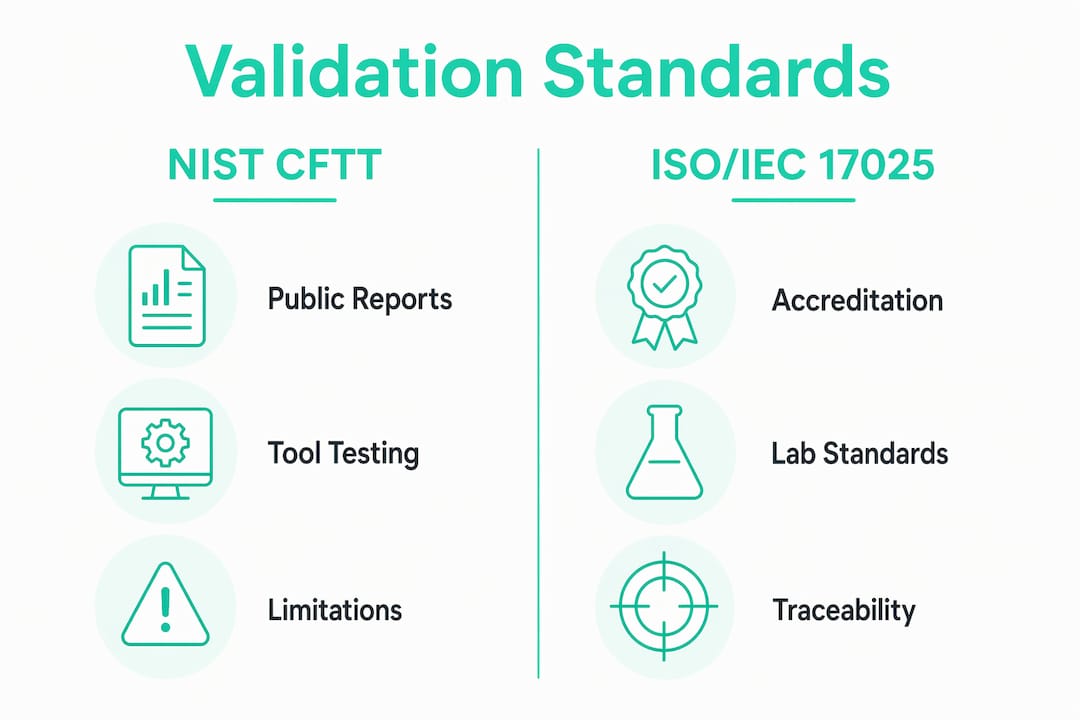
Validation is the mechanism that converts a vendor's marketing claim into a legally defensible statement. Two frameworks govern this process: the NIST Computer Forensics Tool Testing (CFTT) programme and ISO/IEC 17025 laboratory accreditation.
The NIST CFTT programme publishes publicly available validation reports that detail tool limitations, test parameters, and known error conditions. These reports directly support Daubert standard requirements for testability and known error rates. Presenting CFTT data in court gives judges and opposing counsel a transparent basis for evaluating forensic evidence.
ISO/IEC 17025 goes further. It requires laboratories to conduct in-house validation that goes beyond vendor claims. A tool may perform correctly in the vendor's test environment and produce different results in your specific infrastructure. In-house validation catches that gap before it becomes a courtroom problem.
The Daubert standard itself sets four criteria for scientific evidence admissibility:
- The methodology must be testable and falsifiable.
- The error rate must be known and acceptable.
- The methodology must have been subject to peer review.
- The methodology must be generally accepted within the relevant scientific community.
Proprietary tools that lack published CFTT reports or independent peer review struggle to satisfy criteria two and three. That is why cross-verified forensics are now a professional standard rather than a best-practice recommendation.
"Practitioners should not rely only on vendor claims but use CFTT data in court for testability and error rate transparency. Validation is a continuous methodological process, not a one-time check."
Validation documentation must be integrated into evidence presentation from the outset. Attaching a tool's CFTT report and your in-house validation log to the case file before disclosure is the clearest way to pre-empt admissibility challenges.
Why combine proprietary and open-source tools in forensic analysis?
Proprietary platforms excel at enterprise-scale workflow and reporting. Open-source tools react faster to novel forensic artefacts. Combining both enables a defence-in-depth forensic approach that neither category achieves alone.
The operational trade-offs are real and worth understanding clearly:
| Dimension | Proprietary platforms | Open-source tools |
|---|---|---|
| Scalability | High, handles enterprise data volumes | Variable, depends on implementation |
| Artefact coverage | Broad but fixed to update cycles | Agile, community-updated rapidly |
| Licensing cost | High upfront and annual fees | Free, but hidden in maintenance time |
| Validation documentation | Vendor-supplied, CFTT-supported | Requires manual documentation |
| Legal admissibility support | Structured reporting built in | Requires additional formatting work |
The cost of open-source tools is hidden in the time and effort spent troubleshooting and maintaining custom environments. Proprietary tools justify their licensing fees through integrated workflows and automated reporting that reduce that overhead significantly.
The most effective forensic programmes use proprietary tools for scale and open-source tools as independent sanity checks. When a proprietary platform produces an artefact timeline, running the same data through an open-source parser confirms or challenges the result. Discrepancies between outputs are investigative signals, not inconveniences. They indicate either a tool limitation or an artefact that requires deeper manual analysis.
Practitioners building domain-specific parsers in Python or Rust can extend this further. Custom tooling allows precise, context-aware analysis of artefact types that neither proprietary nor general open-source tools handle well, particularly in novel breach scenarios involving custom applications or non-standard data stores.
What best practices should professionals follow with proprietary forensic tools?
Forensic tool effectiveness depends as much on how you use the tool as on the tool itself. Multiple forensic tools frequently produce differing results in artefact parsing and evidence recovery. That reality demands structured quality assurance at every stage of an investigation.
- Review vendor release notes after every update. Parsing logic changes between versions. Document which version of each tool was used for each investigation, and flag any changes that could affect previously collected evidence.
- Conduct and document independent validation tests. Run known artefact sets through each tool quarterly. Record results, compare against previous baselines, and note any deviations.
- Apply defence-in-depth. Use at least two tools for every critical artefact category. Where outputs differ, apply manual file system review before drawing conclusions.
- Maintain thorough workflow documentation. Every acquisition, processing step, and analytical decision must be logged with timestamps and tool version numbers. This documentation is your chain-of-custody record.
- Communicate tool limitations in legal reports. Disclose known error conditions, validation status, and any artefacts that required manual verification. Transparency pre-empts admissibility challenges.
The importance of forensic tools in breach investigations is not diminished by their limitations. It is defined by how rigorously those limitations are managed. A well-documented investigation using a tool with known error rates is more defensible than an undocumented investigation using a tool assumed to be perfect.
Pro Tip: Build a tool limitation register for your lab. For each platform in use, record known parsing gaps, version-specific issues, and any CFTT findings that apply. Reference this register when scoping investigations and when preparing legal disclosure.
Key takeaways
Proprietary forensic tools deliver the most value when their capabilities are matched to the investigation's scope, their limitations are documented, and their outputs are cross-verified against independent sources.
| Point | Details |
|---|---|
| Effectiveness has a ceiling | Proprietary tools score 83%–100% on domain tasks; no single tool achieves full coverage across all artefact types. |
| Black-box errors are real risks | Timestamp offsets, missing fields, and spatial downsampling can distort evidence and undermine legal admissibility. |
| Validation is continuous | NIST CFTT reports and ISO/IEC 17025 in-house testing must be documented and updated, not completed once. |
| Open-source tools are sanity checks | Use open-source parsers to cross-verify proprietary outputs, particularly for novel artefacts and high-stakes evidence. |
| Documentation is your defence | Chain-of-custody logs, tool version records, and limitation disclosures are what make forensic evidence court-admissible. |
Makkari's view on where proprietary forensic tooling is heading
The proliferation of forensic tools is accelerating, and that creates a problem most practitioners do not discuss openly. More tools mean more integration work, more output normalisation, and more opportunities for contradictions to appear in evidence packages. The answer is not to consolidate onto a single platform. It is to build the discipline to manage a toolkit deliberately.
What I have seen consistently, working on the front line of breach investigations, is that the teams who struggle in court are not the ones using inferior tools. They are the ones who trusted their tools without understanding their internal mechanics. A proprietary platform's black-box nature is manageable. Unquestioning reliance on it is not.
My recommendation is to treat validation as a permanent operational function, not a pre-investigation checklist item. Build domain-specific parsers where your standard toolkit has gaps. Use open-source tools not as a fallback but as a deliberate cross-check. And document every decision, because the moment evidence is challenged, your documentation is the only thing standing between your findings and a dismissed case.
Proprietary tools bring genuine value in high-pressure enterprise environments. The speed, the integrated reporting, and the vendor support are real advantages. But that value is only realised when the investigator understands what the tool cannot do as clearly as what it can.
— Makkari
How Makkarisecurity supports validated forensic investigations
Makkarisecurity's approach to breach investigations is built on the same principles this article describes: validated tooling, cross-verified outputs, and documentation that holds up in court.
Makkarisecurity's proprietary forensic engine, developed over five years, combines live memory capture with cross-verified analysis to produce evidence that meets NIST CFTT and ISO/IEC 17025 standards. The team integrates proprietary and open-source tools deliberately, applying defence-in-depth across every investigation. For organisations that need court-admissible DFIR and expert breach counsel, Makkarisecurity provides panel support and legal advisory services backed by a flawless re-breach record. Explore Makkarisecurity's full forensic capabilities to understand how validated forensic practice applies to your specific breach scenario.
FAQ
What is the role of proprietary forensic tools in breach investigations?
Proprietary forensic tools provide integrated data acquisition, artefact parsing, and validated reporting that supports both investigative accuracy and legal admissibility. Their primary role is to process large volumes of evidence consistently under documented, repeatable conditions.
How do NIST CFTT and ISO/IEC 17025 apply to forensic tools?
NIST CFTT publishes independent validation reports detailing tool limitations and error rates, which satisfy Daubert standard requirements for testability. ISO/IEC 17025 requires laboratories to conduct their own in-house validation beyond vendor-supplied documentation.
Why do different forensic tools produce different results?
Forensic tools use different internal parsers for artefact types such as SQLite databases and plist files, which means the same evidence source can yield different outputs depending on the tool used. Cross-tool verification is the standard method for resolving these discrepancies before legal reporting.
What errors can proprietary forensic tools introduce into evidence?
Common errors include timestamp offsets from incorrect timezone handling, GPS coordinate rounding, and missing database fields that parsers do not recognise. These errors can distort timelines and artefact attribution, making independent cross-verification before disclosure a professional requirement.
When should open-source tools be used alongside proprietary platforms?
Open-source tools should be used as independent cross-checks on proprietary outputs, particularly for novel artefacts or high-stakes evidence categories. They react faster to new forensic artefact types and provide a transparent, auditable parsing method that supports legal admissibility arguments.