
A well-structured, diverse cyber incident response panel is the single most reliable way to close the gaps that homogenous teams consistently miss. The term "incident response panel" refers to the cross-functional group responsible for detecting, containing, and recovering from cyber incidents, and the evidence is clear: diverse teams outperform uniform ones on critical decision-making under pressure. Building yours requires more than hiring across demographics. It demands deliberate role design, structured recruitment, cultural representation, and a plan that holds up when things go wrong at 2:00AM on a Sunday.
To build a diverse cyber incident response panel that actually works, you need:
- Range of technical expertise: forensic analysts, threat intelligence specialists, network engineers, and cloud security practitioners
- Cultural and regional representation: team members whose backgrounds reflect the user communities and threat actors your organisation faces
- Non-technical roles: legal liaison, communications officer, HR representative, and executive sponsor
- Structured recruitment: diverse selection panels, blind shortlisting, and documented inclusivity criteria
- Governance: clear escalation paths, defined decision authority, and a tested incident response plan aligned to NCSC UK guidance
- Regular testing: tabletop exercises, red team engagements, and post-incident reviews on a fixed cycle
What does an incident response plan actually cover?
Every panel operates within a plan, and that plan follows a recognised lifecycle. The NIST SP 800-61 framework and the NCSC's own guidance both describe incident response in phases, each of which maps directly to specific panel responsibilities.
The standard phases are:
- Preparation: Defining roles, building playbooks, establishing communication channels, and training the team before any incident occurs
- Detection and analysis: Identifying indicators of compromise, triaging alerts, and confirming whether an event constitutes a genuine incident
- Containment: Isolating affected systems to prevent lateral movement while preserving forensic evidence and chain-of-custody integrity
- Eradication: Removing the threat actor, malicious artefacts, and any persistence mechanisms from the environment
- Recovery: Restoring systems to normal operation, verifying integrity, and monitoring for recurrence
- Post-incident review: Documenting what happened, what worked, what failed, and updating the plan accordingly
Each phase demands different skills. Containment requires fast technical judgement; post-incident review requires honest analysis and clear writing. A panel built around a single skill type will consistently underperform in at least two or three of these phases.
How should you structure roles and responsibilities within your panel?
Role clarity is the difference between a coordinated response and a chaotic one. When everyone knows their authority and their lane, decisions happen faster and with less duplication.
Standard roles for an effective cyber incident team include:
- Incident Commander: Overall accountability for the response. Makes final calls on escalation, external notification, and resource deployment
- Technical Lead: Directs the forensic and engineering work. Coordinates containment and eradication activities across technical sub-teams
- Forensic Analyst: Conducts live memory capture, disk imaging, and evidence preservation. Produces court-admissible findings where required
- Threat Intelligence Analyst: Contextualises the attack, attributes tactics to known threat groups, and advises on likely next moves
- Communications Officer: Manages internal messaging and, where required, external disclosure to regulators, customers, and media
- Legal Liaison: Advises on obligations under the UK Data Protection Act 2018, ICO notification requirements, and any sector-specific regulation
- HR Representative: Handles insider threat scenarios, staff welfare during prolonged incidents, and disciplinary processes where relevant
- Executive Sponsor: Provides organisational authority and budget decisions when the incident escalates beyond the panel's normal operating parameters
Avoid the common mistake of treating the Incident Commander and Technical Lead as interchangeable. They are not. The commander manages the response; the technical lead manages the work. Conflating them under pressure leads to missed communications and delayed decisions. For more on where role confusion causes real damage, the common mistakes during active response guide covers this in detail.
Why does diversity make your incident response team more resilient?
Cybersecurity is a socio-technical discipline, and teams that only understand the technical half of that equation will miss threats that exploit human behaviour. Attackers routinely exploit regional behavioural nuances, phishing lures tailored to specific cultural contexts, and social engineering scripts built around local trust signals. A team without cultural breadth will not recognise those patterns until it is too late.

Diverse teams bring varied cultural and regional experiences that help anticipate how different users might unintentionally bypass security during an incident. That is not a soft benefit. It directly affects detection speed and containment accuracy. Every community uses technology differently, and a panel that reflects that reality will spot anomalies that a uniform team normalises.
Practical steps to build this kind of team:
- Use structured recruitment: Standardise interview questions, score candidates against defined criteria, and document every decision
- Diversify your selection panels: A panel of identical people will unconsciously favour identical candidates
- Set transparent targets: Active recruitment efforts and transparent reporting build stakeholder confidence and support retention
- Run inclusivity training: Not as a one-off exercise, but as a recurring part of professional development
- Audit team composition annually: Compare your panel's profile against the threat landscape your organisation actually faces
Pro Tip: When reviewing CVs for incident response roles, remove names and educational institutions before shortlisting. This single step reduces the pull of familiarity bias and consistently broadens the candidate pool.
Diversity also builds greater stakeholder confidence and helps organisations meet legal requirements around equitable employment. Those are secondary benefits. The primary one is a panel that thinks in more directions than the attacker expects.
How do escalation protocols and playbooks keep your panel coordinated?
Escalation fails when the criteria are vague. "Escalate when it gets serious" is not a protocol. Your panel needs written thresholds: specific indicators that trigger movement from analyst to technical lead, from technical lead to incident commander, and from incident commander to executive sponsor.
Key guidelines for escalation and communication:
- Define severity tiers: Tie each tier to specific technical indicators (e.g., confirmed data exfiltration triggers Tier 1; suspected lateral movement triggers Tier 2)
- Assign communication owners per tier: The person responsible for notifying the executive sponsor should be named in the plan, not decided during the incident
- Use a dedicated out-of-band channel: If your primary systems are compromised, your communication channel cannot run through them. Establish a secondary channel in advance
- Build playbooks for your most likely scenarios: Ransomware, business email compromise, and supply chain compromise each warrant a dedicated playbook with decision trees
- Embed regulatory timelines: The UK GDPR obligation to notify the ICO within 72 hours of becoming aware of a personal data breach must appear in your playbook, not just your legal team's memory
- Test your escalation path: Run a tabletop exercise specifically designed to stress-test the escalation chain, not just the technical response
Playbooks do not replace judgement. They reduce the cognitive load on responders who are already operating under pressure, so that judgement can be applied where it genuinely matters. For guidance on how coordination works across legal and insurance stakeholders, the cyber claim IR coordination guide covers the full picture.
How do you keep your panel and plan sharp over time?
A plan written once and filed away is not a plan. It is a document. The difference is whether your team has tested it, updated it, and genuinely internalised it.
Best practices for maintaining response readiness:
- Run tabletop exercises quarterly: Scenario-based discussions that walk the panel through a simulated incident without touching live systems
- Conduct full simulations at least annually: These should involve realistic attack scenarios, time pressure, and cross-functional participation including legal and communications
- Engage red team exercises: An external team attempting to breach your environment will surface gaps that internal testing consistently misses
- Track KPIs: Mean time to detect (MTTD), mean time to contain (MTTC), and post-incident review completion rates are the three metrics that most reliably reflect panel effectiveness
- Review after every real incident: Even minor incidents contain lessons. A structured post-incident review within five working days captures detail that fades quickly
- Update training for diverse team members: Tailor development programmes to the specific roles and backgrounds within your panel, not a generic cybersecurity curriculum
- Revisit the plan when the threat landscape shifts: A plan built before a major ransomware campaign or a new regulatory requirement is already partially obsolete
Use the incident response readiness assessment checklist to benchmark your panel's current state before designing your testing cycle.
How do you develop a cybersecurity incident response plan from scratch?
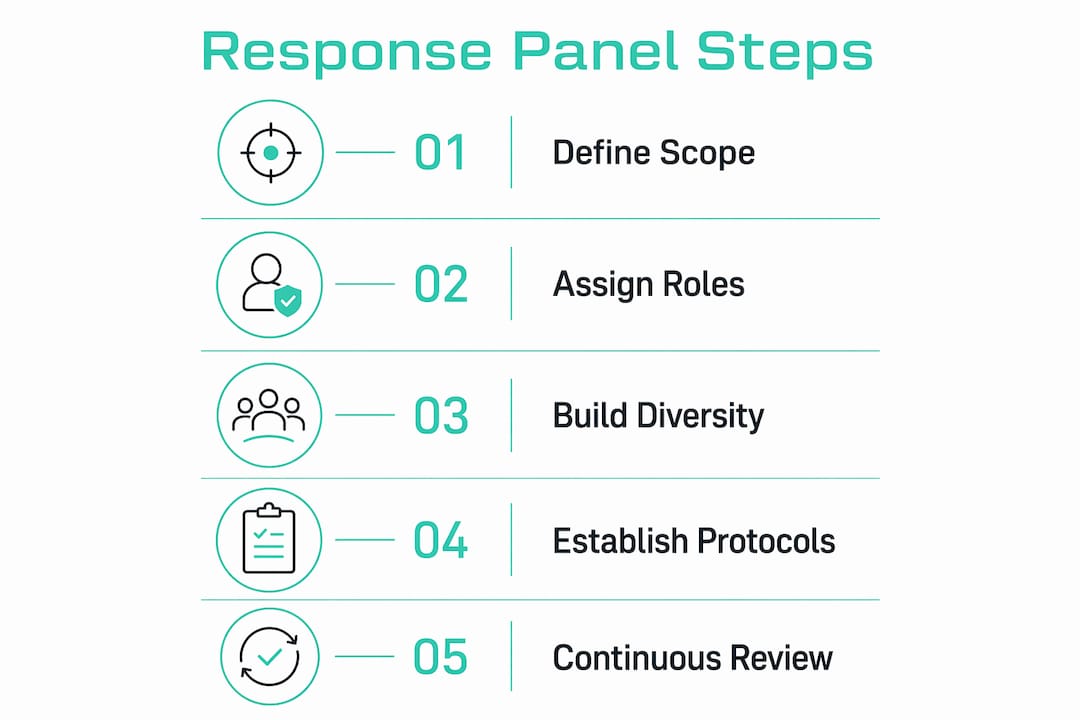
Start with scope. Before writing a single procedure, define what constitutes an incident for your organisation, which systems are in scope, and who has authority to declare an incident formally. Without that foundation, every subsequent decision becomes contested under pressure.
The NCSC recommends that organisations align their plans to a recognised framework. NIST SP 800-61 and the NCSC's own incident management collection are both credible starting points for UK organisations. Your plan should document the six phases described earlier, assign named owners to each, and specify the tools and communication channels the panel will use throughout.
Write the plan with your panel, not for them. Responders who contributed to the document understand it better and follow it more reliably than those who received it as a finished product. Once drafted, the plan needs a formal sign-off from your executive sponsor and a scheduled review date, typically every six to twelve months or after any significant incident.
What does good diversity practice look like in team assembly?
Diversity in a cybersecurity response panel extends well beyond gender and ethnicity, though both matter. It includes professional background, sector experience, neurodiversity, language capability, and geographic knowledge. A panel that has handled incidents across financial services, healthcare, and critical national infrastructure will approach a novel attack differently than one built entirely from a single sector.
Practical assembly guidance:
- Recruit from non-traditional pipelines: apprenticeship schemes, career-changers, and military veterans bring problem-solving approaches that conventional hiring misses
- Partner with organisations such as CyberFirst, NCSC's talent development programme, to access a broader candidate pool
- Build mentoring structures that support retention, particularly for team members from underrepresented groups who may face isolation in technical environments
- Assess cultural competency as a formal criterion during recruitment, not as an afterthought
The ABA Cybersecurity Guidelines offer a useful reference for legal teams working alongside incident response panels, particularly on how to document diversity considerations within compliance frameworks.
How should decision-making work during a live incident?
Decision-making under pressure degrades quickly without a clear structure. The most common failure mode is consensus-seeking: a panel that tries to reach agreement on every decision will lose critical time during fast-moving incidents.

The incident commander holds final decision authority. That authority must be explicit in the plan and understood by every panel member before an incident occurs. Below the commander, decisions should be delegated to the lowest competent level: technical containment decisions belong to the technical lead, not the commander. This keeps the commander free to manage the broader response while specialists handle execution.
Communication discipline matters as much as decision authority. During a live incident, all updates should flow through a single channel and follow a structured format: current status, actions taken, next steps, and any blockers. Unstructured communication creates noise that slows the response and increases the risk of missed information. For teams building this structure for the first time, the incident response triage workflow guide provides a practical framework for sequencing decisions under pressure.
How can external partnerships strengthen your panel's diversity?
No internal panel covers every specialism. External partnerships fill the gaps, and they do so in ways that also broaden the panel's collective perspective.
Consider the following partnership types:
- Specialist DFIR providers: Organisations like Makkarisecurity bring forensic depth, live memory capture capability, and court-admissible evidence handling that most internal teams cannot replicate at scale. Makkarisecurity's breach counsel and panel support service integrates directly with existing response structures without displacing internal ownership
- Sector-specific information sharing groups: The UK's CiSP (Cyber Security Information Sharing Partnership), operated by the NCSC, connects organisations with peers facing similar threats and provides access to a wider range of perspectives than any single panel can hold internally
- Academic and research partnerships: Universities with cybersecurity programmes offer access to emerging research, diverse talent pipelines, and analytical perspectives that operational teams often lack
- Legal and regulatory advisors: External counsel with sector-specific expertise, particularly around ICO engagement and UK GDPR obligations, strengthens the legal liaison function without requiring a full-time specialist on the panel
- Advisory boards: A formal advisory board composed of external experts, including those from underrepresented backgrounds in cybersecurity, provides governance oversight and challenges assumptions that internal panels develop over time
External partners also bring independence. An internal panel can develop blind spots through familiarity with its own environment. A trusted external partner, particularly one with a proven incident response track record, will surface those blind spots before an attacker does.
Key takeaways
A diverse cyber incident response panel, built with clear roles, structured recruitment, and regular testing, consistently outperforms homogenous teams on detection speed, containment accuracy, and post-incident learning.
| Point | Details |
|---|---|
| Diversity improves decision quality | Diverse teams demonstrate superior critical decision-making under pressure, particularly during complex, fast-moving incidents. |
| Role clarity accelerates response | Defined roles for incident commander, technical lead, legal liaison, and communications officer reduce decision delays during live incidents. |
| Structured recruitment is non-negotiable | Diverse selection panels, blind shortlisting, and transparent reporting are the practical mechanisms that produce genuinely mixed teams. |
| Playbooks and escalation tiers reduce cognitive load | Written severity thresholds and named communication owners keep the panel coordinated when pressure is highest. |
| External partnerships fill specialist gaps | DFIR providers, sector groups, and advisory boards extend the panel's capability and challenge internal blind spots. |