
TL;DR:
- Cyber claim incident response coordination aligns legal, forensic, communication, and insurer teams immediately after a cyber incident to protect evidence and ensure claim success.
- Early and structured coordination prevents claim denials, regulatory penalties, and financial losses by maintaining evidence and meeting all deadlines.
Cyber claim IR coordination is the structured process of synchronising legal, forensic, communications, and operational teams immediately after a cyber incident to protect evidence, meet insurer requirements, and secure a successful claim outcome. The industry term for this discipline is incident response coordination, and it sits at the intersection of cybersecurity incident response and the cyber insurance claims process. Without it, organisations face claim denials, regulatory penalties, and avoidable financial loss. The first 72 hours post-incident are the most critical window for claim success, requiring immediate insurer notification and coordinated action across every discipline involved.

What is cyber claim IR coordination and why does it matter?
Cyber claim IR coordination is defined as the deliberate alignment of legal counsel, digital forensics teams, public relations advisers, and insurers under a single command structure during and after a cyber incident. The goal is threefold: preserve forensic evidence, satisfy policy conditions, and meet regulatory disclosure deadlines. Organisations that treat these workstreams as separate functions consistently produce fragmented responses that insurers penalise at the claims stage.
The coordination model matters because cyber insurance policies are conditional contracts. Coverage depends on following specific procedures, notifying the right parties within defined timeframes, and using insurer-approved vendors. A breach of any one condition can void a claim entirely, regardless of the severity of the incident or the legitimacy of the loss.
Understanding cyber insurance incident response clauses before an incident occurs is the single most effective preparation step an organisation can take. Those clauses define exactly who must be notified, when, and through which channels.
What are the primary phases of incident response coordination?
The cyber insurance claims process follows a defined timeline, and each phase carries specific coordination obligations.
| Phase | Timeframe | Key actions |
|---|---|---|
| Containment and notification | Hours 0–4 | Isolate affected systems; notify insurer and legal counsel |
| Panel engagement | Hours 4–24 | Activate breach coach; engage approved forensic and PR vendors |
| Evidence documentation | Hours 24–72 | Preserve logs, memory captures, and chain-of-custody records |
| Proof of loss submission | Days 7–60 | Compile documented losses; submit formal claim to insurer |
| Insurer investigation | Days 30–120 | Support forensic review; respond to insurer queries |
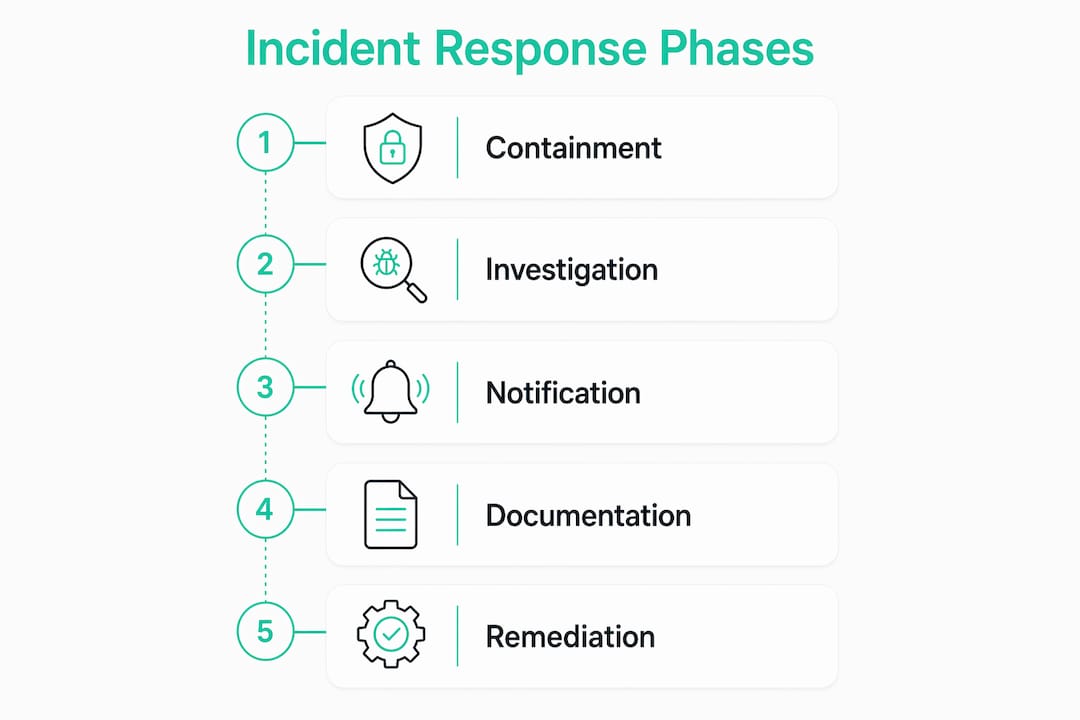
Each phase builds on the last. Errors in the first four hours, such as failing to notify the insurer or engaging an unapproved vendor, create problems that cannot be corrected later in the process.
Evidence preservation must take priority over system remediation during the first 72 hours. Premature rebuilding or log wiping destroys the forensic data that insurers and regulators require to validate a claim.
Pro Tip: Before an incident occurs, confirm with your insurer which forensic and legal vendors sit on their approved panel. Engaging an unapproved firm, even a trusted one, can result in those costs being excluded from your claim.
The documentation phase is where most organisations underinvest. Timestamped records of every decision, every system action, and every communication form the evidentiary backbone of a successful claim. Treat this phase as if you are building a legal file, because you are.
How does the breach coach coordinate legal, forensic, and insurer teams?
The breach coach is a specialist legal counsel appointed at the start of an incident to act as the central coordinator across all response workstreams. Their role is not advisory in the traditional sense. They direct the response, manage vendor engagement, and maintain Attorney-Client privilege over internal investigations, forensic reports, and communications. That privilege protection prevents those materials from being disclosed in subsequent litigation.
The breach coach's coordination responsibilities include:
- Activating the insurer's approved panel of forensic, legal, and communications vendors
- Directing the scope and methodology of the forensic investigation
- Reviewing all external communications before release to avoid prejudicing the claim
- Ensuring the organisation meets policy notification conditions and regulatory deadlines
- Maintaining a documented decision log that supports the insurer's review
Use of non-insurer-approved vendors is one of the most common and costly mistakes in cyber claims management. Even a preferred IT provider engaged without breach coach approval may not be covered under the policy. The financial exposure from that single error can be substantial.
Pro Tip: Instruct your breach coach to issue a written hold notice to all internal IT and security staff within the first hour. This prevents well-intentioned remediation that destroys forensic evidence.
The breach coach also manages the relationship between the organisation and its insurer throughout the investigation period. In complex claims involving layered insurance towers, this coordination function becomes even more critical. Fragmented insurer reviews in multi-insurer structures cause delays and duplicated efforts. A breach coach who proactively manages visibility across all insurers prevents those inefficiencies from compounding.
What are the consequences of poor incident response coordination?
Poor coordination produces four categories of harm: claim denial, delayed payout, regulatory penalties, and reputational damage. Each is preventable with the right structure in place before an incident occurs.
- Late insurer notification. This is the leading cause of claim denials. Most policies require notification within 24–72 hours of discovering an incident. Missing that window gives insurers grounds to deny coverage entirely.
- Evidence destruction through premature remediation. Wiping systems or rebuilding servers before forensic imaging is complete destroys the evidence base. Insurers cannot validate losses without it, and regulators cannot accept it as a defence.
- Engagement of non-approved vendors. Costs incurred with vendors outside the insurer's approved panel are routinely excluded from reimbursement. Organisations discover this only when the invoice arrives.
- Fragmented communication across insurer towers. Organisations with layered cyber coverage often manage each insurer separately. That fragmentation produces inconsistent information, duplicated requests, and extended settlement timelines.
Cyber claims specialists confirm that a steady, claims-led approach with clear roles and decisive actions shifts response from scramble to coordinated recovery. The organisations that fare best are those that treat the claims process as a parallel workstream to technical remediation, not an afterthought.
The financial impact of poor coordination extends well beyond the denied claim. Regulatory fines, litigation costs, and reputational harm accumulate rapidly when the response is disorganised. Coordination is not a procedural nicety. It is a financial control.
How can organisations improve their IR coordination readiness?
Readiness is built before an incident, not during one. The following steps produce measurable improvements in both response quality and claim outcomes.
- Document and test your IR plan at least twice annually. Organisations that test their plans twice yearly reduce breach costs by £1.49 million on average. Yet 70% of organisations seldom test their plans at all. That gap represents a significant and avoidable financial risk.
- Conduct tabletop exercises with legal, IT, and communications teams together. Tabletop exercises reveal coordination gaps that written plans never expose. Run scenarios that include insurer notification, vendor activation, and regulatory disclosure decisions.
- Maintain verifiable evidence of your security posture. Insurers assess pre-incident controls during the investigation phase. Documented evidence of staff training, patch management, and access controls strengthens your claim and reduces the risk of a coverage dispute.
- Engage your breach coach and panel vendors before an incident. Pre-incident retainer agreements with approved vendors mean activation takes minutes, not hours. That speed matters enormously in the first four hours of a response.
- Assign a single claims communication owner. All correspondence with the insurer should pass through one designated point of contact, ideally the breach coach or a senior legal officer. Inconsistent communications from multiple sources create contradictions that insurers exploit during review.
Pro Tip: Use an IR readiness assessment checklist to benchmark your current coordination capability against insurer expectations. Gaps identified before an incident cost far less to fix than gaps discovered during one.
What regulatory requirements shape incident response coordination?
Regulatory disclosure obligations now run in parallel with insurer notification requirements, and the timelines are tight. Organisations must build compliance into their coordination structure from the outset.
Key regulatory coordination requirements include:
- Form 8-K filings (US-listed entities). The US Securities and Exchange Commission requires materiality disclosure within 4 business days of determining an incident is material. Legal counsel must be involved in that determination from the first hour.
- The 1-10-60 rule. Industry standards call for alert detection within 1 minute, scoping within 10 minutes, and containment start within 60 minutes. This rule sets the operational tempo that coordination structures must support.
- UK and EU notification timelines. Under the UK GDPR and the EU's NIS2 Directive, organisations must notify the relevant supervisory authority within 72 hours of becoming aware of a personal data breach. IR coordination must include a designated data protection officer or equivalent from the outset.
- Documentation standards for regulatory defence. Every decision made during the response must be recorded with a timestamp, a named decision-maker, and a stated rationale. That record supports both regulatory filings and any subsequent legal defence.
Legal and compliance teams must be embedded in the coordination structure from the first hour of response. Treating regulatory disclosure as a separate workstream from the technical response is a structural error that produces missed deadlines and inconsistent filings.
Key takeaways
Effective cyber claim IR coordination requires a breach coach, approved panel vendors, and a tested IR plan working in concert from the first hour of an incident.
| Point | Details |
|---|---|
| First 72 hours are decisive | Insurer notification and evidence preservation in this window determine claim success or failure. |
| Breach coach is the central coordinator | Legal counsel maintains privilege and directs all vendor and insurer communications throughout the response. |
| Approved vendors are mandatory | Engaging non-panel vendors, even trusted ones, risks exclusion of those costs from the claim. |
| Test your IR plan twice yearly | Organisations that do so reduce breach costs significantly and improve coordination under pressure. |
| Regulatory timelines run concurrently | UK GDPR, NIS2, and SEC Form 8-K deadlines operate in parallel with insurer notification requirements. |
What working on the front line of cyber claims has taught me
The most consistent mistake I see is organisations treating the insurance claim as something to deal with after the technical response is under control. That sequencing is wrong. The claim starts at the moment of detection, and every action taken in the first four hours either supports or undermines it.
The 'fixing first and documenting later' trap is real and costly. IT teams act with the best intentions when they rebuild systems quickly. But a rebuilt server with no forensic image is a denied claim waiting to happen. The discipline of preserving evidence before remediation is not instinctive. It has to be trained, tested, and written into the IR plan as a hard rule.
Early coordinated decision-making across legal, forensic, and communications teams produces better outcomes than any single workstream acting alone. The organisations that recover fastest are not necessarily those with the most sophisticated security tools. They are the ones with clear roles, pre-agreed vendor relationships, and a breach coach who has the authority to direct the response from the first minute.
Readiness is not about perfection. No IR plan survives first contact with a real incident unchanged. What matters is that the structure exists, the roles are understood, and the team has practised the decisions they will face under pressure. Continuous refinement of that plan, informed by tabletop exercises and post-incident reviews, is the only reliable path to consistent claim outcomes.
— Makkari
How Makkarisecurity supports cyber claim IR coordination
Makkarisecurity provides specialist Digital Forensics and Incident Response services built specifically for organisations managing cyber incidents and insurance claims. Our breach counsel and panel support service places court-admissible forensic expertise and legal coordination at the centre of your response from the first hour.
Our proprietary forensic engine delivers live memory capture and cross-verified results, producing the chain-of-custody documentation that insurers and regulators require. The Eviction Pledge guarantees that once a threat actor is evicted, they will not return for a minimum of 60 days, or you will not be charged. Explore our full incident response capabilities and standby retainer options to put coordinated response in place before you need it.
FAQ
What is cyber claim IR coordination?
Cyber claim IR coordination is the structured process of aligning legal, forensic, communications, and insurer teams during a cyber incident to preserve evidence, meet policy conditions, and secure a successful claim outcome.
What does a breach coach do during a cyber claim?
A breach coach acts as the central incident response coordinator, maintaining Attorney-Client privilege, activating approved panel vendors, and directing all communications with the insurer throughout the response.
Why do cyber insurance claims get denied?
The most common causes of claim denial are late insurer notification, use of non-approved vendors, and premature system remediation that destroys the forensic evidence insurers need to validate the loss.
How often should organisations test their IR plans?
Organisations should test their incident response plans at least twice annually. Regular testing reduces breach costs significantly and ensures coordination structures perform under real incident conditions.
What regulatory deadlines affect incident response coordination?
UK GDPR and NIS2 require supervisory authority notification within 72 hours of a personal data breach. US-listed entities must file a Form 8-K within 4 business days of determining an incident is material. Both timelines run concurrently with insurer notification obligations.