
TL;DR:
- Digital Forensics and Incident Response (DFIR) combines evidence collection and incident response to demonstrate legal accountability during investigations. It supports compliance by enabling organizations to determine breach scope, reconstruct timelines, and preserve evidence for timely regulatory notifications. Proper forensic practices, such as chain of custody and forensic readiness, are essential for evidence integrity and legal defensibility during investigations.
Digital Forensics and Incident Response (DFIR) is defined as the discipline that combines forensic evidence collection with structured incident response to establish factual accountability during regulatory and legal proceedings. The role of DFIR in compliance investigations is not peripheral. It is the evidentiary backbone that determines whether an organisation can demonstrate regulatory compliance or faces penalties for inadequate proof. Digital evidence features in approximately 90% of criminal and civil cases globally, which means forensic rigour is not optional for compliance officers and legal teams. Frameworks including GDPR, HIPAA, and India's DPDPA all require organisations to produce accurate, timely, and legally defensible evidence when a breach occurs.
How does DFIR support regulatory notification and compliance mandates?
DFIR directly enables organisations to meet mandatory breach notification deadlines. Regulators do not accept estimates. They require documented evidence of what happened, when it happened, and which data was affected.

The notification windows are tight. India's DPDPA requires breach notification within 72 hours, and CERT-In mandates incident reporting within six hours. GDPR imposes the same 72-hour window for notifying supervisory authorities. Missing these deadlines carries significant financial and reputational consequences. That consequence is avoidable only when forensic investigation begins immediately after detection.
DFIR supports compliant notification in three concrete ways:
- Scope determination. Forensic analysis identifies exactly which systems, accounts, and data sets were accessed or exfiltrated. Without this, notification filings are speculative and legally vulnerable.
- Timeline reconstruction. Investigators establish the precise sequence of attacker activity, from initial access to lateral movement to data extraction. Regulators expect this level of detail.
- Evidence preservation. Forensic teams create verified, write-protected copies of affected systems before any remediation occurs. This prevents the destruction of evidence that regulators may later request.
Pro Tip: Appoint a forensic lead before an incident occurs. When a breach happens, the first 60 minutes determine whether your notification will be accurate or corrected three times over.
Organisations that invest in forensic investigation scope planning before an incident are consistently better positioned to file accurate, timely notifications. The alternative is filing under uncertainty and amending repeatedly, which regulators treat as a sign of inadequate governance.
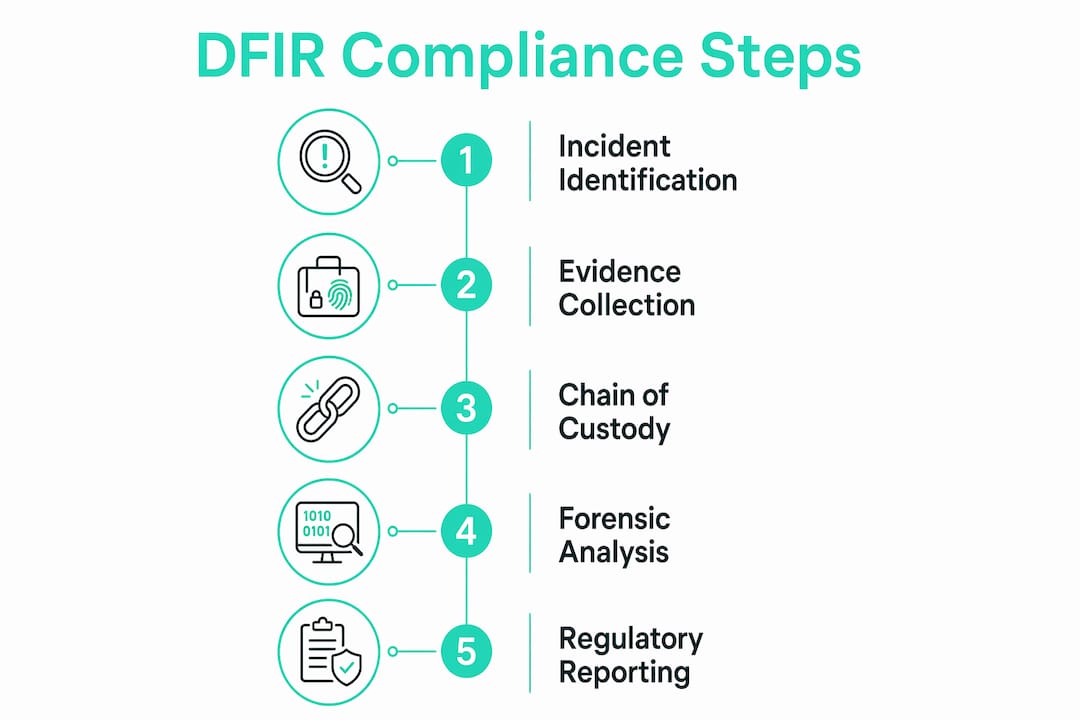
What forensic practices ensure evidence integrity and legal defensibility?
Evidence integrity is the single most consequential factor in a compliance investigation. Penalties for inadequate forensic records can significantly exceed the direct financial costs of the breach itself. That finding should change how compliance officers view forensic investment.
Chain of custody
Chain of custody documentation must record who collected the evidence, when they collected it, the methods used, cryptographic hash values, and the full access history. A single undocumented transfer breaks the chain. A broken chain renders evidence inadmissible in regulatory proceedings and litigation. The standard is uncompromising because regulators and courts treat documentation gaps as evidence of negligence.
Order of volatility
Capturing the most volatile data first, starting with RAM, is fundamental to forensic validity. RAM holds active processes, encryption keys, and attacker artefacts that disappear the moment a system is powered down. Standard IT troubleshooting ignores this sequence. Forensic investigation cannot. The role of memory forensics in breach response is precisely this: capturing what would otherwise be lost before any other action is taken.
Forensic readiness
Forensic readiness means having defined evidence sources, retention policies, trained personnel, and configured tools before an incident occurs. Pre-established forensic readiness ensures evidence collection can begin immediately and remain defensible. Organisations without it spend the first hours of an investigation debating access permissions and tool availability rather than collecting evidence.
| Forensic practice | Compliance benefit |
|---|---|
| Chain of custody documentation | Maintains admissibility in regulatory and court proceedings |
| Order of volatility collection | Preserves volatile artefacts before system changes destroy them |
| Cryptographic hashing | Proves evidence has not been altered since collection |
| Forensic readiness programme | Reduces investigation start time and evidence loss risk |
Pro Tip: Run a forensic readiness audit annually. Identify which log sources are retained, for how long, and whether your team can access them within the first hour of an incident.
How do digital forensic findings translate into regulatory and legal reporting?
Forensic findings mean nothing if they cannot be understood by the people who need to act on them. Effective forensic reporting requires translating technical analysis into business impact statements tailored to regulators, boards, and legal counsel. A report written for a forensic analyst will not satisfy a data protection authority.
Compliance officers and legal teams need forensic reports structured around three distinct outputs:
- Regulatory submissions. These documents answer the regulator's specific questions: what data was affected, how many individuals, and what controls failed. They use plain language and reference specific regulatory obligations.
- Legal counsel briefings. These are detailed, privileged documents that include technical findings, attacker methodology, and internal control failures. They are prepared under attorney-client privilege to protect sensitive conclusions from discovery.
- Executive summaries. These focus on business risk, remediation status, and regulatory exposure. They avoid technical detail and focus on decisions the board needs to make.
Attorney-client privilege extends to DFIR investigations when directed by legal counsel, protecting the investigation's confidential findings from disclosure in litigation. This is a critical structural decision. Organisations that engage legal counsel before commissioning a forensic investigation preserve this protection. Those that engage counsel after the investigation is complete often lose it.
Pro Tip: Structure your forensic engagement so that legal counsel formally instructs the forensic team. This single step can determine whether your investigation report is protected or disclosed in subsequent litigation.
Forensic findings also feed directly into insurance claims, SEC disclosures, and data protection authority correspondence. Each audience has different evidentiary standards. Cross-verified forensic findings provide the consistency that satisfies all of them simultaneously.
What challenges arise when integrating DFIR into compliance investigations?
Embedding DFIR into compliance investigations is operationally complex. Three challenges arise consistently across organisations of all sizes.
Cloud forensics. Evidence in cloud environments resides with third-party providers. Cloud forensics introduces significant complexity because data access depends on provider cooperation and pre-enabled forensic tools. Organisations that have not configured cloud-native logging and forensic capabilities before an incident frequently find that critical evidence is unavailable or has already been overwritten by provider retention policies.
Containment versus completeness. Rapid containment stops ongoing damage. Premature containment destroys forensic evidence. Documenting the trade-offs between containment speed and forensic completeness is essential so that regulatory bodies accept the investigation decisions made under pressure. Compliance officers must understand that this tension is inherent and that the decision process must be recorded, not just the outcome.
Cross-team coordination. Forensic investigations involve IT, legal, compliance, communications, and executive leadership simultaneously. Without a pre-defined command structure, teams duplicate effort, contradict each other in regulatory submissions, and delay evidence collection.
Hybrid DFIR models that combine internal triage with external specialist support address all three challenges effectively. Internal teams provide speed and system knowledge. External specialists provide forensic depth, independence, and court-admissible methodology. Most organisations cannot maintain both capabilities internally at the level regulators expect.
Pro Tip: Establish a pre-agreed escalation protocol with an external DFIR partner before an incident. Waiting until a breach occurs to negotiate terms and access costs hours you do not have.
The forensic analysis process must be documented in your incident response plan, not improvised during a live investigation. Regulators assess the quality of your process, not just your outcome.
Key takeaways
DFIR is the evidentiary foundation of every compliance investigation, and organisations without forensic readiness face regulatory penalties that exceed the cost of the breach itself.
| Point | Details |
|---|---|
| DFIR underpins regulatory notification | Forensic investigation determines scope, timeline, and affected data required for accurate breach filings. |
| Chain of custody is non-negotiable | Undocumented evidence transfers break admissibility and expose organisations to additional regulatory penalties. |
| Forensic readiness reduces investigation time | Pre-configured tools, retention policies, and trained personnel allow evidence collection to begin immediately. |
| Legal counsel must be engaged early | Instructing legal counsel before forensic work begins protects investigation findings under attorney-client privilege. |
| Hybrid DFIR models outperform single-source teams | Combining internal triage with external specialists delivers the speed and depth regulators expect. |
DFIR is a compliance discipline, not just a technical one
Across the investigations Makkarisecurity has supported, the most common and costly mistake is treating DFIR as an IT function rather than a compliance and legal function. Compliance officers often receive forensic reports they cannot use because no one translated the findings into regulatory language. Legal teams sometimes commission investigations without establishing privilege, then discover the report is disclosable. These are not technical failures. They are governance failures.
The organisations that manage regulatory investigations well share one characteristic: they treat forensic readiness as a compliance programme, not an IT project. They have pre-agreed legal instruction structures, defined evidence retention policies, and external DFIR partners on retainer before any incident occurs. When a breach happens, they move within minutes rather than hours.
The 72-hour notification window under GDPR and DPDPA is not generous. For an organisation without forensic readiness, it is almost impossible to meet accurately. For an organisation with it, it is achievable. That gap is entirely a function of preparation, not luck.
Involving legal counsel at the moment of detection, not after the investigation is complete, is the single most protective decision a compliance officer can make. It costs nothing extra and preserves options that are otherwise permanently lost.
— Makkari
How Makkarisecurity supports compliance-driven DFIR investigations
Compliance officers and legal teams need a DFIR partner who understands both the forensic and regulatory dimensions of an investigation. Makkarisecurity provides exactly that.
Makkarisecurity's breach counsel and panel support integrates forensic investigation with legal coordination from the first moment of engagement. Every investigation produces court-admissible evidence, documented chain of custody, and reports structured for regulators, legal counsel, and executives. The Eviction Pledge guarantees that once a threat actor is removed, they will not return for a minimum of 60 days, or the engagement is free. For compliance officers who need certainty, not estimates, Makkarisecurity's incident response and forensics services provide the documented, defensible outcomes that regulators expect.
FAQ
What is the role of DFIR in compliance investigations?
DFIR provides the forensic evidence, chain of custody documentation, and timeline reconstruction that regulators require to verify an organisation's compliance with breach notification and data protection obligations. Without it, compliance filings are speculative and legally vulnerable.
How quickly must organisations notify regulators after a breach?
GDPR and India's DPDPA both require notification within 72 hours of discovering a breach. CERT-In mandates reporting within six hours. Accurate notification within these windows requires forensic investigation to begin immediately after detection.
What is chain of custody and why does it matter?
Chain of custody is the documented record of who collected evidence, when, by what method, and who accessed it subsequently. A broken chain renders evidence inadmissible in regulatory proceedings and can result in penalties that exceed the breach's direct financial costs.
How does attorney-client privilege apply to DFIR investigations?
When legal counsel formally instructs the forensic team, the investigation and its findings are protected under attorney-client privilege. This prevents sensitive internal findings from being disclosed in subsequent litigation or regulatory proceedings.
What is forensic readiness?
Forensic readiness is the pre-incident preparation of evidence sources, retention policies, trained personnel, and configured tools that allow an organisation to begin a credible, defensible investigation immediately when a breach occurs.