
Specialized forensic analysis use cases span criminal investigation, incident response, data breach analysis, intellectual property theft, and insider threat detection. Each context demands a distinct methodology, and the gap between a conviction and an acquittal often comes down to how precisely the right technique was applied to the right evidence. FBI, CISA, and UK NCSC guidance confirms that network forensics plays a central role across these scenarios, detecting sensitive data exfiltration by analysing traffic patterns that would otherwise go unnoticed. The breadth of application is what makes this discipline genuinely demanding.
The core use cases investigators encounter include:
- Criminal investigation: recovering deleted files, reconstructing timelines, and producing court-admissible evidence from seized devices
- Incident response: identifying the initial access vector, lateral movement paths, and persistence mechanisms during an active or recent breach
- Data breach analysis: determining what data was accessed, exfiltrated, or destroyed, and by whom
- Intellectual property theft: tracing document access logs, email exfiltration, and USB transfer records to establish intent and scope
- Insider threat detection: correlating user behaviour analytics with file access and network activity to identify anomalous patterns
- Network forensics: analysing traffic patterns using live capture and post-incident review, integrating with SIEM and EDR platforms to detect breaches and insider attacks in near real time
The UK National Cyber Security Centre (NCSC), the FBI, and CISA have all published joint guidance reinforcing that these use cases are not siloed. A ransomware incident, for example, routinely requires simultaneous network forensics, malware analysis, and mobile device examination before the full picture emerges.
What does the forensic analysis process actually involve?
Every credible forensic investigation follows a structured sequence. Skipping or compressing any stage risks evidence contamination, inadmissibility, or incomplete findings. The core forensic stages are:
- Identification: locating potential evidence sources, whether physical devices, cloud repositories, network logs, or social media accounts
- Preservation: creating verified forensic images and write-blocking original media to prevent alteration
- Collection: gathering evidence under documented chain-of-custody procedures, with cryptographic hashing to confirm integrity
- Examination: applying specialist techniques to extract, decode, and interpret data from acquired images
- Analysis: correlating findings across sources to build a coherent investigative narrative
- Reporting: producing a clear, technically accurate report suitable for legal proceedings or internal governance
Adherence to standards such as those published by NIST's Organisation of Scientific Area Committees (OSAC) underpins the reliability of every stage. OSAC has listed over 200 standards on its registry, covering 22 forensic science disciplines, and over 200 forensic science service providers have submitted implementation data against those standards. That breadth of standardisation matters: courts increasingly scrutinise not just what was found, but how it was found.
Cross-device correlation sits at the heart of modern examination workflows. Investigators recover deleted artefacts, including deleted iMessages, by cross-device correlation and file carving techniques, then verify findings against cloud backups and network logs before drawing conclusions.

Pro Tip: Before imaging any device, document its exact power state, network connectivity status, and visible screen content with a timestamped photograph. This single step has resolved chain-of-custody disputes in UK Crown Court proceedings.
Which digital forensic techniques apply to which use cases?
The technique determines what you can recover. Choosing the wrong one wastes time; choosing none at all destroys the investigation. Forensic data analysis transforms large datasets into intelligence for regulatory compliance and loss reduction, but only when the right analytical method is matched to the evidence type.
| Technique | Primary use case | What it recovers |
|---|---|---|
| Data carving | Deleted file recovery | Fragmented files without filesystem metadata |
| Cross-device correlation | Insider threat, IP theft | Consistent artefacts across phone, laptop, cloud |
| Malware analysis (static/dynamic) | Incident response, cybercrime | — |
| Mobile forensics | Criminal investigation | Call records, deleted chats, location history |
| Cloud forensics | Data breach, SaaS compromise | Access logs, API calls, shared file activity |
| Network forensics | Breach detection, exfiltration | Traffic anomalies, lateral movement, DNS queries |
| Memory forensics (live capture) | Ransomware, APT response | In-memory malware, encryption keys, credentials |
Live memory capture deserves particular attention. Volatile memory holds encryption keys, running processes, and injected shellcode that disappear the moment a machine is powered down. Capturing it before shutdown is the difference between tracing a ransomware operator's infrastructure and starting from zero.
In encrypted network environments, investigators extract Server Name Indication (SNI) data before session key establishment. This technique reveals adversary movement patterns even when TLS encryption prevents full packet inspection, a capability that has proven decisive in several UK financial sector investigations.
Large language models (LLMs) are now entering the examination stage. Platforms such as MARVEL use AI to reconstruct faces from decomposed remains, enhance CCTV footage, and analyse large chat datasets to maintain investigative efficiency. The UK government's recent disclosure reforms explicitly reference AI-powered platforms as a mechanism for accelerating justice. That is a significant institutional endorsement.
How does social media forensics work in practice?
Social media data is now a primary evidence source in fraud, terrorism, cyberbullying, and organised crime investigations. Chats, images, videos, and metadata each carry distinct forensic value. A timestamp on a photograph, for instance, can place a suspect at a location with greater precision than witness testimony.

The volume of data is the central challenge. A single investigation may involve thousands of posts, direct messages, and media files spread across multiple platforms. AI and machine learning tools address this by automating classification, flagging anomalous content, and surfacing relevant artefacts that manual review would miss. Research published in Frontiers in Computer Science confirms that social media forensic methods are actively evolving to handle this scale, with automated frameworks now capable of processing platform-specific data structures at speed.
LLMs improve forensic text analysis by interpreting slang and ambiguous phrasing in mobile chat data. Research published in Science Direct establishes that prompt engineering and quantitative evaluation of precision, recall, and hallucination rate are critical for legal defensibility when LLMs are used in evidence analysis. A model that hallucinates a phrase that was never sent is not a minor error; it is a potential miscarriage of justice.
Metadata extraction from social media images frequently reveals GPS coordinates, device identifiers, and creation timestamps that the poster never intended to share. Forensic teams use this to corroborate or contradict stated alibis, map criminal networks, and authenticate media in disinformation investigations.
What legal standards govern forensic evidence handling in the UK?
UK forensic investigators operate within a demanding legal framework. Evidence that is collected correctly but documented poorly will not survive cross-examination. The standards are not optional; they are the foundation on which every finding rests.
Key legal and procedural requirements include:
- Police and Criminal Evidence Act 1984 (PACE): governs the seizure, retention, and handling of evidence in criminal investigations, including digital material
- Regulation of Investigatory Powers Act 2000 (RIPA): regulates the interception of communications and acquisition of communications data
- UK GDPR and the Data Protection Act 2018: impose strict obligations on the processing of personal data during forensic examinations, including proportionality and data minimisation
- Association of Chief Police Officers (ACPO) Good Practice Guide for Digital Evidence: sets out the four principles of digital evidence handling, including the requirement that no action taken by investigators should change data held on a computer or storage media
- ISO/IEC 27037: the international standard for identification, collection, acquisition, and preservation of digital evidence, widely adopted by UK forensic laboratories
Chain of custody documentation must record every person who handled evidence, every transfer, and every examination performed. A gap in that record gives defence counsel grounds to challenge admissibility. In practice, this means timestamped logs, cryptographic hash verification at each stage, and secure, access-controlled storage throughout.
Data privacy considerations add a further layer. Forensic examination of a device belonging to a third party, or analysis of communications involving individuals not under investigation, requires careful scoping to avoid unlawful processing under UK GDPR. Proportionality is not just an ethical principle; it is a legal requirement that courts enforce.
Best practices for evidence handling in UK forensic contexts:
- Photograph and document the physical state of every device before seizure
- Apply write-blockers before any imaging process begins
- Generate and record SHA-256 or MD5 hashes immediately after acquisition
- Store all evidence in tamper-evident packaging with unique reference numbers
- Maintain a contemporaneous log of every action taken, with timestamps and operator identifiers
- Obtain appropriate legal authority before examining content, particularly communications data
What are the biggest challenges in specialised forensic examinations?
Encryption is the most persistent obstacle. Full-disk encryption on modern devices, combined with end-to-end encrypted messaging applications, can render large volumes of potentially relevant data inaccessible without the correct credentials or a lawful decryption order. Investigators increasingly rely on extracting artefacts from unencrypted memory, cloud backups, or linked devices rather than breaking encryption directly.
High data volumes compound the problem. A single corporate endpoint can hold terabytes of data; a cloud tenancy may hold far more. Manual review at that scale is neither practical nor reliable. Automated triage tools help, but they introduce their own risks, particularly when AI-driven analysis produces outputs that investigators accept without sufficient scrutiny.
AI hallucination in forensic text analysis is a documented risk. Research on LLM hallucination rates in forensic contexts confirms that prompt engineering and quantitative evaluation of model outputs are not optional refinements; they are prerequisites for any AI-assisted analysis that will be presented in legal proceedings. An unchecked hallucination embedded in an expert report can undermine an entire prosecution.
- Encrypted data: requires lawful authority, memory forensics, or linked-device analysis to circumvent
- High data volume: demands automated triage with human verification at key decision points
- Ambiguous digital content: slang, coded language, and irony require contextual interpretation, not keyword matching
- Tool reliability: forensic tools must be validated against known datasets before deployment in live investigations
- Evidence contamination: any write operation to original media, however minor, can invalidate findings
- Evolving technology: cloud-native architectures, containerised environments, and ephemeral infrastructure require updated acquisition techniques
Proactive forensic analysis represents a meaningful shift in how organisations approach these challenges. Rather than waiting for a breach to trigger an investigation, proactive notification and analysis frameworks enable organisations to detect abnormal activity patterns before a breach occurs. The NCSC has actively promoted this shift, framing it as preventative security intelligence rather than purely reactive investigation.
Unified forensic workspaces address the operational challenge of linking artefacts across detection and recovery phases. In ransomware investigations, unified workspace environments allow investigators to pivot directly from forensic artefacts to host and user mappings, keeping chain of custody intact and avoiding the delays that arise when detection and recovery tools operate in isolation.
How does Makkarisecurity approach UK forensic investigations?
Makkarisecurity operates at the intersection of speed and legal rigour, two qualities that are often treated as competing priorities but need not be. The firm's proprietary forensic engine, developed over five years, performs live memory capture and cross-verified analysis in a single workflow, reducing the window between initial triage and actionable findings.
The Eviction Pledge is the clearest expression of that confidence. Once Makkarisecurity evicts a threat actor, the actor will not return for a minimum of 60 days, or the client is not charged. That guarantee is backed by a flawless re-breach record. No comparable commitment exists in the standard market offering.
In practice, a UK financial services client experiencing a suspected insider threat engagement would see Makkarisecurity deploy live memory capture across affected endpoints, correlate artefacts against network traffic logs, and produce a chain-of-custody-compliant report within a defined response window. The DFIR capabilities cover incident response, digital forensics, and retainer agreements, giving organisations the option of standing readiness rather than reactive engagement.
Blockchain-based evidence integrity frameworks are part of the firm's forward methodology. Blockchain in forensic evidence provides tamper-proof assurance of evidence authenticity across geographically distributed collection points, a requirement that arises frequently in multi-jurisdiction investigations involving UK, Gibraltar, and European entities.
Pro Tip: If you are managing an active incident, isolate affected systems from the network before calling in forensic support, but do not power them down. Live memory contains artefacts that a cold image will never recover, and Makkarisecurity's engine is built to capture them.
Why does interdisciplinary collaboration define modern forensic investigations?
No single specialism solves a complex investigation alone. A ransomware case that begins as a network intrusion quickly involves malware reverse engineering, mobile device examination, financial transaction analysis, and legal review. The investigators who move fastest are those who have already established the working relationships and shared protocols that allow these disciplines to operate in parallel rather than in sequence.
In the UK, this means forensic analysts working alongside Crown Prosecution Service lawyers, financial intelligence units, and cybersecurity incident responders from the outset. The NCSC's joint guidance with the FBI and CISA reflects exactly this model: cross-agency, cross-discipline collaboration as the default, not the exception. When a digital forensic investigation spans cloud infrastructure, mobile devices, and social media platforms simultaneously, the handoffs between specialists must be governed by shared chain-of-custody protocols, or the integrity of the entire investigation is at risk.
Endpoint detection and response (EDR) platforms are a practical example of where disciplines converge. Understanding how endpoint detection response works is now a baseline requirement for forensic analysts working on insider threat cases, because EDR telemetry frequently provides the first indication of anomalous behaviour that triggers a full forensic examination. Analysts who can read EDR data fluently reduce the time from detection to evidence acquisition by a material margin.
Shared terminology and documentation standards are the unglamorous foundation of effective collaboration. When a network forensics specialist hands findings to a mobile forensics examiner, both must be working from the same evidence reference numbers, the same hash values, and the same chain-of-custody log. Without that discipline, multi-team investigations produce contradictory reports that defence counsel exploit with ease.
Key takeaways
Specialized forensic analysis use cases require matched techniques, strict chain-of-custody documentation, and interdisciplinary collaboration to produce legally admissible, reliable findings in UK investigations.
| Point | Details |
|---|---|
| Use case breadth | Forensic analysis applies across criminal investigation, incident response, data breach, IP theft, and insider threat detection. |
| Process integrity | Every investigation must follow identification, preservation, collection, examination, analysis, and reporting stages without compression. |
| AI in forensic analysis | LLMs and AI platforms accelerate chat and media analysis, but hallucination rates must be quantitatively evaluated before outputs enter legal proceedings. |
| UK legal framework | PACE, RIPA, UK GDPR, and the ACPO Good Practice Guide collectively govern evidence handling and admissibility in UK forensic contexts. |
| Proactive forensics | Organisations that adopt proactive forensic frameworks detect abnormal activity before breaches occur, shifting from reactive to preventative posture. |
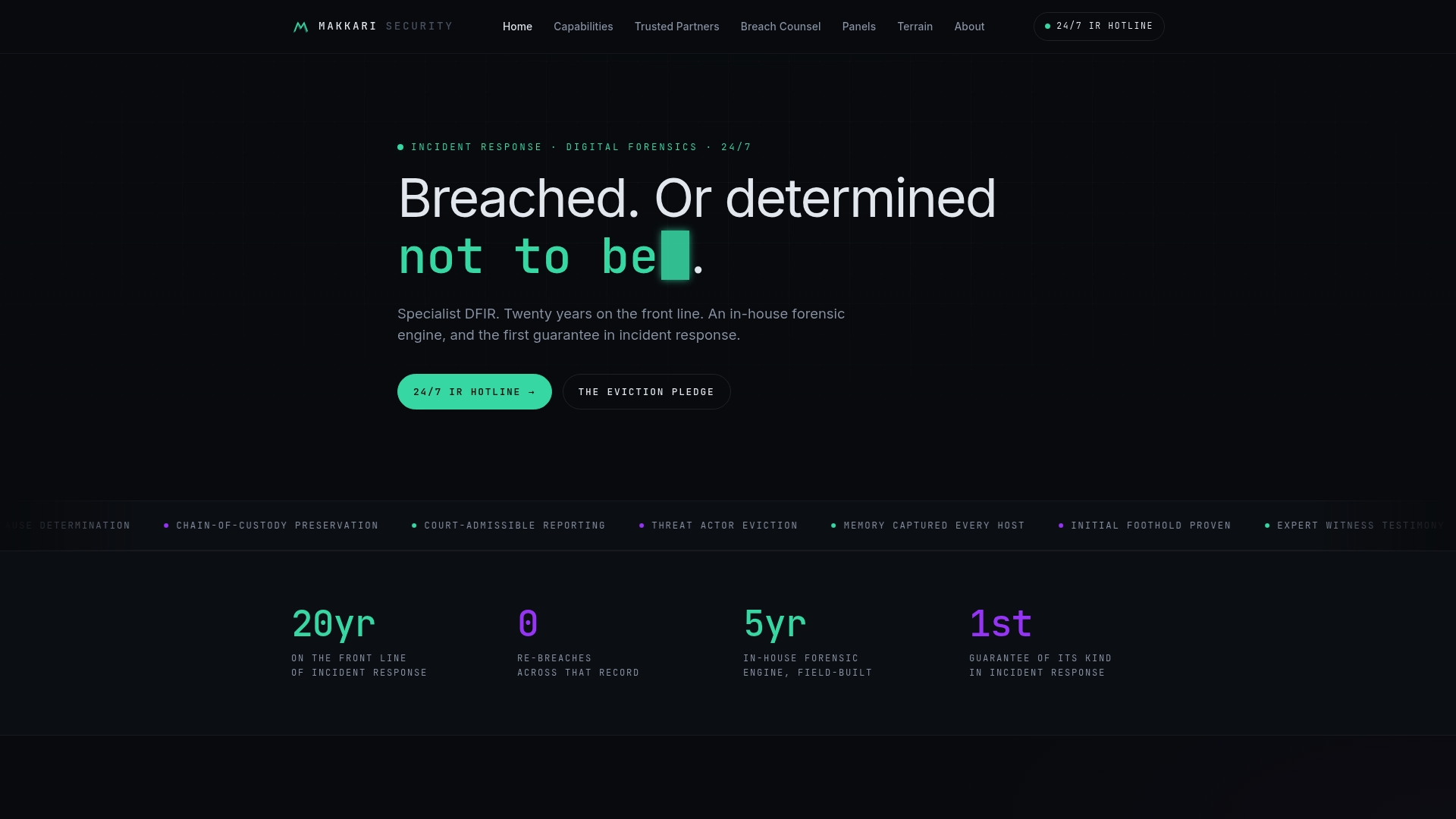
Makkarisecurity delivers DFIR engagements built on a proprietary forensic engine, live memory capture, and a chain-of-custody-compliant workflow that holds up in UK legal proceedings. The Eviction Pledge guarantees threat actors stay out for a minimum of 60 days post-eviction, or you pay nothing. Explore Makkarisecurity's full incident response and forensics capabilities to understand what a forensic engagement actually looks like from first call to final report.