
TL;DR:
- Effective cyber breach documentation is crucial for regulatory compliance and legal defense, requiring real-time, tamper-evident records. It involves collecting specific digital evidence, following strict standards like ISO/IEC 27037, and establishing privilege protocols early. Proper workflow and practices help organizations avoid common mistakes and ensure evidence remains admissible in court.
Cyber breach documentation is defined as the structured collection, preservation, and recording of digital evidence following a security incident, carried out in a manner that satisfies regulatory requirements and court admissibility standards. The process is known formally within the Digital Forensics and Incident Response (DFIR) discipline as producing a defensible incident record. Getting this right matters enormously: the average cost of a data breach reached $4.88 million as of 2026, and poor documentation is one of the fastest routes to increased liability. When you need to document a cyber breach for legal proceedings, the quality of your evidence record determines whether regulators, insurers, and courts rule in your favour.
What legal and regulatory requirements govern cyber breach documentation?
The external frameworks that govern breach documentation set both the minimum standards and the deadlines your organisation must meet. Missing either exposes you to fines and adverse inferences in litigation.
GDPR and UK data protection law sit at the centre of the regulatory picture for most organisations operating in the UK and Europe. Under GDPR, organisations must report personal data breaches to the relevant supervisory authority within 72 hours of becoming aware of them. That 72-hour window is not just a notification deadline. It is a documentation deadline. Every decision, assessment, and action taken before notification must be recorded contemporaneously to demonstrate compliance.
Beyond GDPR, two further frameworks are reshaping expectations:
- NIS2 (Network and Information Systems Directive 2) extends incident reporting obligations to a broader range of critical sectors across the EU, requiring early warnings within 24 hours and full notifications within 72 hours.
- DORA (Digital Operational Resilience Act) applies to financial entities and their ICT service providers, mandating detailed incident classification and reporting with specific documentation requirements.
- US state breach notification laws vary, but most require notification within 30–60 days. Some sectors, such as healthcare under HIPAA, require notification within 60 days of discovery.
Non-compliance carries serious consequences. GDPR fines reach up to 4% of global annual turnover. Beyond fines, incomplete or reconstructed documentation creates adverse inferences in civil litigation. Regulators are no longer focused solely on whether a breach occurred. Regulatory scrutiny now targets the quality of incident management documented contemporaneously and with tamper-evident methods.
Pro Tip: Establish your documentation protocols and regulatory notification timelines before an incident occurs. Organisations that treat documentation as a post-incident task consistently miss the 72-hour GDPR window.
Which technical evidence should be collected and how to preserve it properly?
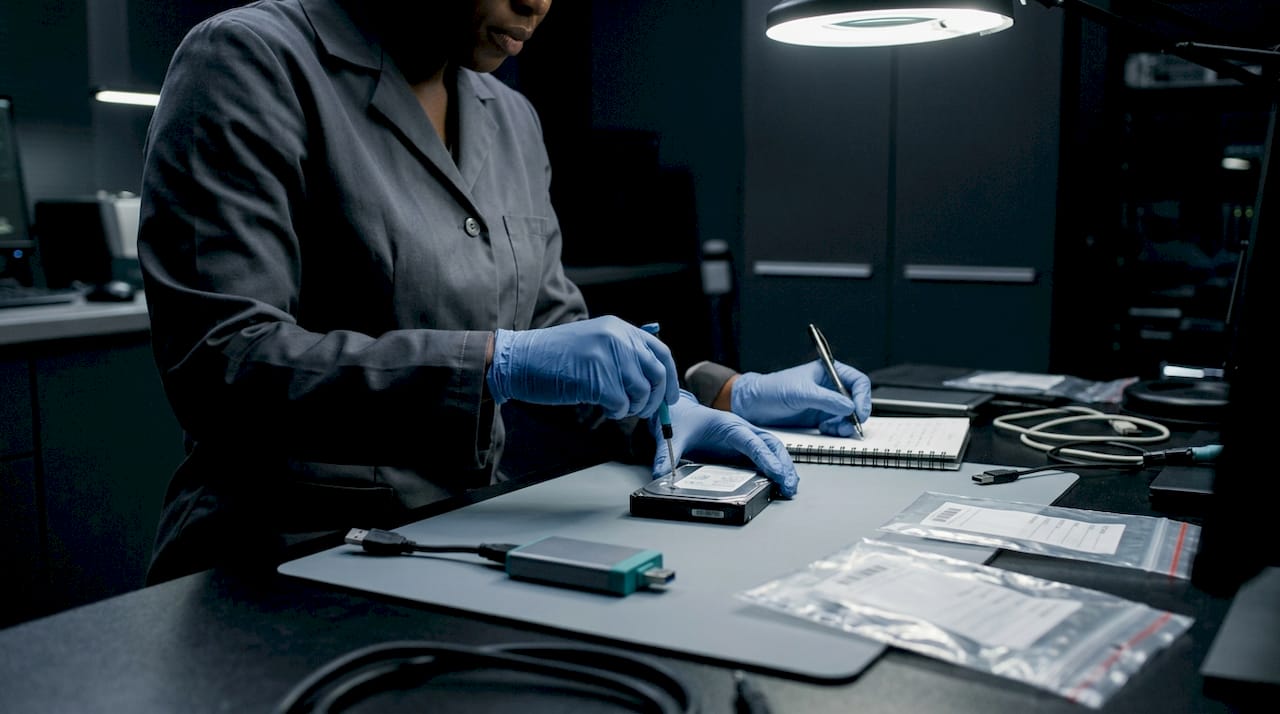
The admissibility of digital evidence in court depends almost entirely on how it was collected and preserved. Evidence acquisition methods are often the first challenge in court, making adherence to ISO/IEC 27037 standards critical for admissibility.
Types of digital evidence to collect
The following categories of evidence are relevant to most cyber breach investigations:
- Forensic disk images. Bit-for-bit copies of affected storage media, created before any remediation activity begins.
- Memory dumps. Volatile memory captures that preserve running processes, active network connections, and encryption keys that disappear on reboot.
- System and application logs. Authentication logs, firewall logs, endpoint detection logs, and database access records.
- Network traffic captures. Packet captures and NetFlow records showing lateral movement and data exfiltration.
- Communication records. Emails, instant messages, and ticketing system entries relevant to the incident timeline.
How to preserve evidence to ISO/IEC 27037 standards
ISO/IEC 27037 demands bit-for-bit copies with cryptographic hashing and a strict chain of custody for every piece of evidence submitted to court. In practice, this means:
- Using write blockers when imaging physical media to prevent any modification of the source.
- Generating SHA-256 cryptographic hashes of every forensic image immediately after acquisition.
- Verifying those hashes repeatedly throughout the investigation and before any court submission.
- Storing images in a secure, access-controlled environment with a full audit trail.
Digital evidence is vulnerable to alteration, so forensic images must be verified repeatedly with cryptographic hashes and stored securely with full chain-of-custody documentation. Metadata timestamps are fragile. Experts advise validating timestamps across multiple corroborative log sources rather than relying on a single timestamp, which can be manipulated or corrupted.
The most common and damaging pitfall is premature remediation. System reimaging before forensic capture destroys volatile evidence and is the leading cause of critical data loss in breach litigation. No system should be wiped, reimaged, or rebuilt until a qualified forensic examiner has completed acquisition. For a detailed walkthrough of acquisition methodology, the forensic analysis process for DFIR teams covers each stage in sequence.
Pro Tip: Capture live memory before isolating or powering down any compromised system. Volatile evidence, including malware running in memory, is lost permanently the moment the machine is shut down.
How to create a defensible incident record that meets legal scrutiny?
A defensible incident record is a tamper-evident, contemporaneous log that captures every decision, action, and communication during an incident, with clear author attribution at every entry. Incomplete or reconstructed logs carry adverse inferences in litigation. Courts and regulators treat gaps in documentation as evidence of poor incident management, or worse, deliberate concealment.
What a defensible record must contain
| Element | Requirement |
|---|---|
| Contemporaneity | Entries recorded at the time of the action, not reconstructed afterwards |
| Author attribution | Every entry signed or attributed to a named individual with a verified timestamp |
| Tamper evidence | Append-only logging with cryptographic integrity checks preventing modification |
| Decision rationale | Written justification for every significant decision, including containment choices |
| Communication trail | Records of all internal and external communications, including legal and regulatory notifications |
| Retention compliance | Stored for the period required by applicable regulation, with access controls documented |
Structuring documentation to protect legal privilege
Incident reports commissioned directly by outside counsel benefit from attorney-client privilege, whereas internal IT reports often do not. This distinction shapes how you structure your documentation from day one. The factual incident log remains a separate document from the privileged legal analysis. Privilege protocols should be established before an incident occurs, not during the chaos of active response.
Engaging technical experts early in litigation is vital for identifying relevant evidence, advising on preservation, and framing technical questions for legal teams. The role of DFIR in compliance investigations covers how forensic and legal teams should coordinate from the outset.
Pro Tip: Use append-only logging tools with cryptographic integrity verification for your incident record. Any system that allows editing of past entries will not survive legal scrutiny.
What are the step-by-step actions to document a cyber breach for legal use?
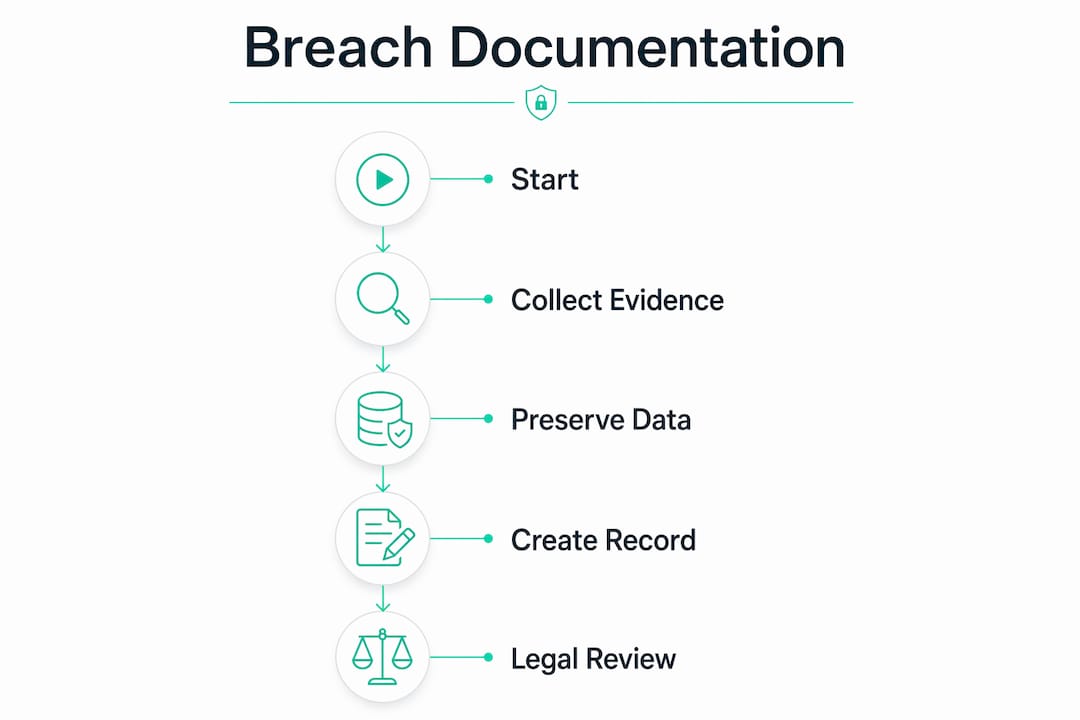
A structured workflow prevents the most common documentation failures. Incident response timelines are foundational for cross-functional alignment, legal review, notification decisions, and audit defence. The following sequence applies from initial detection through to incident closure.
- Open the incident record immediately. The moment a potential breach is detected, open a formal, timestamped incident record. Record the detection method, the alert source, and the name of the person who identified the issue.
- Preserve evidence before containment. Before isolating any system, capture volatile memory and initiate forensic imaging. Document the exact time and method of every acquisition action.
- Document containment decisions with rationale. Every containment action, such as network isolation, account suspension, or firewall rule changes, must be logged with a timestamp, the name of the authorising person, and the written reason for the decision.
- Conduct scope and impact analysis. Record which systems, data sets, and jurisdictions are affected. Note the categories of personal data involved, the estimated number of data subjects, and any cross-border data flows relevant to GDPR or NIS2 obligations.
The scope analysis feeds directly into your notification decision. Key items to document at this stage include:
- Systems confirmed as compromised versus systems under investigation
- Data types affected, including special category data under GDPR
- Jurisdictions involved and the applicable notification deadlines for each
- Business impact, including operational disruption and financial exposure
- Record legal review and notification decisions. Document the legal review process, including who was consulted, what advice was given, and the final decision on whether and when to notify regulators and affected individuals. Retain all written legal advice in the privileged file.
- Log recovery actions and close the record. Document every recovery step, including system restoration, credential resets, and patch deployment. Map the breach progression using a framework such as MITRE ATT&CK to support root cause analysis. Correlated narratives using MITRE ATT&CK mapping aid understanding of breach progression and are vital for legal analysis. Close the incident record formally with a post-incident review summary.
For guidance on defining the investigation scope with evidential and legal considerations, the forensic investigation scope guide provides a structured approach.
Key takeaways
Producing a legally defensible breach record requires contemporaneous, tamper-evident documentation that follows ISO/IEC 27037 forensic standards and meets GDPR, NIS2, and DORA notification timelines from the moment of detection.
| Point | Details |
|---|---|
| Start documentation immediately | Open a timestamped incident record at the moment of detection, before any containment action. |
| Preserve evidence before remediation | Capture volatile memory and forensic disk images before isolating or reimaging any system. |
| Follow ISO/IEC 27037 standards | Use write blockers, SHA-256 hashing, and strict chain-of-custody controls for all digital evidence. |
| Separate factual and privileged records | Keep the factual incident log distinct from privileged legal analysis to protect attorney-client privilege. |
| Meet regulatory notification deadlines | GDPR requires notification within 72 hours; document every decision that supports your notification timeline. |
What I have learned from breach documentation failures
The pattern I see most often is organisations that treat documentation as an afterthought. The technical team focuses on stopping the attack, and the paperwork follows days later, reconstructed from memory and chat logs. That reconstructed record is almost always inadequate. Courts and regulators can tell the difference between a log written in real time and one assembled retrospectively.
The second consistent failure is the privilege problem. Legal teams are brought in too late, after the internal IT team has already written a detailed report that cannot be protected. That report then becomes disclosable in litigation, exposing the organisation's internal assessment of its own security failures. Establishing privilege protocols before an incident is not a legal nicety. It is a material risk management decision.
The third issue is tool selection. Many organisations use general-purpose ticketing systems for incident logging. Those systems allow editing of past entries, which means the log cannot be verified as unaltered. A tamper-evident, append-only logging system is not optional if you intend to use the record in court or before a regulator.
The organisations that handle breach documentation well share one characteristic: they have practised it. They run tabletop exercises that include documentation steps, not just technical response steps. They know who opens the incident record, who authorises containment, and who calls outside counsel. When the real incident arrives, the process runs without hesitation.
— Makkari
Makkarisecurity's approach to court-admissible breach documentation
Makkarisecurity specialises in Digital Forensics and Incident Response, and producing legally defensible breach documentation is central to every engagement. The team's proprietary forensic engine delivers live memory capture and cross-verified results, generating evidence records that meet ISO/IEC 27037 standards from the first moment of response.
For organisations that need court-admissible documentation from the outset, Makkarisecurity's breach counsel and DFIR services integrate forensic evidence collection with legal privilege management in a single coordinated response. Retainer clients receive priority response and pre-agreed documentation protocols, so the process starts correctly from the first alert. Explore the full range of incident response capabilities or contact Makkarisecurity directly to discuss how a retainer arrangement can protect your organisation before the next incident occurs.
FAQ
What is a defensible incident record?
A defensible incident record is a tamper-evident, contemporaneous log of all decisions, actions, and communications during a cyber incident, with author attribution at every entry. Incomplete or reconstructed logs carry adverse inferences in litigation.
How long do organisations have to report a breach under GDPR?
GDPR requires organisations to notify the relevant supervisory authority within 72 hours of becoming aware of a personal data breach. Documentation of the decision-making process must support that timeline.
What is ISO/IEC 27037 and why does it matter for legal proceedings?
ISO/IEC 27037 is the international standard for digital evidence collection, requiring bit-for-bit forensic copies, SHA-256 cryptographic hashing, and strict chain-of-custody controls. Courts assess evidence admissibility against these standards.
Can internal IT incident reports be protected by attorney-client privilege?
Internal IT reports generally cannot be protected by attorney-client privilege. Reports commissioned directly by outside counsel can attract privilege, which is why legal counsel should be engaged from the start of any significant incident.
What is the most common mistake in cyber breach evidence collection?
Premature system reimaging before forensic capture is the most common and damaging mistake. It permanently destroys volatile evidence, including memory contents and active process data, that may be critical to litigation.