
TL;DR:
- A breach response panel is an insurer-curated, pre-vetted roster of specialists activated immediately after reporting a suspected incident. Engaging breach counsel first ensures legal privilege, while panels accelerate response times, reduce costs, and standardize vendor performance. Proper preparation and understanding of panel terms are crucial to effective cyber incident management.
A breach response panel is a curated, pre-vetted roster of specialists assembled by your cyber insurer to deploy the moment you report a suspected incident. Under UK GDPR, the ICO expects notification within 72 hours of becoming aware of a qualifying breach. Panels exist precisely to make that timeline achievable.

The TL;DR verdict: panels accelerate response, control costs through pre-negotiated fees, and create legal privilege pathways. The trade-off is reduced vendor choice and, in some policies, mandatory use of panel providers.
Typical panel members include:
- Breach counsel (coordinates all activity under legal privilege)
- Digital forensics / DFIR specialists (evidence collection, root-cause analysis)
- Notification specialists (drafting and distributing breach notices)
- Crisis PR (media and stakeholder communications)
- Call-centre providers (handling affected-individual queries)
- Ransomware negotiators (engaged selectively for extortion events)
Immediate action: locate your insurer's 24/7 hotline number now, before an incident occurs. It is usually printed in the declarations page or the incident response section of your policy.
Table of Contents
- Why do insurers establish breach response panels?
- Who does what during a breach response?
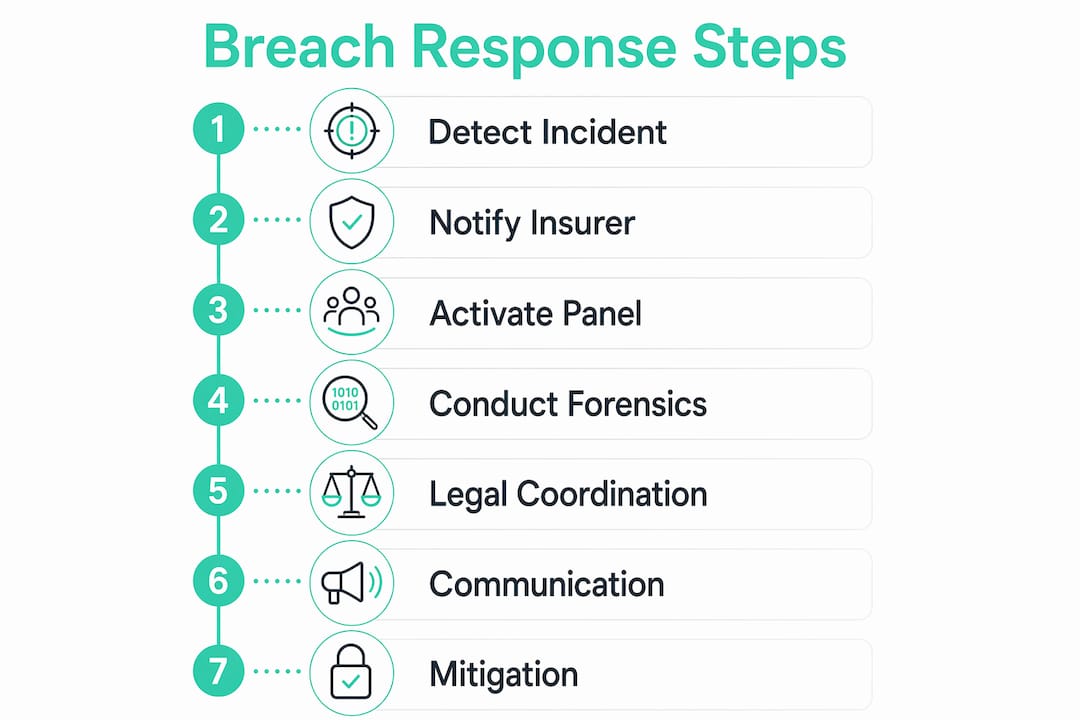
- How does panel activation work step by step?
- How are breach response costs structured in your policy?
- Why breach counsel is the most important panel member
- What are the real benefits and limitations of insurer panels?
- What should you review in your insurer's panel right now?
- How should you prepare before a breach occurs?
- What should you expect from a best-in-class DFIR vendor?
- Key takeaways
- What practitioners get wrong about panels
- Makkarisecurity's breach counsel and DFIR services
- Useful sources and further reading
Why do insurers establish breach response panels?
Insurers, or their third-party administrators, build panels to solve two problems simultaneously: claim severity and response speed. By standardising vendor quality and price, carriers reduce the average cost of a claim while giving policyholders immediate access to practitioners who already understand the insurer's reporting requirements.
Vetting criteria typically cover professional indemnity insurance, sector experience, chain-of-custody procedures, and evidence of prior panel performance. Contractual terms lock in response-time commitments and fee schedules before any incident occurs, which removes the negotiation delay that can cost critical hours during containment.
Panels have evolved from optional add-ons into core loss-mitigation infrastructure. For cyber underwriters, a well-run panel is one of the most direct levers they have over claim outcomes.
Pro Tip: Ask your broker for the insurer's panel vetting criteria in writing. If the insurer cannot produce them, treat that as a red flag during renewal.
Who does what during a breach response?
Understanding the division of labour lets you spot gaps before an incident exposes them.
| Panel Role | Primary Responsibility | Coordination Point |
|---|---|---|
| Breach counsel | Establishes privilege; directs forensic scope | First call after hotline; all vendors report through counsel |
| DFIR specialists | Evidence collection, live memory capture, root-cause analysis | Engaged by counsel to preserve work-product protection |
| Notification specialists | Drafting, printing and distributing breach notices | Activated once counsel confirms notification obligation |
| Crisis PR | Media statements, internal communications | Briefed by counsel; coordinates with notification team |
| Call-centre provider | Handling inbound queries from affected individuals | Activated alongside or after notification |
| Ransomware negotiator | Threat-actor communication, decryption key negotiation | Engaged selectively; operates under counsel's direction |
Friction most commonly appears between forensic scope and legal strategy. Forensic teams want to document everything; counsel may limit written technical summaries until privilege is confirmed. Resolving that tension early, in writing, prevents gaps in evidence preservation.
The forensic analysis process a panel DFIR vendor performs covers disk imaging, log correlation, and network traffic reconstruction. Knowing what to expect helps you prepare internal systems and access credentials in advance.
How does panel activation work step by step?
- Call the hotline immediately. Policy triage is typically free and preserves your policy limits for later professional costs. Do not wait for breach confirmation.
- Initial triage. The insurer or TPA assesses scope, assigns a claims handler, and determines which panel members to activate.
- Breach counsel engagement. Counsel is brought in first to establish attorney-client privilege over all subsequent forensic work.
- Forensic onboarding. The DFIR vendor receives a formal instruction letter from counsel, not from you directly. This protects their reports as work-product.
- Containment and evidence preservation. Forensic specialists isolate affected systems, capture live memory, and begin root-cause analysis. Containment and assessment run concurrently where possible.
- ICO notification decision. Counsel advises on whether the incident meets the UK GDPR threshold. The 72-hour clock runs from the point the organisation becomes "aware" of a qualifying breach, not from confirmed attribution.
- Notification execution. Notification specialists draft and distribute communications to affected individuals and, where required, the ICO.
- Ongoing remediation and review. Panel vendors support recovery milestones and produce a post-incident report for the insurer and, where appropriate, regulators.
How are breach response costs structured in your policy?
Breach response expenses sit within a dedicated sublimit, separate from your overall policy limit. That sublimit covers forensics, breach counsel, notification, call-centre provision, and crisis PR. The overall limit handles third-party liability and business interruption.
Forensic engagement for a complex incident commonly involves substantial costs, which scale with environment complexity, dwell time, and remediation scope. Costs for such incidents typically range from £50,000 to several hundred thousand pounds. A ransomware event affecting multiple cloud environments sits at the upper end of that range.
Key checks to make in your policy wording:
- Locate the "breach response expenses" or "incident response costs" definition and confirm what is explicitly included.
- Compare the sublimit against your estimated forensic exposure. A £100,000 sublimit on a policy covering a 2,000-seat organisation is likely insufficient.
- Check whether notification costs include credit monitoring or identity protection services, which can be significant for large data sets.
- Confirm the approval process: some policies require written insurer consent before costs are incurred, not just before reimbursement.
Cost signal: forensic costs scale sharply with dwell time. Every week an attacker remains undetected before discovery adds scope to the investigation and cost to the claim.
Why breach counsel is the most important panel member
Breach counsel coordinates all panel activity under privilege, which means forensic reports, investigation findings, and internal communications prepared at counsel's direction are far less likely to be disclosable in regulatory proceedings or civil litigation.
When forensic firms are engaged directly by the insured rather than through counsel, their reports lose that protection. That distinction matters most when the ICO is investigating or when affected individuals are considering legal action.
Operational steps to preserve privilege from the outset:
- Engage breach counsel as your first call after the hotline, before any internal IT team begins forensic activity.
- Ensure the forensic instruction letter comes from counsel, not from your IT or security team.
- Limit written technical summaries and Slack messages about findings until counsel advises it is safe to document them.
- Document that forensic work was commissioned for the purpose of obtaining legal advice.
Pro Tip: If your internal IT team has already begun forensic activity before counsel is engaged, tell counsel immediately. They can often still establish privilege over subsequent work, but only if they know what has already been done.
Understanding how to document a cyber breach for legal proceedings is a practical skill every security lead should have before an incident occurs.
What are the real benefits and limitations of insurer panels?
Operational benefits:
- Immediate access to vetted specialists with no procurement delay.
- Pre-negotiated fees that reduce cost uncertainty during a claim.
- Standardised quality controls that give insurers confidence in outcomes.
- Vendors already familiar with the insurer's reporting templates and escalation paths.
Common limitations:
- Using unapproved vendors can result in denial of reimbursement for those costs, even if the work was necessary.
- Panel DFIR vendors may not have deep specialism in your sector or technology stack.
- SLA variability exists between panel members; not all vendors on a panel perform to the same standard.
- Coverage disputes can arise if the insured engages outside vendors without prior written approval.
Two common misconceptions: panels do not remove all insured choice. Most policies allow outside vendors with prior written approval. And panels do not automatically reduce incident severity. A panel is only as effective as the vendors on it and the speed at which you activate it.
What should you review in your insurer's panel right now?
Checklist for your next policy review or board briefing:
- Confirm the 24/7 hotline number and test that it connects to a live triage service.
- Request the full panel list and verify each vendor's specialism against your sector and technology environment.
- Check written SLAs: time-to-respond, time-to-attend on-site, and escalation paths for major incidents.
- Confirm how privilege is routed: does the policy require counsel to instruct forensic vendors, or can you engage them directly?
- Review sublimits against realistic forensic cost scenarios for your organisation's size and data footprint.
- Understand the approval process for outside vendors and the written consent requirement.
Questions to ask your insurer directly:
- Who signs the forensic engagement contract: you, counsel, or the insurer?
- How are costs approved during an active incident, and what is the authorisation threshold?
- What are the dispute resolution steps if you disagree with a vendor's scope or fee?
Red flags: opaque fee schedules, no written SLAs, no 24/7 activation contact, and restrictions on maintaining your own IR retainer alongside the panel.
Reviewing cyber insurance incident response clauses in detail will help you identify coverage gaps before renewal.
How should you prepare before a breach occurs?
Retainers versus insurer panels
An IR retainer with a specialist DFIR firm gives you a pre-agreed scope, fixed response times, and a vendor who already knows your environment. It sits alongside, not instead of, your insurer's panel. When a breach occurs, your retainer provider can begin immediate triage while you activate the insurer hotline. The two workstreams then coordinate under breach counsel's direction.
Check your policy wording: some insurers require written approval before a retainer provider can be engaged during a claim. Resolve that in advance.
Tabletop exercises
| Exercise Element | Panel-Aligned Approach | Benefit |
|---|---|---|
| Scenario design | Include a simulated hotline call and panel activation | Tests real activation steps, not just internal playbooks |
| Privilege simulation | Route forensic instructions through a mock counsel role | Identifies gaps in privilege preservation procedures |
| Evidence handover | Practice transferring forensic artefacts to panel DFIR | Reveals access and tooling gaps before a real incident |
| Notification timing | Test ICO 72-hour decision against realistic triage timelines | Confirms whether your processes meet regulatory expectations |
- Run a tabletop at least annually, ideally with your actual panel vendors or a DFIR retainer provider participating.
- Document decision authorities in your runbook: who can authorise hotline activation, who can approve outside vendor spend, and who communicates with the ICO.
- Align your internal escalation matrix with the insurer's activation steps so there is no ambiguity about sequencing when an incident occurs.
What should you expect from a best-in-class DFIR vendor?
Quality signals that distinguish capable panel vendors from average ones:
- Proven DFIR methodology with documented chain-of-custody procedures suitable for court-admissible evidence.
- Live memory capture capability, which is critical for detecting fileless malware and attacker tooling that leaves no disk artefact.
- Clear, written SLAs covering time-to-respond and time-to-containment.
- Post-incident reporting that is usable by both technical teams and board members.
- Expert witness testimony capability for regulatory proceedings or litigation.
These signals reduce claim severity by shortening the gap between detection and containment. A vendor who can capture live memory on arrival recovers evidence that would otherwise be lost when systems are rebooted.
Makkarisecurity's proprietary forensic engine, developed over five years, delivers live memory capture and cross-verified results. The Eviction Pledge guarantees that once a threat actor is evicted, they will not return for a minimum of 60 days, or Makkarisecurity does not charge for the engagement. That is a provable commitment, not a marketing claim. The role of memory forensics in complex investigations is one area where vendor capability differences are most consequential.
Pro Tip: Ask any DFIR vendor whether their reports have been tested in UK regulatory proceedings or litigation. Court-admissible evidence handling is a specific discipline, not a default capability.
Key takeaways
A breach response panel is a pre-vetted insurer roster that activates structured forensic, legal, and communications support the moment you report a suspected incident, and engaging breach counsel first is the single most consequential decision you will make in the first hour.
| Point | Details |
|---|---|
| Panel definition | An insurer-curated roster of pre-vetted specialists covering forensics, counsel, notification, PR, and call-centre provision. |
| First action | Call the insurer's 24/7 hotline immediately; triage is typically free and preserves policy limits. |
| Privilege routing | Engage breach counsel before any forensic work begins; instruct DFIR vendors through counsel, not directly. |
| Cost awareness | Forensic engagement costs for complex incidents typically range from £50,000 to several hundred thousand pounds; check sublimits match your exposure. |
| Makkarisecurity | Offers court-admissible DFIR, live memory capture, and the Eviction Pledge as provable panel-quality signals for UK organisations. |
What practitioners get wrong about panels
The most consistent mistake organisations make is treating the insurer's panel list as a passive document rather than an active procurement decision. By the time a breach occurs, it is too late to discover that your panel's DFIR vendor has no experience with your cloud environment, or that the SLA allows 48 hours to attend on-site when your ICO notification window is 72 hours from awareness.
The second failure is privilege. Security teams who begin forensic activity independently, before counsel is engaged, routinely create documentation that becomes disclosable. That is not a theoretical risk. It is a pattern that appears in regulatory investigations with real consequences for organisations that believed their response was well-managed.
The third is the approval gap. Organisations that engage outside vendors during an incident without written insurer consent often face reimbursement disputes months later, when the claim is being settled. Resolve the approval process in writing, in advance, and document it in your runbook.
Panels are genuinely useful. They are also contractually binding ecosystems with real constraints. The organisations that get the most from them are the ones that read the terms before the breach, not after.
Makkarisecurity's breach counsel and DFIR services
When a breach occurs, the difference between a controlled response and a costly, protracted claim often comes down to the quality of your DFIR vendor and how quickly they are engaged. Makkarisecurity provides court-admissible DFIR and breach counsel support for organisations across the UK, Gibraltar, and Europe, with a proprietary forensic engine that delivers live memory capture and cross-verified results from the first hour of engagement.
For organisations weighing an IR retainer alongside their insurer's panel, Makkarisecurity's retainer options are structured to complement panel activation, not conflict with it. The Eviction Pledge, a 60-day re-breach guarantee, provides the kind of post-incident assurance that standard panel vendors do not offer. To discuss a readiness review or retainer structure suited to your organisation, contact Makkarisecurity directly via the services page.
Useful sources and further reading
- ICO: Personal data breaches — The primary UK reference for the 72-hour notification requirement, what "aware" means under UK GDPR, and how to assess whether a breach must be reported.
- OAIC: Data breach preparation and response — Practical four-step framework (contain, assess, notify, review) useful for aligning internal runbooks with panel workflows.
- OAIC: Part 3 — Four key steps — Detailed guidance on each response step, including when containment and notification can run concurrently.
- FTC: Data breach response guide for business — US-market reference for notification language and multidisciplinary team assembly; useful for organisations with US data subjects.
- Brit Insurance: Cyber claims and breach counsel — Insurer perspective on how breach counsel establishes privilege and coordinates panel activity.
- DUAL Insurance: Top 5 legal considerations for a cyber incident — Concise legal checklist covering privilege, notification, and insurer obligations during an active incident.
- Seedpod Cyber: Cyber insurance incident response — Explains what IR coverage funds and the consequences of engaging unapproved vendors.